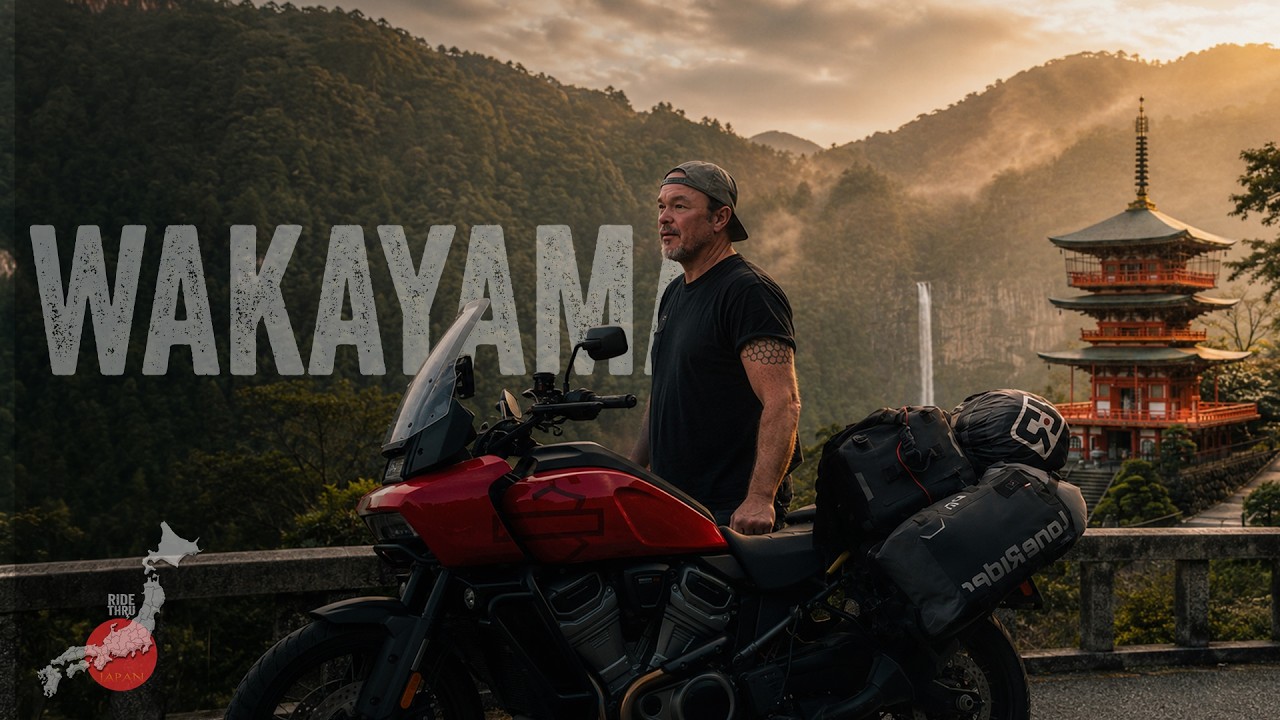
The Long Road South
After Osaka, I needed the road to open up again.
I had spent the previous chapter lost in traffic, concrete, crowds, multi-level roads, and the mental pressure of riding through one of Japan’s biggest cities. Wakayama looked like the reset I needed — coastline, ocean, open road, campsites, and a long ride south along the Pacific.
That was the plan.
But Wakayama had other ideas.
This episode of Project 47 follows a solo motorcycle journey through Wakayama Prefecture, Japan — riding alone down the coast through some of the strongest wind I have ever faced on a motorcycle, pushing south along Route 42, reaching the southernmost point of Honshu, and ending at Nachi Falls, a place I had wanted to see for more than 20 years.
This is not a Wakayama travel guide.
It is a motorcycle travel film about endurance, weather, fatigue, coastal roads, and the long push south when the ride looks beautiful but refuses to make things easy.
A Solo Motorcycle Journey Through Wakayama, Japan
Wakayama should have been a release.
After the noise and pressure of Osaka, the idea was simple: get out of the city, follow the coast, stay close to the ocean, find somewhere to camp, and let the journey return to the rhythm that had carried me through so many earlier prefectures.
For a while, it looked like that might happen.
The scenery changed fast. The buildings thinned out. The coast started to appear. Wakayama felt greener, calmer, and more open than the city I had just escaped.
But a long solo motorcycle journey across Japan rarely gives you exactly what you expect.
The road south became one of the hardest riding days of Project 47 so far. Not because of distance alone. Not because of traffic. Not because of bad roads.
Because of the wind.
Strong, sudden, physical wind that pushed across the road, caught the bike, moved the sidestand, and turned a beautiful coastal ride into a fight to stay focused.
That became the real story of Wakayama.
Not just the places I reached.
The ride I had to survive to get there.
Out of the City and Heading South
At first, I was not even sure I had fully left Osaka.
The edges of the city seemed to stretch on forever. Buildings, roads, traffic, and suburban sprawl kept following me south, and I was waiting for that clear moment where the prefecture changed and the ride began to feel different.
Eventually, Osaka started to fall behind.
I still had no fixed plan. No hotel booked. No campsite confirmed. Just a direction: south.
That is often how solo motorcycle travel works best. You have a rough idea, a region to aim for, and enough flexibility to let the day decide where you end up.
I wanted to camp if I could.
But even that was not going to be simple.
A Quick Break and a Change of Plan
I stopped at a park to regroup and check the map.
Sometimes in Japan, places like that unexpectedly turn out to have campsites. Sometimes they are perfect. Sometimes they are too expensive. This one was around 5,000 yen for a night of camping.
A short distance down the road, I found a hotel for roughly the same price.
That made the decision easy.
The funny part was that the hotel turned out to be a love hotel — one of those very Japanese travel hacks that can actually make a lot of sense when you are traveling by motorcycle. Big room, big bed, big bath, more space than a normal business hotel, and often much cheaper.
It might not be the romantic image of adventure travel.
But after weeks on the road, a huge room, a proper shower, space for gear, and a chance to edit footage is a victory.
Wakayama had barely started, and already the plan had changed.
High Expectations for Wakayama
Even in the first few kilometers, Wakayama started making a strong impression.
The roads were good. The scenery was green. The city itself felt more open and relaxed than Osaka. I met a cool local biker almost immediately, and the prefecture already felt like it had the kind of rhythm I had been hoping for.
That raised my expectations.
Wakayama is known for its coastline, and that was the ride I wanted. I was not trying to chase every shrine, temple, or famous stop. I wanted the coast. I wanted the road. I wanted the view. I wanted the motorcycle to carry me south along the Pacific.
After the city pressure of Osaka, that sounded perfect.
And for a while, it was.
The road began to follow the sea. The ocean opened beside me. The day looked like it was going to become exactly what I needed.
Then the wind arrived.
Chasing One of Japan’s Best Coastlines
The Wakayama coast is the kind of place that makes sense from the seat of a motorcycle.
The road follows the shape of the peninsula, wrapping along the Pacific, cutting through small towns, passing rugged rock formations, and opening to views that make you want to stop every few minutes.
This was why I wanted to stay by the ocean.
Wakayama has mountains inland, and I knew there were great roads there too. But after Osaka, I did not want to disappear into the hills immediately. I wanted the coast to become the episode.
Route 42 started to give me exactly that.
Ocean. Curves. Small towns. Trees. Cliffs. Coastal views. The sense of slowly working around the edge of Honshu, one section at a time.
It was beautiful.
But beauty does not mean easy.
Pulling Over for the View
At one point, I pulled over at a lookout.
The view was spectacular. Islands, ocean, wind, and that wide Pacific feeling that makes Wakayama feel so different from the inland prefectures.
It would have been perfect for the drone.
But the wind was already too strong.
That is one of the practical realities of filming a motorcycle travel documentary alone. The shot you want is not always the shot you can safely get. The cameras may stabilize the footage, but they do not show what the wind feels like on your body, on your helmet, or on the bike when you stop.
I stayed there for a moment, took in the view, checked the map, and tried to figure out whether I could keep following the coast the way I had planned.
Then things got worse.
Fast.
The Winds Turn Terrifying
The wind went from manageable to terrifying.
I am not exaggerating.
It was the worst wind I had ever ridden in. Gusts were hitting hard enough that when I got off the bike, the wind stood it up and moved the sidestand. For a moment, I genuinely thought I might come back to find the motorcycle lying on its side.
On the road, it was worse.
The wind caught the bike from the side, pushed me around, and made every turn feel uncertain. I could not relax. I could not enjoy the view. I could not just ride the coast the way I had imagined.
I had to manage the motorcycle.
Stay focused. Keep the bike balanced. Read the wind. Look for shelter. Keep moving without letting the conditions take control.
That is a different kind of motorcycle travel.
Not romantic. Not cinematic in the obvious way.
Just physical, stressful, and exhausting.
Finding Shelter Behind the Hills
As soon as the road bent behind a hill, the wind eased.
Not completely, but enough to breathe.
That contrast was immediate. One moment I was getting hammered by gusts along the exposed coast. The next, the landscape blocked enough of the wind to make the ride feel possible again.
Wakayama became a constant negotiation after that.
Open coastal sections were stunning but punishing. Sheltered sections gave me a chance to recover. The coastline kept delivering views, but the weather made stopping difficult and riding more tiring than it should have been.
A little further down the road, I met a local rider.
He told me the wind had already knocked his bike over earlier that day.
He laughed it off as part of life in Wakayama.
That helped put things in perspective.
This was not just me being dramatic. The wind was real. The risk was real. And the coast was going to make me work for every kilometer.
Managing the Momentum
At that point, the goal became simple.
Keep riding south.
There were plenty of places I could have stopped. Wakayama is full of shrines, viewpoints, towns, beaches, and mountain routes. But when the wind is that strong, the journey changes. You stop less. You film less. You think more about momentum, shelter, and where you might sleep before dark.
That is one of the lessons of solo motorcycle travel in Japan.
You cannot see everything.
You cannot force every plan.
Sometimes the ride itself becomes the experience.
And in Wakayama, the experience was the long coast road, the wind, the fatigue, and the decision to keep moving even when the conditions kept pushing back.
A Local Connection and a Place to Camp
By the end of the day, I was exhausted.
I had been riding for hours, dealing with wind, watching the coast, trying to find the right place to stop, and thinking constantly about where I could sleep.
Then an older local man pulled up beside me and started talking off camera.
It turned out he had a campsite nearby.
So I followed him.
That became one of those small road moments that changes everything. One minute you are tired, uncertain, and still searching. The next, someone local points you toward exactly what you need.
The camp spot near Shirahama was beautiful.
No wind. No crowds. Space to myself. A sky that looked like it might give me stars.
After the fight down the coast, that felt like a gift.
Morning Logistics and Small Victories
The next morning was calm and beautiful.
I had slept pretty well, apart from a few wild boars and some strange animal noises in the night. That is part of camping in Japan. Sometimes the soundtrack is traffic. Sometimes it is wind. Sometimes it is deer, boars, and whatever else is moving around in the dark.
Packing up felt good.
After weeks on the road, you start finding satisfaction in small things. A better pack. A tighter load. Gear fitting properly. The motorcycle starting to feel like a system you understand.
Then you realize you left your tent pegs in your back pocket.
That is the road too.
Small victories. Small mistakes. Load the bike. Laugh it off. Keep moving.
The Long Coast Ride Around the Peninsula
The second day in Wakayama became the kind of ride I had hoped for.
The coast continued around the peninsula, rugged and beautiful, with mountains inland and the Pacific constantly pulling the road outward. Route 42 was exactly the kind of motorcycle road that makes a prefecture memorable.
Not always fast. Not always easy. But alive.
The view kept changing. Tree tunnels appeared. Small towns passed by. The ocean returned again and again. The coastline felt endless in the best way.
This was the point of Wakayama for me.
The road. The ride. The views. The feeling of tracing the edge of Japan by motorcycle.
There were famous places nearby, but for most of that morning, I did not need them.
The coast was enough.
A Painful Mistake on the Tank
Of course, not every memorable moment is scenic.
At one point, a sudden movement on the bike sent me forward hard into the tank.
It was almost a bad moment for the ride, and definitely a bad moment for my body.
Sometimes motorcycle travel gives you sunsets, coast roads, and perfect corners.
Sometimes it gives you pain that makes you need to stand up for a minute and reconsider your life choices.
That moment did not define Wakayama, but it did add to the physical feeling of the episode.
The wind, the fatigue, the long hours, the constant coastal riding — all of it added up.
The ride south was beautiful.
But it was not gentle.
Reaching the Southernmost Tip of Honshu
Eventually, I reached Kushimoto, the southernmost point of Honshu.
That felt significant.
Project 47 is not just about visiting prefectures. It is about physically crossing Japan by motorcycle, one section at a time. Reaching the southern edge of the main island made the ride feel bigger than one day or one prefecture.
The coastline there is rugged and exposed, with the Pacific stretching out beyond the rocks and ships moving across the horizon.
After fighting the wind and riding south for so long, standing there felt like a marker.
Not the end of Wakayama yet.
But a turning point.
From there, the next major goal was one I had carried for years.
Nachi Falls.
Refueling with a Local Bowl
Before heading inland toward Nachi, I needed food.
Luckily, there was a ramen shop just a minute away.
That small discovery turned into exactly what I needed — a proper bowl, rich broth, chashu that fell apart, and enough food to bring me back after the long ride down the coast.
On a motorcycle trip, meals like that matter.
Not because they are fancy. Because they arrive at the right time.
You sit down tired, hungry, wind-beaten, and slightly worn out. Then the food arrives, and for ten minutes the entire journey becomes simple.
Eat. Drink. Recover.
Then get back on the bike.
Pushing Through the Afternoon Fatigue
After lunch, the road continued.
But so did the fatigue.
That full-stomach, brothy-goodness sleepiness started to creep in, and the wind began building again. Every corner still gave another beautiful view, but I could feel the day getting heavier.
That is one of the most dangerous parts of a long solo motorcycle ride.
Not the dramatic moments. Not the obvious close calls.
The slow build-up.
Wind. Miles. Food. Sun. Corners. Cameras. Decisions. The constant small effort of staying alert.
I still wanted to reach Nachi Falls that day, so the job was to keep moving without overpushing.
Wakayama kept giving me reasons to stop.
But by then, I knew where I wanted to end the episode.
Rugged Roads and Coastal Formations
On the way, I stopped at Hashigui-iwa Rocks.
The formations rise out of the water in a way that looks almost unreal, like a line of stone posts stretching across the coast. It was another reminder of how strange and dramatic Wakayama’s shoreline can be.
But even there, the wind was part of the experience.
The coast was beautiful, but never passive. It kept moving, pushing, cutting across the road, and forcing me to stay aware.
That became the pattern of Wakayama.
Every view came with weather.
Every stop came with fatigue.
Every beautiful road demanded attention.
And still, I kept heading for Nachi.
Navigating the Last Leg to Nachi
The road toward Nachi Falls started to climb into a more tourist-heavy zone.
Tour buses appeared. People were walking along the road. The surroundings became greener, more dramatic, and more recognizably tied to the famous image I had seen so many times — the pagoda, the waterfall, the forest, the old sacred landscape.
The road itself was beautiful, with cherry blossoms still hanging on in places.
But it was not a road to ride aggressively. Too many people. Too many buses. Too much going on.
After the long coast ride, the wind, the fatigue, and the constant push south, the final approach to Nachi felt different.
Slower.
More careful.
More like arriving than riding.
Ending a 20-Year Wait
I had wanted to see Nachi Falls for more than 20 years.
After living in Japan for so long, it is strange how some places can stay on the list forever. You always think you will go one day. Then years pass. Then decades pass. Then suddenly you are standing there in motorcycle gear, tired from the road, finally walking toward a place you have carried in your mind for half your life.
That is what made Nachi Falls matter in this episode.
Not as a tourist stop.
As an ending.
After the wind, the coast, the fatigue, the pain, the ramen, the southern tip of Honshu, and the long road south, Nachi Falls gave Wakayama the kind of close it needed.
A place I had waited years to see.
A place that felt worth the ride.
Looking for a Spot to Sleep
After Nachi, the day was not quite finished.
I still needed to find somewhere to sleep.
That is the reality of solo motorcycle travel. Even after a big emotional destination, the practical work continues. Where am I staying tonight? How far can I ride safely? What is the weather doing? Can I camp? Do I need a hotel? How much daylight is left?
The episode ends there because that is where the journey really lives.
Not in the perfect postcard view.
In the space after it.
One goal reached. Another problem waiting. The road continuing.
Wakayama was supposed to be a reset after Osaka.
Instead, it became a long fight down the coast — beautiful, exhausting, windy, and unforgettable.
Next, the journey continued into Mie.
Watch the Full Wakayama Motorcycle Travel Film
The Long Road South | Solo Motorcycle Journey is part of Project 47, a long-form motorcycle travel documentary series following one rider across all 47 prefectures of Japan.
This episode is for riders, travelers, and anyone who understands that a beautiful road can still fight back. Wakayama delivered one of the most dramatic coastal rides of the journey so far — not because everything went wrong, but because the wind, distance, and fatigue made every kilometer feel earned.
Watch the full Project 47 series:
https://www.youtube.com/playlist?list=PLbArCx0u7LtjYBwxR-rRE5GNXNUOzTTdX
Follow the journey on Instagram:
https://www.instagram.com/RideThruJapan/
Support the ride:
https://ridethrujapan.com/support/
About Project 47
Project 47 is a solo motorcycle travel documentary series across Japan.
The goal is simple: ride through all 47 prefectures, not as a checklist, but as a long-form journey through the roads, landscapes, people, and quiet moments that make Japan feel endless again.
One rider. One motorcycle. Forty-seven prefectures.
This is Japan by motorcycle.