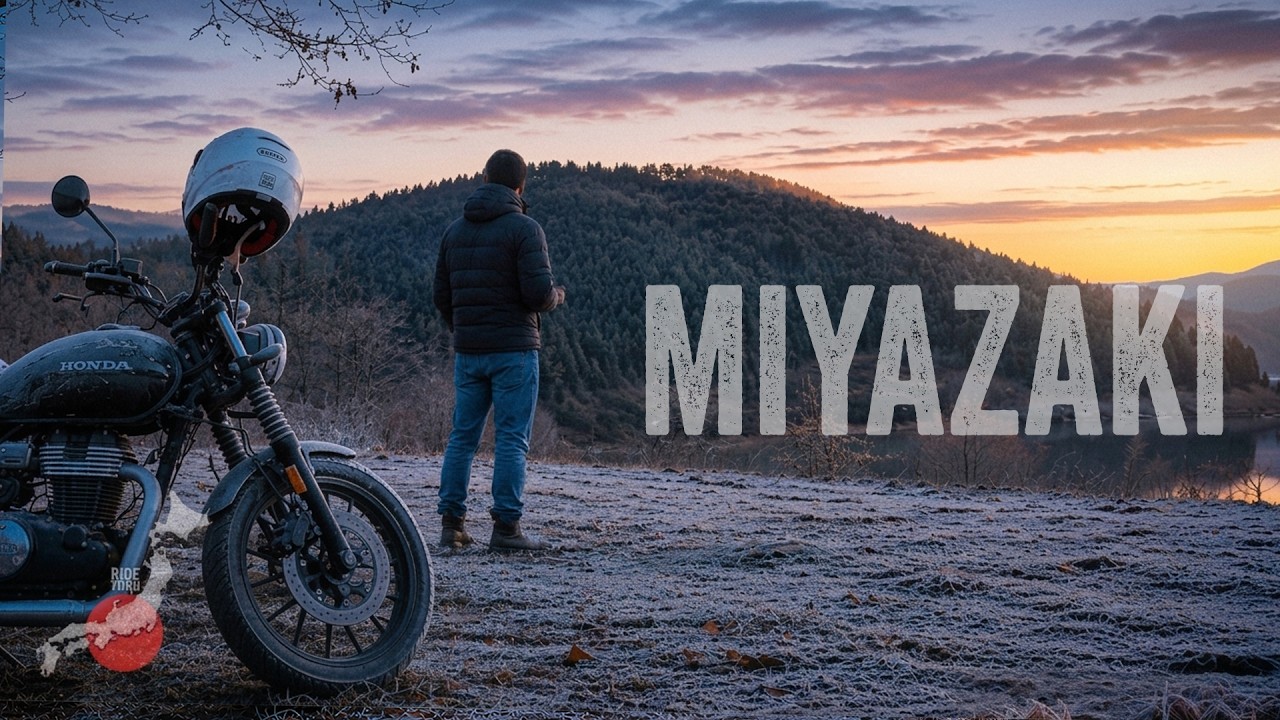
Riding a motorcycle through Japan in February seemed like a great adventure.
In reality, it was a mistake.
Not the kind of mistake you regret — the kind that turns into a story you’ll remember forever.
This ride through Miyazaki Prefecture is Episode 2 of Project 47, a solo motorcycle journey across all 47 prefectures of Japan. The plan was simple: leave from Aoshima, explore the prefecture, camp along the way, and see what I could find.
The only problem?
Winter.
What followed was a freezing ride through mountain passes, unexpected stealth camping, incredible coastal roads, and a reminder that even your home prefecture can still surprise you.
Below is the journey day by day across Miyazaki.
Day 1 — Leaving Aoshima & The Northern Coast
Heading out on a multi-day motorcycle camping trip in February on a naked Honda GB350 might sound a little crazy.
But if I wanted to complete my mission of riding every prefecture in Japan, I couldn’t exactly wait for perfect weather.
Miyazaki is my home prefecture, and while it sits far south, winter here can still bite hard.
I layered up with every piece of gear I had and rolled out from Aoshima, heading north along the coast with no real plan other than to explore.
The first stop was Miyazaki Shrine, one of the most peaceful places in the city. Walking through the long line of vermilion torii gates early in the morning, with almost no one around, felt surreal.
Even in the middle of a city, Japan has a way of hiding quiet places like this.
From there the road north toward Hyuga isn’t particularly thrilling, but it moves quickly through small coastal towns. The wind was already starting to build, and the forecast said it would only get worse.
So I pushed north.
Along the way I spotted a sign for Yatogi Falls.
And if you’ve watched these rides before, you know I can’t pass a waterfall.
The hike down wasn’t exactly easy in motorcycle boots, but the reward was worth it — a massive waterfall roaring through the valley below.
Cold air, mist rising off the water, and the sound of the falls echoing through the forest.
A perfect roadside discovery.
Day 1 Lunch — Chicken Nanban
By midday hunger kicked in.
I’d heard about a place called Kanegahama Shokudo, known for serving one of Miyazaki’s most famous dishes: Chicken Nanban.
Deep-fried chicken over rice, topped with tartar sauce and a sweet soy glaze.
Simple.
Perfect road trip food.
With the wind continuing to intensify, I decided to head for camp early. I’d found a free campsite tucked away in the mountains — hopefully sheltered from the worst of the weather.
Night 1 — The Windy Camp
The ride up through the valley was calm, but once I reached camp the temperature began dropping fast.
The wind howled through the trees as I set up the tent.
Branches and debris began flying around the campsite, forcing me to move the tent to a slightly more exposed spot just to avoid being hit.
Then, just as suddenly as it started, the wind stopped.
The forecast predicted –4°C overnight.
My thermometer later told me it actually reached –6°C.
Day 2 — Frozen Morning & Takachiho
Morning came with frost everywhere.
The bike was completely frozen over.
Luckily the tent had kept me warm through the night, but there was no rushing the start of the day. I had to wait for the sun to melt the frost before riding anywhere.
Coffee helped.
Eventually the road climbed north toward Takachiho, one of the most spiritual towns in Japan.
Even in winter the scenery here is incredible — rice fields stretching across the valley floor, bridges connecting steep mountain slopes, and quiet villages scattered across the hills.
Takachiho is deeply tied to Japanese mythology, believed to be the birthplace of many Shinto origin stories.
Unfortunately it has also become quite a tourist hub.
Beautiful — but crowded.
So I kept moving, searching for somewhere quieter.
Unoko Falls & The Frozen Pass
Further south I discovered Unoko Falls, a stunning waterfall hidden deep in the mountains.
The trail to the base was closed, but even from the overlook the view was incredible.
Unfortunately the next problem appeared quickly.
My campsite for the night wasn’t answering the phone.
Daylight was disappearing, temperatures were falling again, and the only route forward required crossing a mountain pass.
Snow lined the edges of the road as I climbed.
Around every blind corner I expected ice.
Sometimes I found it.
My hands were frozen. I could barely feel the throttle or brake lever.
But stopping wasn’t an option.
If darkness hit in the mountains, the road would turn into a skating rink.
Eventually the road began descending, and I made it through the pass just as the last sunlight touched the valley below.
I had survived the ride.
Now I just needed somewhere to sleep.
Night 2 — Stealth Camping
With no official campsite available, I ended up stealth camping in a small park.
It was gravel under the grass — so hard I broke a tent peg trying to drive it into the ground.
But the tent went up.
The bike went inside to avoid another frozen morning.
And I finally slept.
Day 3 — Aya Castle & Samurai History
For the first time since leaving home, the morning felt warm.
Sunlight filled the valleys and the roads ahead were empty.
Miyazaki may not have the big tourist attractions other prefectures boast, but for riders it’s incredible — wide sweeping corners, quiet mountain roads, and almost no traffic.
My first stop was Aya Castle.
Unlike many castles in Japan that have been rebuilt with modern materials, Aya’s wooden construction feels far more authentic.
The exposed timber beams make it look hand-built rather than reconstructed.
One of the most beautiful castles I’ve visited.
From there I rode south toward Obi, once a samurai castle town ruled by the Ito family for nearly 300 years.
The castle itself is gone, but the stone walls, gardens, and the lord’s residence remain.
Walking through the old wooden house, you can still imagine what life might have been like during the Edo period.
Night 3 — Camping with Wild Horses
That afternoon I rode south toward one of the most unique campsites in Japan:
Cape Toi (Toi Misaki).
Located inside a national park, the area is home to the Misaki horses, one of Japan’s native horse breeds.
The campsite sits on a cliff overlooking the ocean.
Windy.
Wild.
Absolutely beautiful.
I spent the evening chatting with the campsite owner Hiro-san before settling into the tent for the night.
Day 4 — The Nichinan Coast
Morning brought calm weather and a beautiful sunrise.
Before leaving I walked up the hill to see the Misaki horses grazing along the cliffs.
Small, sturdy, and unique to this region, they once faced extinction before local conservation efforts helped bring their numbers back.
Eventually it was time to ride north again.
Waiting ahead was one of the best roads in Japan:
The Nichinan Coast (Route 220).
This road runs along the Pacific Ocean with sweeping curves, almost no traffic lights, and views that stretch endlessly along the coastline.
For motorcycle riders, it’s paradise.
Kojima Island & Udo Shrine
One stop along the coast was Kojima, famous for its wild macaques.
This is the location where scientists first observed monkeys washing sweet potatoes in the ocean — an early sign of learned behavior and cultural transmission among animals.
Further north sits one of my favorite shrines in Japan:
Gion Shrine.
Hidden inside a cave overlooking the ocean, it’s one of the most unique spiritual locations in the country.
Final Stop — Aoshima
Before finishing the ride, I stopped at Route 220 Café, a gathering spot for riders traveling the Nichinan coast.
Massive portions.
Exactly what you want after days on the road.
From there it was just a short ride back to Aoshima, the small island known for its unusual “Devil’s Washboard” rock formations and tropical palm trees.
At the center of the island sits Aoshima Shrine, dedicated to love and relationships.
A peaceful place to end the ride.
Four days.
Frozen mountain passes.
Wild horses.
Hidden waterfalls.
And some of the best coastal riding in Japan.
And the journey is only just beginning.
Next stop: Kumamoto Prefecture.