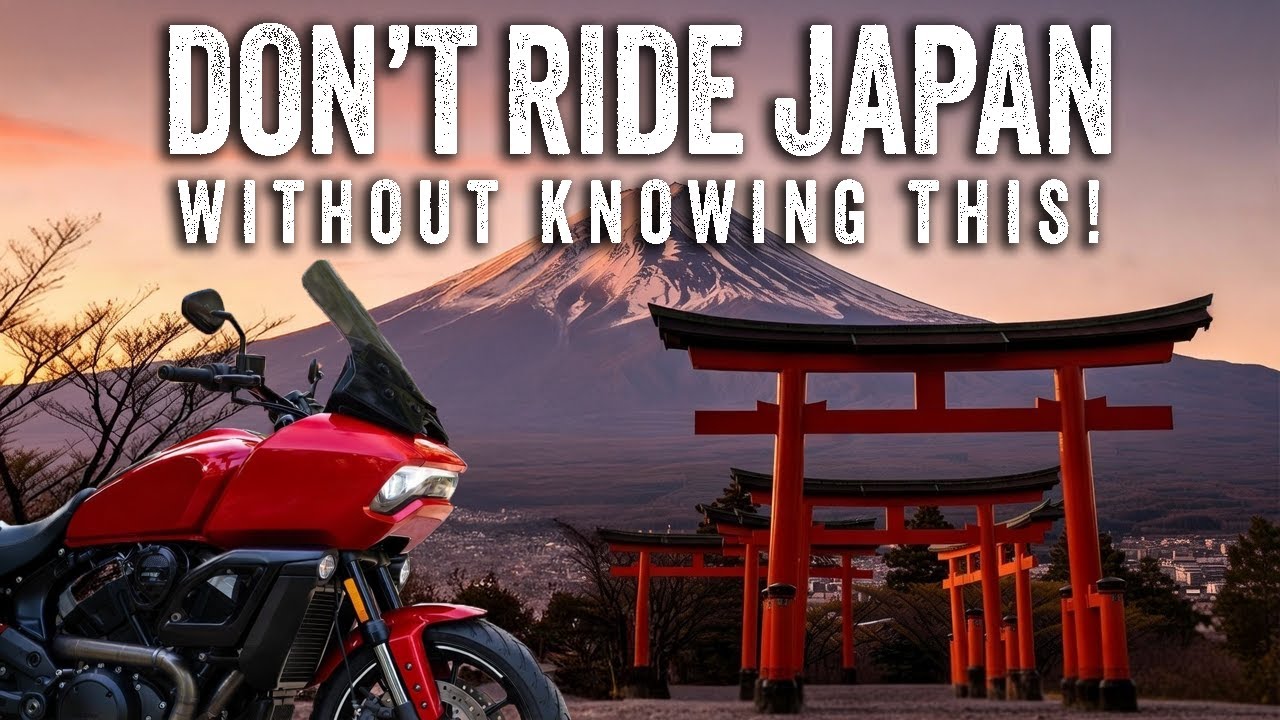
Japan can feel as though it was designed to be explored by motorcycle.
Beyond the crowded cities are volcanic mountain roads, empty coastlines, forest tracks, tiny fishing communities and remote valleys that most visitors never see. The country is compact enough to cross, yet varied enough that the road can feel completely different from one prefecture to the next.
But riding here is not as simple as renting a motorcycle, opening a map and heading for the mountains.
Japan has its own traffic rules, road markings, toll systems, parking restrictions and unwritten habits. Some will be familiar. Others can catch even experienced international riders by surprise.
I have lived in Japan for more than 26 years, and I am currently riding through all 47 prefectures for Project 47, my solo motorcycle documentary series. This guide covers the things I believe visiting riders genuinely need to understand before setting out.
1. Make Sure You Are Legally Licensed to Ride in Japan
Before booking a motorcycle, confirm that your licence is valid in Japan.
Depending on where your licence was issued, you will generally need one of the following:
- A valid Japanese motorcycle licence.
- An International Driving Permit issued under the 1949 Geneva Convention.
- A licence from an approved country or region accompanied by an official Japanese translation.
The foreign-licence-and-translation system applies only to certain places, including Switzerland, Germany, France, Belgium, Monaco and Taiwan. Your licence or permit must also authorise you to ride the class of motorcycle you intend to rent.
An International Driving Permit must be obtained before arriving in Japan. Japan does not recognise every document marketed online as an “international driving licence,” so confirm the requirements with the Japanese authorities and your rental company before travelling.
The permitted driving period is generally limited to the shorter of the document’s validity or one year from your arrival in Japan.
Do not leave this until you reach the rental counter. Having the wrong version of an International Driving Permit can end the trip before it begins.
2. Japan Drives on the Left
Vehicles in Japan travel on the left-hand side of the road.
Riders arriving from countries that drive on the right often adapt quickly on open roads. The moments that require the most attention are usually:
- Turning at intersections.
- Pulling out after stopping.
- Leaving petrol stations and car parks.
- Rejoining the road after taking photographs.
- Entering a quiet road with no other traffic to follow.
It is surprisingly easy to revert to muscle memory when tired or distracted.
After every stop, consciously remind yourself to return to the left. Japan’s National Police Agency specifically warns overseas drivers about accidentally moving onto the wrong side after turning or re-entering a road.
3. Stop Signs and Railway Crossings Work Differently in Japan
Japan’s stop signs can be easy for visiting riders to miss because they do not look like the octagonal signs used in many other countries.
The Japanese stop sign is a red, inverted triangle displaying the word 止まれ—pronounced tomare, meaning “stop.” Newer signs may also include the English word STOP, but you should learn to recognise the Japanese characters because many signs still rely primarily on them.
You will also frequently see 止まれ painted in large white characters on the road as you approach an intersection. The road marking reinforces the instruction, but it may be faded, partially hidden by traffic or difficult to see in rain. Watch for both the triangular sign and the markings on the road.
At a stop sign, you must bring the motorcycle to a complete stop before the stop line, not merely slow down. Check carefully in both directions before proceeding. Many Japanese intersections are narrow and have buildings, walls, hedges or utility poles obstructing your view.
Railway crossings require a full stop
Japanese railway crossings are particularly important for visiting riders to understand.
At a railway crossing without a traffic signal controlling your movement, you must come to a complete stop before entering the crossing, check both directions and confirm that no train is approaching. This applies even when:
- The barriers are raised.
- The warning lights are off.
- The alarm is not sounding.
- No stop sign is separately displayed.
- You have just watched another vehicle cross safely.
Do not simply follow the vehicle ahead. Stop where you can see the tracks clearly, check for trains and make sure there is enough space on the far side for your motorcycle before crossing.
Where a railway crossing is controlled by a normal traffic signal, follow that signal. Never enter unless you can clear the tracks completely. Traffic can stop unexpectedly on the far side, particularly in urban areas.
For riders unfamiliar with Japan, the safest habit is to treat every railway crossing as a deliberate stop-and-check point rather than an ordinary section of road.
4. Lane Filtering in Japan Is Not a Simple Yes-or-No Question
Lane filtering is one of the subjects I am asked about most frequently.
You will see Japanese riders moving between stationary or slow traffic, particularly in large cities. That does not mean riders have a blanket legal right to filter wherever they choose.
The legality of an individual manoeuvre can depend on several things:
- Whether you cross a prohibited lane marking.
- Whether you pass on the left or right.
- Your position relative to the stop line.
- Directional lane arrows.
- No-overtaking restrictions.
- The available space and whether the manoeuvre is considered unsafe.
- Whether you move onto a shoulder, side strip or other restricted area.
One correction worth making clear is that a solid white line does not automatically mean that changing lanes is prohibited.
A solid yellow line used between traffic lanes indicates a lane-change restriction. A solid yellow centre line can also prohibit crossing into the opposing side of the road to overtake. White markings perform several different functions and should not automatically be treated as equivalent to yellow regulatory markings.
The safest approach for a visiting rider is simple: do not copy another motorcyclist unless you fully understand why their manoeuvre is legal. Never cross the stop line at a red light, use the expressway shoulder or force your way through a space that could disappear without warning.
What local riders commonly do and what the law permits are not always the same thing.
5. Expressways Are Excellent—but Understand ETC Before Using Them
Japan has an extensive network of fast, well-maintained expressways. They are useful when you need to cover distance, escape a major city or cross an area quickly.
They are also expensive, and they can remove much of what makes travelling through Japan interesting.
Motorcycle size restrictions
Motorcycles of 125cc or less are prohibited from using national expressways and most roads designated exclusively for motor vehicles. In practical terms, you will normally need a motorcycle of at least 126cc for expressway travel.
Be careful when using navigation apps on a small motorcycle. A route designed for a car may direct you towards a motorway entrance that your motorcycle is not permitted to use.
ETC toll payment
ETC is Japan’s Electronic Toll Collection system. A compatible onboard unit and an inserted ETC card allow you to pass through toll gates without stopping to pay manually.
Not every expressway entrance requires ETC, but ETC-only toll gates are becoming increasingly common. NEXCO operators continued converting additional toll gates to ETC-only operation during 2026.
When renting a motorcycle, ask two separate questions:
- Does the motorcycle have an ETC onboard unit?
- Does the rental include an ETC card that I can actually use?
A fitted ETC reader is useless without an active card.
Where ordinary toll lanes remain available, you may be able to collect a ticket and pay manually at the exit. Payment arrangements can vary, so carrying cash is sensible.
If you accidentally enter an ETC-only toll gate without working ETC, do not reverse. Enter the lane marked “Support” or “ETC/Support,” stop and follow the instructions.
Carrying a passenger on the expressway
Two-up riding on Japanese expressways is generally restricted to riders who are at least 20 years old and have held an appropriate motorcycle licence for a combined period of at least three years.
In addition, several central sections of Tokyo’s Metropolitan Expressway prohibit motorcycle passengers regardless of the rider’s experience. These restricted sections include the entire Inner Circular Route and a number of connecting routes.
Check the exact restrictions before riding through central Tokyo with a passenger.
6. Motorcycle Helmets Are Mandatory
You must wear a motorcycle helmet when riding in Japan.
A legal minimum, however, is not necessarily the equipment you should choose for a serious tour.
Japan’s weather and road conditions can change quickly. A warm coastal morning can become cold rain at elevation. Mountain roads may contain gravel, moss, fallen branches, standing water and debris from recent storms.
For anything beyond a short city ride, I strongly recommend:
- A properly fitting full-face or adventure helmet.
- Gloves.
- An abrasion-resistant jacket and trousers.
- Motorcycle boots.
- Waterproof layers.
- Impact protection for the back, shoulders, elbows, hips and knees.
Japan may have an orderly road culture, but asphalt is asphalt wherever you ride.
7. Treat Japan as a Zero-Alcohol Riding Country
Japan has extremely strict drink-driving laws and severe penalties.
The enforcement threshold for driving under the influence includes a breath-alcohol concentration of 0.15 milligrams per litre or more, corresponding to a blood-alcohol concentration of 0.3 milligrams per millilitre or more. However, riders should not treat that threshold as permission to drink before riding.
Japanese law prohibits operating a vehicle after drinking, and impairment can still create serious legal consequences. Penalties can also apply to people who provide the vehicle, supply the alcohol or knowingly ride with an intoxicated driver.
The practical rule is much easier to remember:
If you are riding, do not drink.
That includes being careful the morning after a heavy night. Alcohol remaining in your system can still put you over the legal threshold.
8. Do Not Assume the “Flow of Traffic” Protects You From a Speeding Ticket
Speed limits in Japan are often lower than visiting riders expect.
A wide and apparently empty road may carry a limit of only 40 or 50 kilometres per hour. Mountain routes can change speed repeatedly as they pass through settlements, tunnels and hazardous sections.
You will see traffic moving faster than the posted limit. That does not make the higher speed legal, and travelling with the flow is not a defence against enforcement.
Where no different limit is displayed, JAF states a general maximum of 60 kilometres per hour for regular vehicles on ordinary roads and 100 kilometres per hour on expressways. Posted limits always take priority, and some roads or vehicle categories have different restrictions.
Watch for:
- Small roadside speed signs.
- Sudden reductions near communities.
- Police vehicles positioned beside rural roads.
- Unmarked patrol cars.
- Fixed and mobile enforcement.
- Low limits inside long tunnels.
Japan rewards riders who slow down and pay attention. Much of the best scenery is missed when you are focused only on speed.
9. Motorcycle Parking Can Be More Difficult Than Riding
Japan often provides excellent motorcycle parking at attractions, ferry terminals, roadside facilities and larger commercial centres. Motorcycle spaces are frequently close to the entrance and may be free or inexpensive.
The difficulty comes in major cities.
Many multistorey car parks, mechanical parking towers and small coin-operated lots cannot accept motorcycles. Legal motorcycle parking can be limited even when car parking is everywhere.
Do not assume that you can park somewhere simply because several other motorcycles are already there. They may have permission, be using a private space or all be parked illegally.
Look for signs containing:
- 二輪 — two-wheeled vehicles.
- バイク — motorcycle or bike.
- 駐輪場 — two-wheeler parking area.
- 自動二輪 — motorcycle.
For overnight stays, ask your hotel or accommodation about motorcycle parking before booking. A property described as having “parking” may only have spaces designed for cars.
Tokyo’s police provide separate guidance for motorcycle parking, reflecting the fact that motorcycles cannot simply use every ordinary parking facility.
10. Learn to Love the Michi-no-Eki
One of the most useful parts of travelling through rural Japan is the Michi-no-Eki network.
The term is sometimes translated as “roadside station.” These facilities are located along ordinary roads—not generally inside expressways—and provide a reliable place to stop, use the toilet, check your route and take a break.
Official Michi-no-Eki facilities provide free parking and toilets available 24 hours a day. Many also have:
- Local produce.
- Regional food.
- Restaurants.
- Tourist information.
- Vending machines.
- Small museums or exhibitions.
- Hot springs.
- Views over the surrounding area.
The shops and restaurants are not normally open 24 hours, so do not rely on arriving late and finding a meal.
On expressways, the equivalent stopping facilities are called Service Areas and Parking Areas, usually abbreviated to SA and PA.
Michi-no-Eki were created primarily as places for road users to rest and access local information.
They are not campsites. Do not pitch a tent in the car park.
11. Motorcycle Camping in Japan Requires More Planning Than You Might Expect
Japan looks wild from the road, but surprisingly little land is truly open for unrestricted public camping.
Forests, riverbanks, fields and apparently unused spaces usually belong to a municipality, company or private landowner. Camping without permission can create problems, particularly near communities that already deal with rubbish, noise and irresponsible visitors.
Registered campsites are available throughout the country, but they may be:
- Seasonal.
- Closed on particular weekdays.
- Reservation-only.
- Unable to accept late arrivals.
- More expensive than expected.
- Located far from your intended route.
During Project 47, I have spent a large part of the journey moto-camping. The hardest part is often not finding a beautiful location—it is finding somewhere legal, open and practical at the end of the day.
Research several possibilities before leaving each morning. Never assume the campsite marked on an old map or blog is still operating.
12. Rural Roads Can Become Extremely Narrow
Japan’s major roads are usually excellent. The more interesting routes are often less predictable.
A road shown as a normal connecting route on a map may suddenly narrow until it feels barely wide enough for one car. You may encounter:
- Blind hairpins.
- Buses or trucks using both sides of the road.
- Open drainage channels.
- Wet leaves and moss.
- Rockfall.
- Broken road edges.
- Wildlife.
- Sections closed after storms or landslides.
- Tunnels with little lighting.
- No mobile-phone reception.
Many blind corners have large convex mirrors. Use them, but do not depend on them completely. They can be dirty, damaged or positioned in a way that hides a motorcycle.
Reduce your speed, cover the brakes and keep far enough left to leave room for an approaching vehicle. On exceptionally tight blind corners, a brief, considerate use of the horn can warn oncoming traffic.
These roads can be some of the most enjoyable in Japan, but they are not the place to chase speed.
13. Japan Is Safe, but It Is Not a Utopia
Japan deserves its reputation as a relatively secure place to travel. I frequently leave equipment attached to my motorcycle and have personally had very few problems.
That does not mean theft never happens.
Motorcycles, helmets, luggage and cameras can still disappear. Use the same common sense you would use anywhere else:
- Lock the steering.
- Take the motorcycle key with you.
- Do not leave your wallet, passport or phone unattended.
- Secure expensive luggage overnight.
- Use a disc lock or additional security where appropriate.
- Avoid leaving the motorcycle in an isolated urban location for long periods.
- Confirm that your rental insurance covers theft and damage.
Enjoy the relative safety, but do not let the image of Japan as a crime-free country make you careless.
Is Japan a Good Country for Motorcycle Touring?
Absolutely.
The practical details can appear complicated, but riding here is worth the preparation.
The real attraction is not simply the famous mountain roads or the immaculate expressways. It is the way the country changes once you leave the standard tourist route.
On a motorcycle, you experience the space between destinations: declining villages, empty coastal roads, sudden storms, old shopping streets, mountain communities and landscapes that cannot be understood from a train window.
That is the Japan I am documenting in Project 47.
I am riding solo through every one of Japan’s 47 prefectures, following the road rather than a list of famous attractions. It is a long-form motorcycle travel documentary about the places, people and experiences that appear when you keep going beyond the version of Japan most visitors already know.
Thinking About Riding Across Japan?
Watch the video above for a direct explanation of the essential rules, then continue into the complete journey.
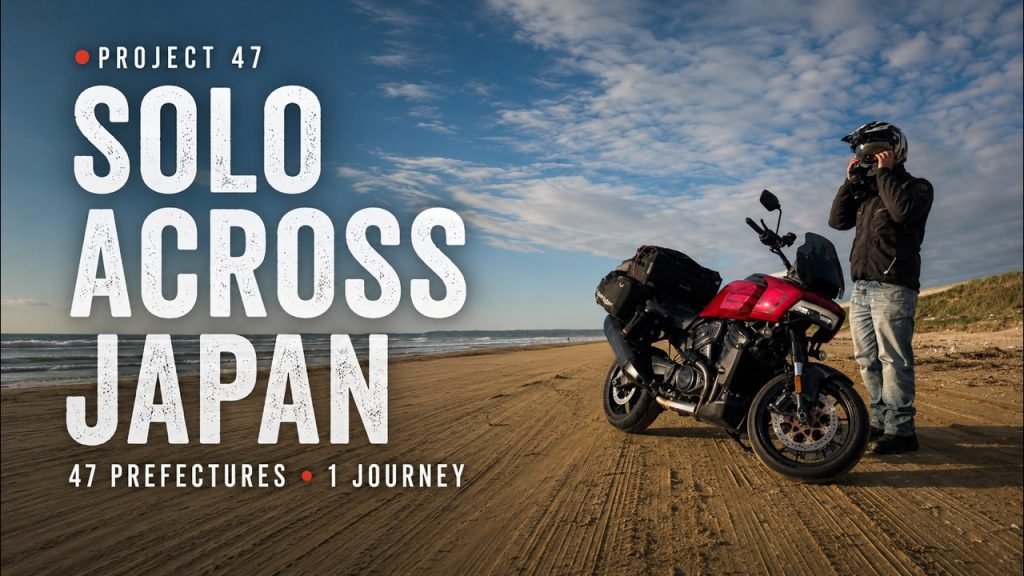
One rider. One motorcycle. All 47 prefectures.
Frequently Asked Questions
Can a tourist ride a motorcycle in Japan?
Yes, provided the rider has a driving document recognised in Japan and that document includes the correct motorcycle category. Depending on the issuing country, this may be a 1949 Geneva Convention International Driving Permit or an eligible foreign licence accompanied by an official Japanese translation.
Is lane splitting legal in Japan?
Japan does not provide motorcyclists with a simple blanket right to split lanes. The legality of a manoeuvre depends on the road markings, method of passing, stop lines, traffic restrictions and whether the movement is safe. A solid yellow lane boundary indicates that changing lanes is prohibited.
Can a 125cc motorcycle use Japanese expressways?
No. Motorcycles of 125cc or less are generally prohibited from national expressways and motor-vehicle-only roads. A motorcycle normally needs to be at least 126cc.
Do I need ETC to use Japan’s expressways?
ETC is not required at every toll gate, but it is increasingly important because more interchanges are being converted to ETC-only operation. Confirm that a rental motorcycle includes both an ETC onboard unit and a usable ETC card.
Can I camp at a Michi-no-Eki?
A Michi-no-Eki is a roadside rest facility, not a campsite. You can stop, rest and use its facilities, but you should not pitch a tent in the parking area. Use a registered campsite or another location where you have explicit permission.
Is riding in Japan difficult?
The major roads are generally straightforward, but cities, unfamiliar road markings, left-side traffic and extremely narrow rural roads can challenge visiting riders. Start cautiously, avoid building an overambitious schedule and allow time to adapt.
Traffic rules, toll systems and licence requirements can change. Confirm the latest requirements with Japan’s National Police Agency, the relevant expressway operator and your motorcycle rental company before travelling.