Most motorcycle jacket reviews begin with materials, armour ratings and a long list of specifications.
Mine begins with a problem.
I was carrying too much gear.
For shorter rides, I was perfectly happy wearing a leather motorcycle jacket and carrying rain gear for when the weather turned bad. But as my trips became longer—sometimes several weeks at a time—that system started to become a pain.
The jacket was one thing. Waterproofs were another. Cold-weather layers added more. Every time the weather changed, something had to come out of the luggage or go back into it.
I wanted to simplify the whole setup.
That is why I bought the REV’IT Trench 2 GTX.
I wasn’t looking for the most technical adventure jacket I could find, and I wasn’t particularly interested in having seventeen pockets and fluorescent panels hanging off me. I wanted one understated motorcycle jacket that I could wear day after day and that could deal with rain, cold, wind and at least some warmer weather without forcing me to carry another jacket alongside it.
After thousands of kilometres of real-world riding in the Trench 2 GTX, I think I’ve got a pretty good idea of what it does well.
And where the compromise lies.
Quick verdict: The REV’IT Trench 2 GTX is an excellent all-weather touring jacket for riders who value waterproofing, comfort and versatility over maximum hot-weather airflow. Its biggest weakness is simple: when you’re not moving in hot weather, it gets hot.
Why I Bought the Trench 2 GTX
I bought this jacket specifically for long-distance motorcycle travel.
On a journey lasting a few hours, you can dress for the forecast.
On a journey lasting several weeks, that’s not really possible.
You might leave in sunshine, encounter rain in the afternoon, climb into dramatically colder temperatures in the mountains and then do the whole thing again the following day.
When you’re travelling solo, you also have to carry everything yourself.
That changes what I want from motorcycle gear.
I’m less interested in whether a jacket is absolutely perfect in one particular condition and more interested in how many different jobs it can do well enough that I don’t have to carry something else.
That’s the role the Trench 2 GTX fills for me.
It has become my main touring jacket because I can put it on in the morning without needing to know exactly what the weather will be doing eight hours later.
The Gore-Tex Shell Is the Main Event
The Trench 2 GTX uses a laminated Gore-Tex construction, and that’s the foundation of the whole jacket.
REV’IT specifies a 2-layer nylon 600D Gore-Tex outer shell, with the membrane laminated directly to the outer material.
In practical terms, the important part for me is much simpler:
When it starts raining, I don’t have to stop.
There is no separate waterproof liner to install and no rain jacket buried somewhere in my luggage.
I just keep riding.
That sounds like a small thing until you’re several hours into a long day, the sky opens up and you realise you don’t have to pull into a convenience store, petrol station or under a bridge and start unpacking waterproofs.
The outer shell is also extremely effective at blocking wind.
Again, that sounds obvious, but wind protection makes a huge difference to how cold you feel on a motorcycle.
With the jacket sealed up properly, there is very little cold air working its way through the shell.
The flip side is equally obvious.
If the wind can’t easily get in when it’s cold, something has to be done about airflow when it’s hot.
And that’s probably the most interesting part of the Trench 2 GTX.
The Chest Vents Are Much Better Than They Look
When I first considered buying a black Gore-Tex jacket, particularly knowing that I would be riding through warmer weather, I did wonder whether I was completely out of my mind.
A waterproof shell that blocks wind is not naturally going to be cool.
REV’IT’s solution is its large VCS Aquadefence ventilation panels on the chest.
And they work.
Each side opens into a large mesh intake rather than simply exposing a narrow zipper.
You unzip the panel, pull it open and secure it in the open position using the magnetic attachment at the top.
With both sides open, you suddenly have two substantial areas allowing air directly into the jacket.
The difference once you’re moving is dramatic.
At roughly 40 km/h and above, I can feel enough air entering that the jacket actually begins to billow slightly around my upper body.
That’s not marketing copy.
That’s what it feels like riding in it.
You can also open the cuffs substantially, allowing more air to enter through the sleeves.
Together, those two things make the Trench 2 GTX considerably more comfortable in warm weather than I expected.
But there is a catch
You need to be moving.
Stop at a set of traffic lights on a hot summer day and you’re still sitting inside a black waterproof motorcycle jacket.
There is no magic happening there.
In slow city traffic, it gets hot.
If I were buying a jacket specifically for commuting through heavy traffic in extreme summer heat, I would choose something else—probably a proper mesh jacket.
But that’s not what I bought the Trench 2 GTX to do.
Out on the road, where air is actually moving through the vents, the usable temperature range is surprisingly broad.
There Are No Big Rear Exhaust Vents
One thing I noticed immediately is that there aren’t large ventilation zippers across the back.
A lot of touring jackets use front intakes and rear exhaust vents to move air completely through the garment.
The Trench 2 GTX relies heavily on those large chest openings instead.
Would rear vents improve it?
Probably.
Have I found the lack of them to be a major problem?
Not really.
The volume of air coming through the chest is substantial enough that I’ve never found myself thinking the ventilation system doesn’t work.
The bigger limitation remains speed.
Moving: good.
Stationary: hot.
It’s really that simple.
In Cold Weather, It Is Excellent
This is where the characteristics of the jacket reverse completely.
Close those chest vents.
Tighten the cuffs.
Seal everything up.
Now the same shell that was creating problems when sitting stationary in summer becomes exactly what you want.
Wind penetration is minimal.
The Trench 2 GTX also comes with a removable thermal liner that runs through the sleeves as well as the torso.
Install that and the jacket becomes seriously warm.
I’ve found that I need far fewer layers underneath it than I would normally expect because I’m not constantly fighting cold air being forced through the outer jacket.
On a long ride, that matters.
Four thin layers underneath a jacket might keep you warm, but that’s four layers you also need to carry when you’re not wearing them.
If one jacket and one liner can achieve the same result, my luggage becomes simpler.
That’s exactly what I wanted when I bought it.
The Pockets Are Designed by Someone Who Has Worn Motorcycle Gloves
This sounds ridiculous until you spend enough time on the road.
Then it becomes one of the jacket’s best features.
The two large lower pockets don’t require you to mess around with small zippers every time you want something.
The flaps use magnetic closures.
Put your gloved hand underneath, lift the flap and you’re in.
Let it go and the magnets find their position again.
Simple.
It is a genuinely good piece of design.
There is also a small zippered pocket on the left sleeve.
The zipper pull is large enough to operate while wearing gloves and locks down neatly when closed rather than flapping around while you ride.
I use that pocket for the things I need to get to quickly—particularly toll or highway cards.
That’s exactly the kind of feature I appreciate on a touring jacket.
When you stop somewhere briefly, the last thing you want to do is take off your gloves, unzip your main jacket, find your wallet, dig through it and then put everything back together again.
There is also another easily accessible zippered pocket higher on the jacket that works well for a phone or wallet.
Inside are additional mesh pockets.
They’re fine.
But they’re probably my least favourite pockets on the jacket.
The flexible mesh material makes the zippers slightly more annoying to operate, particularly with gloves, so I rarely bother with them.
The external pockets are so much easier that they get almost all the use.
It Feels Good on the Motorcycle
This matters far more than how a jacket feels while standing in front of a mirror.
I’ve spent long days wearing the Trench 2 GTX and have never found it restrictive when reaching forward to the handlebars.
There is enough movement through the shoulders and upper body that I don’t feel as though I’m fighting the jacket.
That’s important because a heavy touring jacket can become exhausting if it’s constantly pulling against you.
The fit can also be adjusted in several places.
There are adjustment straps around the lower arms, which help keep the sleeves and armour positioned correctly.
The cuffs can be cinched down tightly or opened significantly for ventilation.
There are waist adjusters.
And the lower hem can be pulled tighter to reduce the amount of wind or water getting underneath the jacket.
None of those features are particularly revolutionary individually.
Together, they make it possible to change how the jacket fits depending on the conditions.
Warm day?
Loosen it up.
Cold, wet ride?
Tighten everything down.
That’s exactly what a versatile touring jacket should allow you to do.
The Protection Is Better Than I Originally Realised
One thing I didn’t go deeply into when I originally reviewed the jacket was the actual certification.
REV’IT specifies SEEFLEX CE Level 2 armour at both the shoulders and elbows, and the Trench 2 GTX itself is certified Class AA under EN 17092-3:2020.
The elbow protection is particularly substantial.
It doesn’t just sit in a small area directly over the joint. The protected section extends well down the forearm.
Despite that size, I don’t really notice the armour while riding.
That’s a good thing.
Protection that is technically excellent but uncomfortable enough that you eventually stop wearing it isn’t particularly useful.
The Trench 2 GTX is also prepared for a SEESOFT CE Level 2 back protector and CE Level 1 divided chest protectors.
Those are optional rather than standard equipment, so that is worth factoring into the real cost if you want the full protection setup.
I Like That It Doesn’t Look Like an Adventure Jacket
This is entirely subjective.
But it mattered to me.
A lot of touring and adventure motorcycle jackets look like touring and adventure motorcycle jackets.
You know the type.
Contrast panels everywhere.
Large logos.
Straps.
Pockets.
More zippers.
More straps.
Different coloured sections seemingly added because someone found another piece of fabric.
The Trench 2 GTX is much quieter.
Mine is black and looks relatively understated off the motorcycle.
That’s one of the reasons I bought it.
When I travel, riding the motorcycle is only part of what I’m doing.
I stop.
I walk around.
I film.
I meet people.
I go inside shops and restaurants.
I don’t necessarily want to look as though I’m preparing to cross the Sahara every time I get off the bike.
The Trench 2 GTX works particularly well in that respect.
It looks like a good jacket first and technical motorcycle equipment second.
I like that.
What Is It Actually Like Living With the Trench 2 GTX?
This is the part of a review I care about most.
Not what does it have?
What is it like to own?
After thousands of kilometres, the thing I appreciate most is that I rarely have to think about it.
Rain starts?
Keep riding.
Temperature drops?
Close the vents.
Really cold?
Install the liner.
Warmer afternoon?
Open the chest panels and cuffs.
Need a card?
It’s on my sleeve.
Need something from the main pocket?
I can get to it without fighting the jacket.
That lack of friction is what makes good touring equipment good.
When you’re travelling for days or weeks, tiny annoyances repeat themselves hundreds of times.
A stupid zipper becomes really stupid.
An awkward pocket becomes really awkward.
A jacket that constantly needs another layer over or underneath it starts taking up mental space as well as luggage space.
The Trench 2 GTX mostly disappears into the journey.
I put it on and get on with riding.
What I Don’t Like
There are things I would change.
1. It’s hot when you’re stationary
This is easily the biggest one.
If you’re expecting the Gore-Tex construction and chest vents to somehow produce mesh-jacket levels of summer ventilation, you’re going to be disappointed.
They don’t.
The vents work extremely well when air is being pushed into them.
Traffic removes the air.
Now you’re wearing a black Gore-Tex jacket in the sun.
Enjoy.
2. I’d take rear ventilation if REV’IT offered it
The chest system works, but I wouldn’t object to having additional exhaust ventilation at the back.
More control over airflow is rarely a bad thing.
3. The internal mesh pockets could be better
This is minor, but the outside pockets are so easy to use that the internal ones feel clumsy by comparison.
I rarely use them.
4. Full protection costs extra
The standard shoulder and elbow protection is excellent, but if you want the optional back and chest protection, that is additional expense.
With a jacket at this level, some riders may reasonably wish the back protector were included.
Is It a Four-Season Jacket?
I don’t particularly like calling motorcycle clothing “four season.”
Four seasons where?
Norway?
Australia?
Japan?
Arizona?
A jacket can be excellent across a broad range of temperatures without being comfortable in every climatic extreme on Earth.
That’s how I would describe the Trench 2 GTX.
It has an extremely broad operating range.
Cold weather: very good.
Wet weather: very good.
Wind: excellent.
Mild weather: very good.
Warm weather while moving: much better than expected.
Extreme heat and slow traffic: not what it was built for.
For the type of long-distance riding I do, that combination makes much more sense than a jacket that is brilliant in one specific climate and compromised everywhere else.
Who Should Buy the REV’IT Trench 2 GTX?
I think the Trench 2 GTX makes the most sense for a rider who wants one serious jacket to cover a lot of riding.
Particularly:
- Long-distance touring
- Solo motorcycle travel
- Commuting in variable weather
- Multi-day trips where conditions are difficult to predict
- Riders who don’t want separate waterproof gear
- Riders who prefer understated styling
If you spend most of your time riding slowly in very hot climates, I would look elsewhere.
If you’re regularly travelling long distances and need to deal with rain, wind, cold mornings, warmer afternoons and whatever turns up between them, this jacket begins to make a lot more sense.
How I’ve Tested Mine
I didn’t borrow the Trench 2 GTX for a weekend.
I bought it myself.
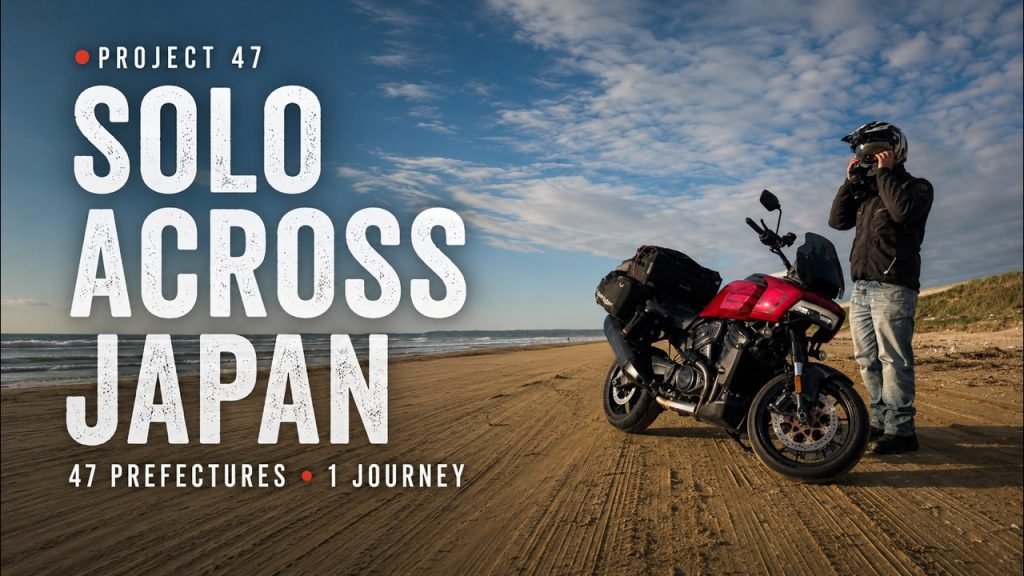
I’ve worn it for thousands of kilometres of real motorcycle travel, including extended solo trips while filming Project 47, my journey through all 47 prefectures of Japan.
That has meant long days in the saddle, changing temperatures, rain, mountain roads, highways, cities and plenty of weather that didn’t care what the forecast said.
That’s also how I want to review gear on Ride Thru.
I’m not particularly interested in reviewing something because a company sent it to me and I wore it three times.
If it appears here, it’s because I’ve actually used it.
REV’IT Trench 2 GTX Review: Final Verdict
The Trench 2 GTX isn’t a perfect motorcycle jacket.
I’m not convinced a perfect motorcycle jacket exists.
What it is, however, is a very good solution to the problem I originally bought it to solve.
I wanted to carry less gear without becoming more dependent on the weather.
That’s exactly what it has allowed me to do.
The waterproof laminated shell means I don’t carry separate rain gear for normal riding.
The wind protection and thermal liner give it excellent cold-weather ability.
The huge chest vents extend its usefulness much further into warm weather than I expected.
The pockets work brilliantly with gloves.
It’s comfortable over long distances.
And it doesn’t make me look like I’ve just ridden directly out of a Dakar bivouac when I walk into a café.
There are cooler jackets.
There are lighter jackets.
There are more aggressively technical adventure jackets.
But after thousands of kilometres, I keep reaching for the Trench 2 GTX because it handles the widest range of real-world conditions with the least amount of fuss.
For long-distance motorcycle touring, that’s exactly what I wanted.
And that’s why it’s still the jacket I wear.