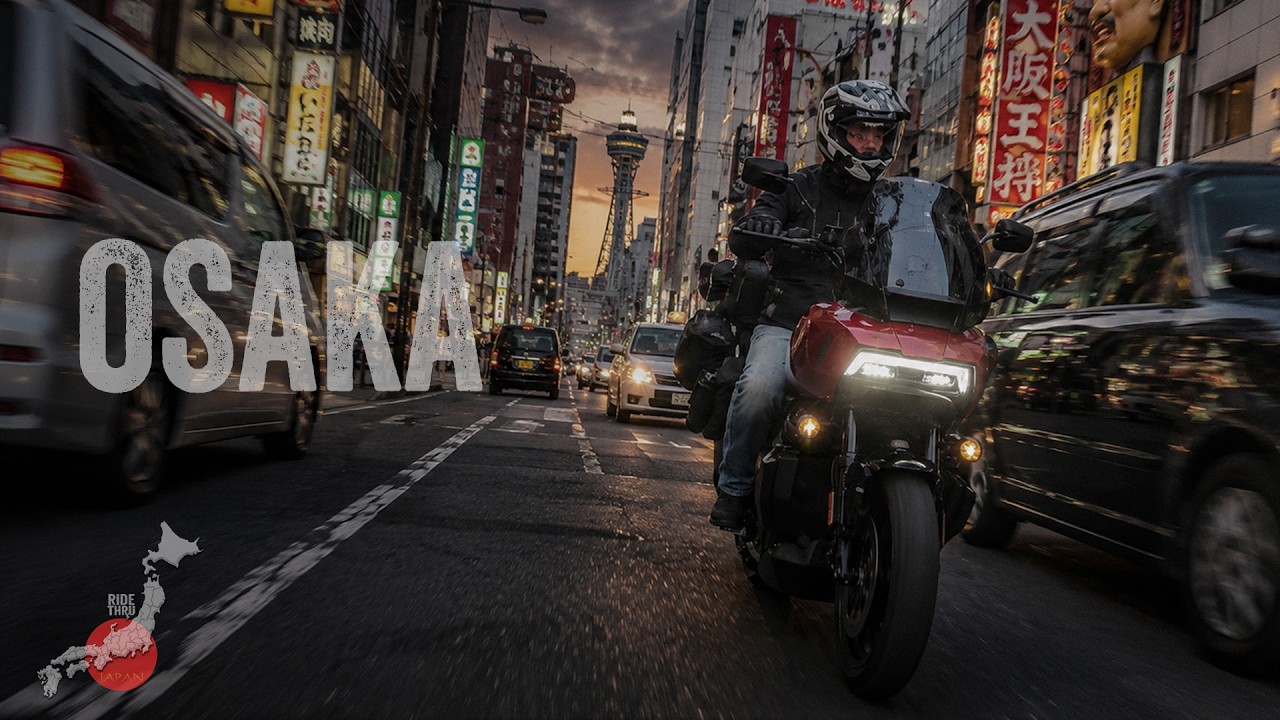
Lost in Osaka
Osaka was the part of the journey I had been trying to avoid.
After weeks of riding through mountains, coast roads, forests, campsites, rivers, small towns, and empty rural routes, Project 47 finally reached one of Japan’s biggest urban areas.
And almost immediately, everything changed.
This episode follows a solo motorcycle journey through Osaka Prefecture, Japan — riding alone into city traffic, elevated roads, confusing navigation, crowded streets, underground stations, concrete towers, and the mental pressure of crossing a major city by motorcycle.
This is not an Osaka travel guide.
It is a motorcycle travel film about what happens when a journey built around open roads is forced into noise, traffic, people, confusion, and concrete.
A Solo Motorcycle Journey Into Osaka, Japan
For most of Project 47, I had been chasing the quieter side of Japan.
Mountain roads. Coastal routes. Campsites. Small towns. Ferry ports. Rural shrines. Places where the road had room to breathe and the motorcycle felt like the right way to move through the country.
Osaka was different.
This was not a chapter about remote landscapes or empty roads. It was not about finding the perfect mountain route or chasing a view before sunset. Osaka brought a completely different kind of pressure.
Traffic. Noise. Narrow decisions. Multi-level roads. Crowds. Confusing navigation. Constant movement. And the strange feeling of being surrounded by millions of people while still feeling completely alone.
Solo motorcycle travel is not always difficult because of distance or weather.
Sometimes the hardest ride is through the city you would rather avoid.
That was Osaka.
An Early Parking Mistake
I had not even properly made it into Osaka yet, and already I was in trouble.
Parking the bike seemed simple enough at first, but in a major city, even small decisions start to carry more weight. Where can you stop? How long can you leave the motorcycle there? Are you in someone’s way? Are you about to get blocked in, ticketed, or forced into some situation that makes the whole day harder?
That was the first hint of what Osaka would become.
In the mountains, the problems are usually obvious. Weather. Fuel. Closed roads. Distance. Fatigue.
In the city, the pressure is different.
Everything is tighter. Everything moves faster. Everything feels like it needs a decision right now.
And I was not even in the worst of it yet.
The Final Stretch Into the City
Before Osaka fully swallowed the ride, there was one last stretch of good road.
The switchbacks still had some life in them. The motorcycle still felt good. The road still gave me a small reminder of the kind of riding I had been doing before the city took over.
It felt like the final breath before entering the concrete.
After weeks of open space, Osaka was everything I had been avoiding — bigger, louder, denser, and far outside my comfort zone. I knew I was not going to roll into the city and relax.
The plan was simple.
Find the hotel. Get the bike parked. Back up the footage. Shower. Sleep. Figure out Osaka in the morning.
That was enough for day one.
Sometimes, on a solo motorcycle journey, survival is the plan.
Well Outside My Comfort Zone
The next morning, I left the motorcycle behind.
That alone says a lot.
For a series built around Japan by motorcycle, stepping away from the bike might sound strange. But Osaka is not the kind of place where riding around aimlessly feels enjoyable. Not for me. Not after weeks of empty roads and rural riding.
So I decided to explore on foot and by train.
Let the body rest. Let the bike stay parked. Try to understand the city without immediately fighting traffic again.
But even off the motorcycle, Osaka was overwhelming.
The noise. The crowds. The size of it. The constant movement. The sense that every direction led into another tunnel, station, shopping street, crossing, or concrete canyon.
I can navigate mountain roads and get lost in the hills without too much stress.
Osaka was different.
Osaka scared me a little.
Trading the Bike for a Long Walk
Walking through Osaka made the contrast even clearer.
In a small country town, you can feel welcome almost immediately. Someone says hello. Someone asks about the bike. Someone points you toward a road, a campsite, a restaurant, or a place worth seeing.
In a city of millions, it is possible to feel invisible.
That was one of the strangest parts of this chapter.
I was surrounded by people, but the ride felt more solitary than it had in some of the most remote prefectures. The city was full, loud, alive, and moving in every direction, but I felt like I was drifting through it on my own.
That is part of solo travel too.
Being alone in the mountains feels natural.
Being alone in a city of millions feels different.
Sometimes it feels heavier.
Feeling Alone in a City of Millions
Osaka is not quiet.
It does not leave much space around you. The city presses in from every direction — signs, shops, stations, people, traffic, food stalls, alleys, concrete, noise, and movement.
After weeks on the road, it was a lot to take in.
The funny thing is that cities are supposed to be easy. Everything is available. Food, hotels, trains, shops, services, convenience stores, and places to go. In theory, it should be less stressful than riding alone through mountains with low fuel and no signal.
But it did not feel that way.
Out in the countryside, the uncertainty is physical.
In Osaka, the uncertainty was mental.
Where am I?
Where am I going?
How do I get out of this station?
How do I get above ground again?
Why does every direction look like concrete?
That was the real Osaka challenge.
Not distance.
Disorientation.
Completely Lost in a Sea of Concrete
At some point, I was completely lost.
So I made a new plan: find the Umeda Sky Building.
I needed to get above the city. I needed a view, not because I was chasing a tourist stop, but because I needed to understand the shape of the place. I needed the lay of the land.
Osaka Station made that harder than expected.
Every time I went underground, I felt like I was being pulled into another layer of the city. More corridors. More signs. More people. More exits that did not quite lead where I thought they would.
It took far longer than it should have, but eventually I found my way through.
That small victory mattered.
On a day like this, the wins are simple.
Find food. Find a beer. Find the building. Find the way up.
A Hard-Earned View of the Lay of the Land
The Umeda Sky Building gave me the view I needed.
High above Osaka, the city finally made sense for a moment. The endless concrete, the towers, the roads, the stations, the density — all of it spread out below instead of pressing in from every side.
There was also something absurd about taking an escalator diagonally between two towers, high above one of the most earthquake-prone countries in the world.
But once I was up there, with a quiet beer and the city below, the day shifted.
The pressure eased.
And in that space, Osaka stopped being only overwhelming. It became human again.
No matter where people come from, most of us are chasing the same thing: a good moment, something real, something worth remembering.
That thought changed the night.
Deciding to Stop Chasing the Obvious
I had planned to see the Osaka everyone knows.
The famous places. The obvious views. The tourist version of the city.
But the more the day went on, the less interested I became in chasing that version. Osaka was not working when I tried to force it into a checklist.
So I stopped.
Just a few steps from the station, I found something better.
A small local place. A random night. Friendly people. Noise, laughter, food, drinks, conversation, and the kind of unexpected welcome that no itinerary can promise.
That became the real Osaka moment.
Not the landmark.
The people.
A Random Night with Locals
What started as a quick stop became one of those nights I will never forget.
It was loud, welcoming, unexpected, and completely different from the overwhelming city I had been fighting all day.
That is the strange thing about Osaka.
From the outside, it felt like too much. Too big. Too loud. Too dense. Too chaotic. But once the city opened a small door, it became warm in a way I did not expect.
The tourist trail had not given me that.
The random bar did.
By the time I made it back to the hotel, I was happy, exhausted, and definitely a little drunk.
But the motorcycle was waiting.
And in the morning, Osaka would not be done with me.
Riding Into the Morning Noise
By morning, the neon had faded.
But the traffic had not.
It was time to get back on the bike and ride through Osaka.
This was the part I had been dreading. Not because I cannot ride in traffic, but because Osaka’s roads are not simple. There are one-way streets, stacked roads, elevated routes, underpasses, expressways, bridges, lanes that split suddenly, and navigation instructions that do not always explain which level of the city you are supposed to be on.
That is a serious problem on a motorcycle.
A car gives you more time to make mistakes. On a bike, you are exposed, narrow, and constantly making lane decisions while trying to read traffic, signs, mirrors, and navigation at the same time.
And I woke up feeling rough from the night before.
Not ideal.
But there was only one way out.
Ride.
Navigating the Confusion of Multi-Level Roads
The hardest part of riding through Osaka was not the speed.
It was the layers.
Roads above roads. Roads below roads. Expressways crossing overhead. Local streets bending underneath. Navigation saying “go left” or “go right” without making it clear whether that meant the street beside me, the ramp above me, or the road I had already missed.
That kind of riding is mentally exhausting.
Every wrong lane can send you somewhere you did not intend to go. Every missed turn can add more confusion. And when navigation does not reroute quickly, the city starts pulling you in the wrong direction before you have time to correct it.
At one point, I realized I had gone completely the wrong way.
So I had to stop, reset the navigation, and try again.
That was Osaka by motorcycle.
Not beautiful. Not relaxing. Not the kind of ride you dream about.
But real.
Searching for the Way Out
The goal became simple.
Get out.
I could see Osaka Castle through the trees from time to time. Green roof. Ornate shape. One of the city’s obvious landmarks. But by then, I had no interest in parking the bike, fighting the crowds, and walking through a castle area packed with people.
That is not what this journey needed.
Project 47 is not about forcing every famous stop into an episode. It is about crossing each prefecture by road and seeing what that experience actually feels like.
And what Osaka felt like, at that moment, was confusion.
Three possible directions. A toll gate. A bridge road. A port route. Expressway ramps. Local lanes. Concrete everywhere.
I had come into Osaka expecting chaos.
Getting out felt a lot like getting in.
No Interest in the Tourist Crowds
There are plenty of famous places in Osaka.
But this episode was never really about them.
The city had already given me the story: the pressure of urban riding, the loneliness of crowded places, the disorientation of stations and concrete, the unexpected warmth of a random local night, and the mental fatigue of trying to navigate one of Japan’s busiest urban environments by motorcycle.
That was enough.
A tourist version of Osaka would have been easy to build. Food streets. Castle. Neon. Crowds. A few famous shots.
But that would not have been honest to the ride.
This was not a travel guide.
This was the chapter where the road forced me into the city I had been avoiding.
And the challenge was not what to see.
The challenge was how to get through.
Escaping the Urban Chaos
Eventually, the route started to make sense.
The layers of road began to thin. The confusion slowly loosened. The city still towered around me, but the ride was finally pointing south.
That was the strange victory of Osaka.
I had not conquered the city. I had not even really understood it. But I had made it through.
And somewhere between getting lost, getting overwhelmed, day-drinking, finding the Umeda Sky Building, meeting locals, waking up rough, missing turns, and fighting the multi-level roads, Osaka gave me more than I expected.
It was bigger, louder, and more overwhelming than I wanted.
But it was not empty.
It had a side I will not forget.
Finally Heading South for Wakayama
After surviving Osaka, it was time to head south.
Wakayama was next.
And after the noise, concrete, traffic, and mental pressure of the city, the idea of getting back toward open roads felt like oxygen.
That is what made Osaka important in Project 47.
It was not the most scenic ride. It was not the most relaxing. It was not the kind of episode built around perfect motorcycle roads or beautiful campsites.
But it showed another side of solo motorcycle travel in Japan.
The city side.
The side where the challenge is not remoteness, but intensity.
One rider. One motorcycle. One massive city to cross.
And finally, the road out.
Watch the Full Osaka Motorcycle Travel Film
Lost in Osaka | Solo Motorcycle Journey is part of Project 47, a long-form motorcycle travel documentary series following one rider across all 47 prefectures of Japan.
This episode is for riders, travelers, and anyone who understands that not every difficult part of a motorcycle journey happens in the mountains. Sometimes the hardest ride is the one through the city you would rather avoid.
Watch the full Project 47 series:
https://www.youtube.com/playlist?list=PLbArCx0u7LtjYBwxR-rRE5GNXNUOzTTdX
Follow the journey on Instagram:
https://www.instagram.com/RideThruJapan/
Support the ride:
https://ridethrujapan.com/support/
About Project 47
Project 47 is a solo motorcycle travel documentary series across Japan.
The goal is simple: ride through all 47 prefectures, not as a checklist, but as a long-form journey through the roads, landscapes, people, and quiet moments that make Japan feel endless again.
One rider. One motorcycle. Forty-seven prefectures.
This is Japan by motorcycle.