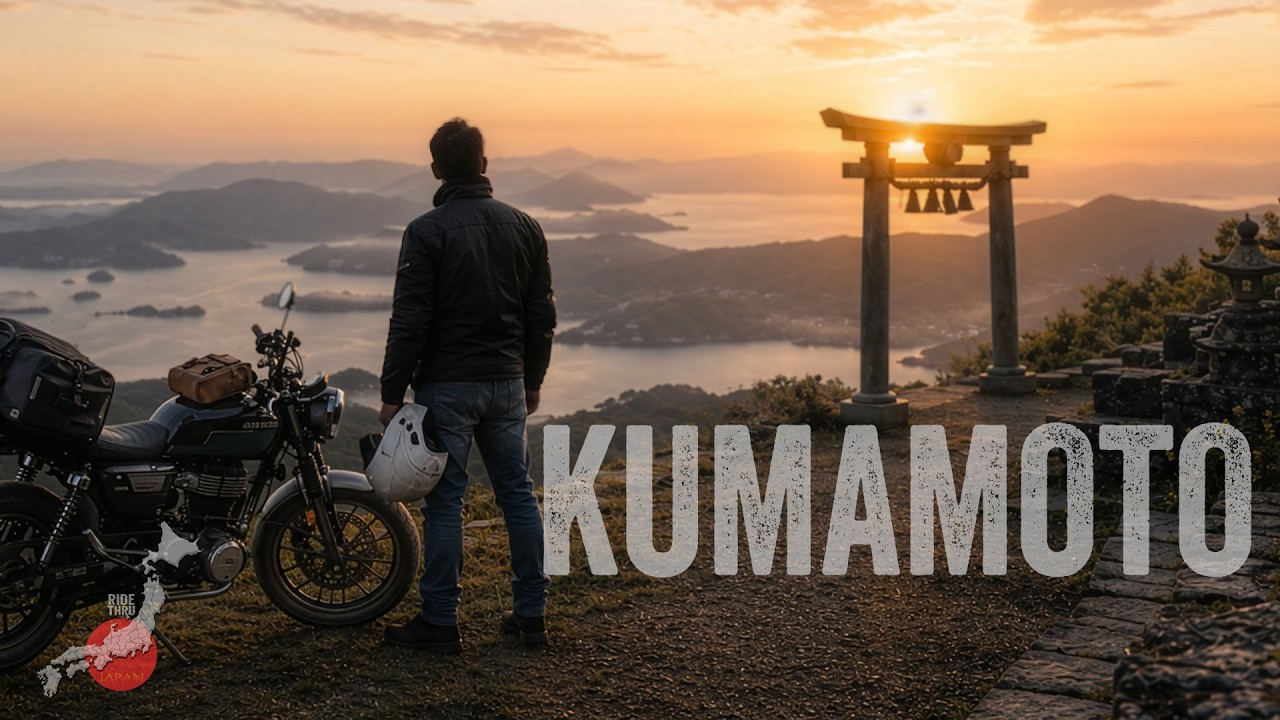
Kumamoto was supposed to be about the roads.
Five days later, it had become something else entirely.
This chapter of Project 47 took me across volcanic landscapes, island bridges, hidden waterfalls, mountain passes, and some of the best riding I’ve experienced anywhere in Japan.
But when I think back on Kumamoto now, that’s not what I remember most.
What stays with me are the people.
The campsite owner who handed me a gift moments after I arrived.
The strangers who shared beers and stories.
The ramen shop owner who opened his restaurant just for me after I’d spent half a day getting lost trying to find it.
The family who invited me to join their barbecue without a second thought.
Kumamoto reminded me of something I’ve discovered again and again during this journey across Japan:
Even when you travel alone, you’re never really alone.
Over five days I rode around Mt. Aso, crossed the Amakusa Islands, searched for hidden waterfalls, got hopelessly distracted chasing ramen, and experienced one of the closest calls I’ve had on a motorcycle.
It was a prefecture full of incredible roads, but more importantly, it was a prefecture full of unexpected kindness.
This is Episode 3 of Project 47 — a solo motorcycle journey across all 47 prefectures of Japan.
Below is the journey day by day through Kumamoto.
Day 1 — Entering Kumamoto & Route 445
The morning started with a frozen bike.
Again.
Once the frost burned off, I hit the road and headed into Kumamoto with a lot of excitement. This prefecture has Japan’s largest active volcano, a countryside filled with waterfalls, and a chain of islands stretching out into the sea.
It felt like one of those prefectures where almost anything could happen.
And pretty quickly, it did.
The first hours of the ride were beautiful — mountain views, smooth pavement, sweeping corners, and cherry blossoms beginning to bloom. After only two prefectures, I was already wondering how this journey could possibly keep getting better.
Then I hit Route 445.
At first it flowed through small towns and forest roads lined with sakura. Then it changed.
The road tightened, steepened, and became one of the most technical mountain roads I’d ridden in Japan so far. It was intense, a little scary in places, and unbelievably fun.
The kind of road that demands your full attention and rewards you for giving it.
By the time I stopped for coffee, I was completely fired up.
This was only prefecture number three.
If the rest of Japan was going to be like this, I was in for something special.
Day 1 Afternoon — Cherry Blossoms, Aso & Araki-san
As I pushed on toward Mt. Aso, the ride stayed beautiful the whole way.
Spring was creeping in. Riders were everywhere. Every passing bike came with a wave, and the “wave pool” was getting deeper by the hour.
I made a short detour to visit a spring that a friend had told me about — a place she used to visit as a child. Like so many places in rural Japan, it felt completely unexpected. Quiet, beautiful, and tucked away from the main roads.
By late afternoon the wind had picked up hard, and I started to rethink my original plan of camping higher up around the volcano. With daylight running down, I found a campsite not too far away and decided to call it there for the night.
Before heading in, I put the drone up for a look across Aso in the afternoon light.
Even from a distance, the scale of the place is hard to describe.
Then the campsite gave me one of those moments that makes travel special.
Not long after I set up, the owner, Araki-san, came over and handed me a small gift. It turned out to be a musical instrument. I had no clue how to play it, but that didn’t stop me from trying.
Later that evening I sat with another camper, Hirata-san, drinking beer, laughing, and swapping stories.
Day one in Kumamoto had already become more than just a ride.
Day 2 — Riding the Rim of Mt. Aso
I woke up after a great sleep, packed up camp, and set off under a gray sky toward Mt. Aso.
The forecast threatened rain, but I tried not to let it get in my head.
Even under cloud, the roads climbing around Aso felt unreal.
There was almost no one around. The landscape was bleak, dramatic, and ominous in the best possible way. With the weather closing in and the mountain half-hidden in haze, the whole place felt alive.
At times it hardly felt like Japan.
The road wound around the volcanic basin like a ribbon through another world.
Access to the crater itself was closed because of heavy gas venting, but honestly the closed gate almost made it more dramatic. The mountain was there, doing what it does, and all you could do was respect it from a distance.
From there I kept riding the ring of roads around the caldera, stopping for views, looking at horses grazing on the slopes, and trying not to stare too long at the mountains instead of the road in front of me.
The road itself was incredible — technical in places, open and flowing in others, always with another massive view around the next bend.
At one point I spotted Komezuka, that perfectly symmetrical little volcanic cone rising out of the landscape like something carefully placed there for effect.
It didn’t feel real.
Day 2 Afternoon — Daikanbo & Nabegataki Falls
Eventually I reached Daikanbo Lookout, and it was one of those moments where the scale of the place finally hits you.
Looking back across the roads I’d just ridden, across the ring of mountains and the vast valley below, I could see the shape of the whole journey unfolding behind me.
Then, just as I left, the weather broke.
The sky turned blue.
It changed the entire mood of the day in a matter of minutes.
From there I headed north toward Nabegataki Falls, one of Kumamoto’s most famous waterfalls. The place is magical — a curtain of water dropping over a wide rock shelf, with the option to walk behind it.
The rock overhang and cave-like formation behind the falls make it feel less like a viewpoint and more like stepping into a hidden world.
It was one of those places that immediately justifies the whole detour.
By evening I decided to head into Kumamoto City and get a hotel for the night before the heavier rain rolled in.
Night 2 — Horse Meat & Kumamoto City
That night I wandered into an izakaya in Kumamoto City that specialized in basashi — raw horse meat, one of Kumamoto’s best-known local foods.
I ordered the basashi, ended up trying more than I expected, and had one of those travel meals that becomes part food memory, part human memory.
The staff were fantastic.
The place had energy.
And once again it was a reminder that some of the best moments on the road happen when you simply walk into a place and say yes to whatever comes next.
Day 3 — Kumamoto Castle & Reigando Cave
The next morning started with Kumamoto Castle.
From the outside it’s massive, dramatic, and undeniably impressive. Inside, it felt more modern than I expected — more museum than time capsule — but still worth seeing.
Once that was done, I was ready to get out of the city and back onto the bike.
My next destination was Reigando Cave, and this place completely blindsided me.
The cave is famous because Miyamoto Musashi came here in 1642 and spent nearly a year meditating and writing The Book of Five Rings before his death.
That alone would make it worth visiting.
But the whole site is breathtaking.
Statues line the cliffs. The cave sits in a peaceful forested setting. And the shrine there has this quiet power to it that’s hard to explain.
I remember standing there thinking this might be the coolest shrine I’d visited so far.
Simple. Unusual. Deeply atmospheric.
Exactly the kind of place that stays with you long after you leave.
When I returned to the bike, I ended up chatting with another rider for a while.
And again, Kumamoto reminded me that the best part of travel is often not the destination at all — it’s the people you meet between destinations.
Day 3 Evening — Riding to Amakusa
From there I turned west and began the long ride toward the Amakusa Islands.
There wasn’t meant to be much to see on the way, so I dropped into cruise mode and let the ride be the ride.
The bridges linking the islands together were every bit as cool as I’d hoped.
Long spans over open water, island silhouettes in the distance, and that feeling that only comes when a road carries you somewhere remote enough to feel slightly cut off from the rest of the world.
Eventually I reached a free campsite near the water, found a good spot, and started settling in.
Then Kumamoto delivered again.
A woman camping nearby with her son and dog invited me over for a beer and barbecue.
Just like that.
No fuss. No weirdness. Just warmth and generosity.
Japan is incredible like that.
Day 4 — Amakusa, No Maps & The Great Ramen Hunt
Morning in Amakusa was spectacular.
The sunrise lit up the islands while I waited for my kettle to boil, and I started thinking about what I wanted the day to be.
There weren’t a lot of must-see stops on the plan, so I decided to make one for myself.
Find ramen.
But not with Google Maps.
No pinpoints. No shortcuts.
I wanted to do it the old way — ask people, follow instinct, wander a little, and see what happened.
Of course, before I could really get started, Chihiro — the young son from the campsite — came over and asked if I wanted to go look at fish and visit the local shop together.
You don’t say no to that.
After that little detour, I set off into the hills and coastlines of Amakusa, riding beautiful roads and trying to track down ramen the hard way.
Along the route I stopped at Oe Cathedral, one of the first churches built after Japan’s long ban on Christianity was lifted. The church, completed in 1933, feels strangely intimate when it’s empty — less like a public site and more like you’ve quietly stepped into someone’s personal place of faith.
It was fascinating.
But I was still hungry.
Eventually a woman at a service station pointed me toward her favorite ramen shop in Amakusa City.
Mission on.
Only I managed to ride straight past the town I needed, not realizing until much later that I’d missed it entirely.
So I turned around.
Because by that point, the ramen had become bigger than lunch.
It had become a matter of pride.
Eventually, after enough wrong turns and second-guessing, I found it.
Or rather, I found a ramen shop.
It was closed.
But then the owner saw me and decided he’d make me ramen anyway.
That kind of thing sticks with you.
He served me tonkotsu ramen and fried rice, then came outside afterward to look at the bike and talk motorcycles.
The whole exchange was so generous and effortless that it almost felt normal — until you stop and remember how rare that kind of hospitality really is.
Night 4 — Sunset in the Amakusa Islands
With my stomach full and the ramen quest complete, I grabbed a beer from the convenience store and headed back to camp.
The sunset over the islands was exactly what I’d hoped for.
Tent up.
Ocean beside me.
Island silhouettes fading into evening light.
It was one of those camps that makes you feel very small in the best possible way.
Day 5 — A Hidden Shrine & A Close Call
Day five began with a ride up to a mountain shrine overlooking the islands.
It was the perfect start to the final day — quiet, elevated, and rewarding after the climb.
After that, I decided there was one thing left Kumamoto owed me.
One final waterfall.
Like the ramen search the day before, I didn’t want to just let Google deliver it neatly. I dropped a rough pin in a ravine and figured I’d go looking.
Somewhere in there, I told myself, there had to be a river.
And where there’s a river, there’s a waterfall.
The search turned into a proper mountain ride — technical roads, gravel in the corners, tiny roadside signs, and that wonderful feeling that something good might be just ahead if you keep paying attention.
Then the day turned.
A car came at me on a narrow mountain road and cut the corner badly enough that for a moment I thought I was done.
It was one of the closest calls I’ve had.
Their mirror clipped the rear of my bike bag. Any harder, and I think I’d have been pushed over the barrier and down into the ravine.
I had to stop.
Breathe.
Reset.
It shook me up properly.
But eventually I got back on the bike and kept going — partly because I needed to, and partly because after a moment like that, finding the waterfall somehow mattered even more.
I wanted to end the trip on something good.
And eventually I did.
A small sign.
A rough trail.
The sound of water getting louder.
Then finally, there it was.
A massive waterfall hidden deep in the mountains.
The kind of waterfall that makes the whole journey click into place.
That was the ending Kumamoto deserved.
Five days.
Volcanic roads.
Cherry blossoms.
Island bridges.
Strangers who became part of the story.
And one of the closest calls I’ve had on a motorcycle.
Kumamoto gave me incredible roads, but more than that it reminded me why I travel like this in the first place.
Not just for what I see.
But for the people I meet, the moments I can’t plan, and the strange beautiful truth that even when you ride alone, you are never really alone.