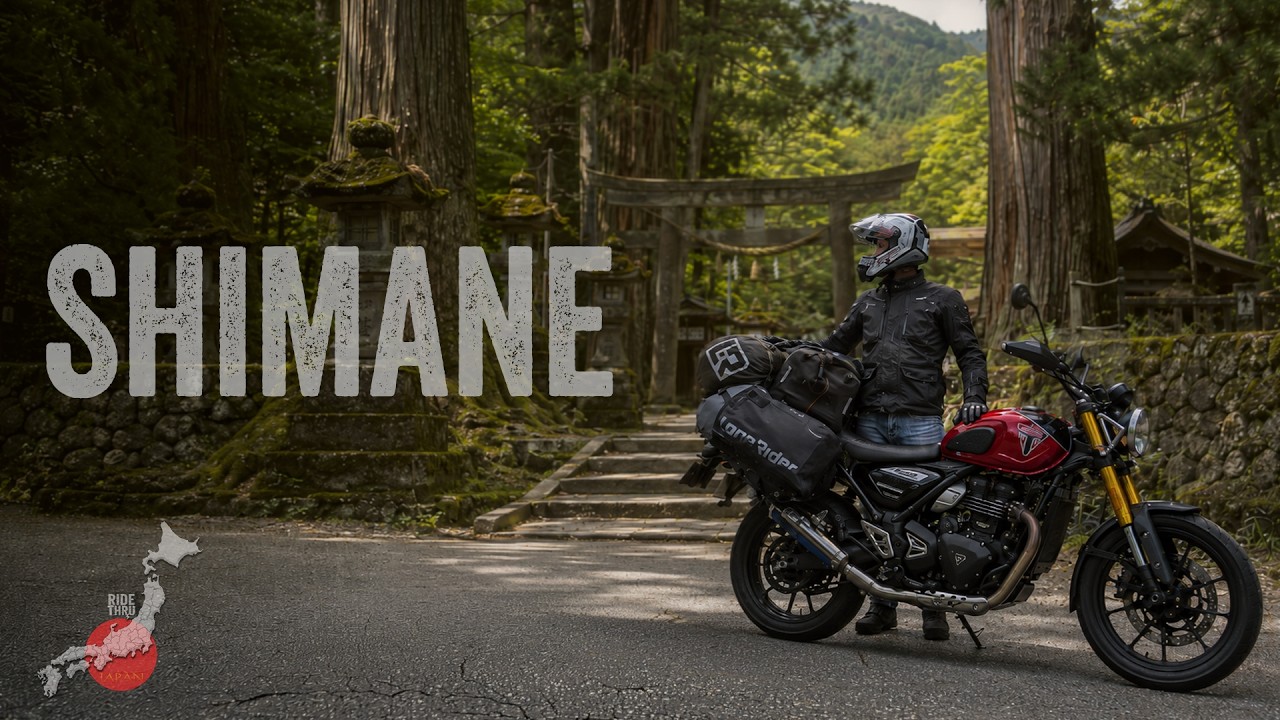
Shimane felt different from the moment I started riding it.
Not louder.
Not more dramatic.
Just deeper.
This was Episode 8 of Project 47, my solo motorcycle journey across all 47 prefectures of Japan. After being pinned down by days of heavy rain, Shimane opened up slowly — first through clouds and wet roads, then through empty coastline, old mountain towns, sacred places, and a kind of quiet that felt heavier than anywhere else I had ridden so far.
This wasn’t just another prefecture ride.
Shimane carried a different weight.
Partly because it is my wife’s home prefecture. Partly because of its myths and history. And partly because the further I rode through it, the more it felt like a place where Japan becomes something older and harder to explain.
Below is the journey across Shimane Prefecture.
Day 1 — Leaving the Rain Behind
Shimane greeted me with rain.
For three days I had been staying with my wife’s family, helping out, waiting for the weather to break, watching the storm sit over the prefecture and hold everything in place.
Then finally the clouds began to lift.
The plan was to start from Hamada, where I was staying, and head back west toward Tsuwano — the town I had originally wanted to begin with before the weather changed everything.
The roads out of Hamada were beautiful straight away.
Rice paddies.
Clouds lifting off the hills.
Hardly another vehicle in sight.
And then, suddenly, the coast appeared.
I pulled over at a small parking area by the sea just to let my gear dry out in the sun. My boots were still soaked from the days of rain. My socks were dry, but they had definitely seen better days.
It didn’t matter.
The sun was out.
The sea was blue.
And for the first time in days, Shimane was finally opening up.
Riding Inland — The Sentimental Pull of Shimane
I had wanted to keep following the coast, but the route I needed would eventually pull me back inland toward Tsuwano.
I didn’t mind.
Even doubling back felt good on a day like that.
And this ride had a different feeling to it because this wasn’t just any prefecture.
This was my wife’s home prefecture.
That gave everything an added layer.
At one point I stopped at a coastal spot knowing that she had ridden there herself years before I ever knew her. Now, decades later, I was there too. We would share that same piece of road, that same view, twenty years apart.
That kind of thing gives a place a different kind of gravity.
Tsuwano — Little Kyoto and a Darker History
By the time I reached Tsuwano, the day was near perfect.
Twenty-six degrees.
Blue sky.
An empty road winding into one of the prettiest towns in the prefecture.
People call Tsuwano “Little Kyoto,” and it makes sense the moment you walk into it.
Tree-lined streets.
Koi swimming through narrow water channels.
Historic buildings and old cultural landmarks tucked into every corner.
I parked near the station and found an old steam locomotive, the D51, sitting there like something from another century. Climbing up into it felt like stepping into childhood and history at the same time.
But Tsuwano has another side too.
As I walked through town, I started noticing churches and references that didn’t fit the image of an old castle town. Looking deeper, I found one of the darker parts of its past.
During the Meiji period, many Kakure Christians — Hidden Christians — were persecuted and martyred here.
That history sits strangely against the beauty of the town.
Tsuwano is one of those places where the surface is graceful and serene, but underneath it, something much heavier remains.
I didn’t have enough time to fully explore it.
But I knew immediately it was somewhere worth returning to.
Night 1 — Coastal Camping and Bear Country
By late afternoon it was time to think about camp.
There had been a lot of bear sightings and attacks in the region recently, which made the mountains feel like the wrong choice for the night.
So I headed back toward the coast.
The road there was gorgeous — running along a river with birds overhead, the light turning softer, everything calm and green and wide open.
Eventually I found a spot by the sea.
Tent up.
Beer open.
Ocean right there.
Day one had been incredible.
And Shimane already felt like one of those prefectures that gets under your skin fast.
Day 2 — A Blessing for the Ride
I woke early to perfect weather.
Day two started with a destination I had found almost by accident — a shrine dedicated to motorcyclists.
That felt like the right way to begin the day.
There was still a week or so of riding ahead of me, and if there was ever a place to ask the road gods for a little luck, this seemed like it.
The ride there followed some of the most beautiful roads I had seen yet in Shimane. Rivers, mountains, train lines following the coast, brilliant blue sky over everything.
At one point I felt like a kid again, just overwhelmed by how good the road was.
Then I saw a turtle in the road.
So I stopped, picked it up, and carried it to safety before some truck flattened it.
Not exactly part of the day’s route plan, but definitely part of the memory.
Eventually I reached the shrine.
Journey blessed.
Onward.
Iwami Ginzan — Ghosts in the Mountain
The next major stop was Iwami Ginzan.
The old silver mine town is beautiful in a quiet, almost deceptive way. To explore it properly, the best thing to do is rent a bicycle and follow the road up through the forest toward the mine.
The town itself is peaceful.
Historic buildings.
Narrow lanes.
Very few people around.
But the deeper you go, the more you feel the weight of what this place once was.
This little mountain town produced much of the silver Japan once exported to the world. And when you finally walk into the mine itself, all that beauty outside collapses into something else.
The tunnels are cramped.
The air feels heavy.
The thought of earthquakes and cave-ins becomes impossible to ignore.
And then there is the human part of it.
Every bit of that was dug by hand.
Standing in there, especially if you are even a little claustrophobic, you can’t help imagining what life must have been like for the miners. It felt as though the ghosts of that labor were still in the walls.
It was one of the most haunting places I visited on this entire trip.
Waterfalls, Forest Roads and the Pull of Izumo
After the mine I headed for a waterfall I had marked down.
It turned out to be more hidden than I expected — buried behind trees, only partly visible from the road, more heard than seen.
Not quite the dramatic waterfall reveal I had imagined.
But that hardly mattered, because by then the roads themselves were enough.
The forest riding in Shimane was unreal.
And I knew the real centerpiece of the day still lay ahead.
Izumo Taisha.
Izumo Taisha — The Zero Point of Japan
I have seen a lot of shrines in Japan.
Hundreds.
But Izumo Taisha felt different the moment I arrived.
The rope hanging at the shrine is enormous — more than five tons — and everything about the place feels heavier, older, more profound.
People say this is where Japan began.
The place where the gods gave the land to humans.
The absolute zero point.
Whether you believe that literally or not, standing there, it doesn’t feel like an empty claim. There is a kind of presence to Izumo Taisha that is hard to put into words.
It doesn’t feel decorative.
It feels foundational.
If some shrines feel peaceful and others feel beautiful, Izumo felt powerful.
Like a center of gravity.
Bentenjima — Where the Gods Meet
Just down the road from Izumo Taisha is Bentenjima, a beach with a rock shrine rising out of the water.
According to legend, once a year all of Japan’s gods gather here.
Standing on that beach, looking at the rock and the sea and the light, it honestly didn’t feel that hard to believe.
Shimane has that quality.
It makes myth feel less like folklore and more like atmosphere.
By the end of day two, I was exhausted but completely full of it all. The plan for the night was simple: head into Izumo City and get some sleep in a Kaikatsu Club before the final push the next day.
Home for the night.
Shimane, so far, had been incredible.
Day 3 — The Forgotten Coast Opens Up
On paper, day three looked easy enough.
Ride up the coast.
See a few sights.
Meet my in-laws for lunch.
Then push across the mountains into Hiroshima.
But riding across Japan on surface roads is never really easy, even when it looks simple.
The Shimane coast on that final day was one of the best riding stretches of the whole trip.
Raw rock meeting the sea.
No ugly concrete tetrapods.
No clutter.
Just the road weaving through wild coastline.
Again and again I found myself thinking the roads here were actually better than the attractions.
That’s how good the riding was.
Hinomisaki Lighthouse and the Wind
One of the major stops that day was Hinomisaki Lighthouse, the tallest stone lighthouse in Japan.
Standing there, looking at it rise above the cliffs, it was hard not to think about the fact that this is a stone structure in an earthquake-prone country and it has still survived for more than a century.
Normally you can climb to the top.
But on that day the wind was too strong, and it was closed.
A frustrating little miss.
Still, the place itself was worth it.
I even tried to put the drone up, only to have a big seahawk decide it didn’t appreciate the intrusion. I got the drone back down before it ended up in the sea.
Shimane was not going to let me get too comfortable.
Matsue Castle and Lunch with Family
From the coast I followed the road toward Matsue.
The scenery changed from sea to rice fields to the lakeshore of Shinji as the city came into view.
Matsue Castle is one of only a handful of original castle keeps remaining in Japan, and the difference is immediate when you walk inside. Dark timber, steep stairs, a real sense of age rather than reconstruction.
It doesn’t feel like a museum pretending to be old.
It feels old.
After that I met my in-laws for lunch.
My father-in-law, Shige-san, is a retired police officer and once one of Japan’s top marksmen. He is also one of those people who can laugh through almost anything.
I’m incredibly lucky to have people like that in my life.
That quiet family moment in the middle of the ride felt just as important as any of the major sights.
The Final Push — Bears, Darkness and Autopilot
By late afternoon I knew I had a problem.
If I was going to get to my overnight stop in Hiroshima, I had to cross the mountains.
And it was getting late.
There had been a sharp rise in bear attacks and sightings in the region, which ruled out the easy option of just camping somewhere in the hills. So I had to keep pushing.
At first the road was incredible.
One of those absurdly good mountain roads that almost makes you forget the time.
But then everything changed.
The light dropped.
The road narrowed.
The streetlights disappeared.
And suddenly I was exactly where I hadn’t wanted to be — on a mountain pass, at night, with poor visibility, in bear country, still far from where I needed to sleep.
It got properly scary.
At one point I could barely see anything ahead of me. Just darkness, road, and whatever might be out there beyond the headlight.
I stopped at a 7-Eleven car park just to breathe and reset.
Two and a half hours of hard riding had left me completely drained. I still had another stretch to go through the city before I could stop for the night.
By the end of it I wasn’t really thinking anymore.
Just moving.
Autopilot.
I made it to Hiroshima, too tired even to properly close out the day.
Straight to sleep.
What Shimane Became
Shimane began with rain and delay.
It ended as one of the most powerful prefectures of the journey so far.
Not because it shouted the loudest.
Because it didn’t.
Because it carried myth and history and coastline and mountain silence in a way that felt older than the rest.
It gave me family connection.
It gave me empty roads.
It gave me silver mines, sacred shrines, wild coast, and a final mountain pass that felt like a trial.
And somewhere in the middle of all that, it shifted something.
Not dramatically.
Just enough to notice.
Shimane felt less like a destination and more like a reminder that the deeper I go into this project, the more the road is changing me too.
Next stop: Hiroshima Prefecture.