Japan Felt Different Out Here
Mie felt different from the start.
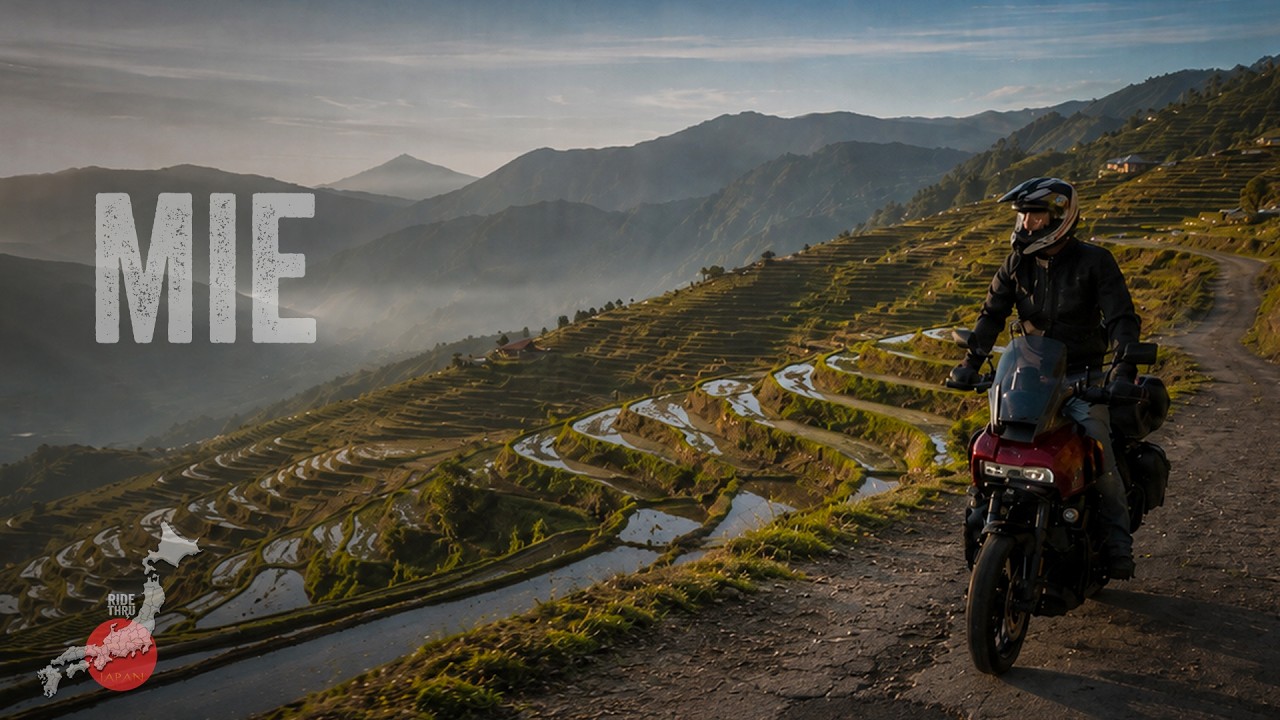
After the brutal wind and rugged coastline of Wakayama, I crossed into a slower, greener, quieter side of Japan — mountain valleys, terraced rice fields, coastal roads, forest routes, small towns, and the kind of riding that slowly works its way into you.
This episode of Project 47 follows a solo motorcycle journey through Mie Prefecture, Japan — riding alone through rural roads, mountain passes, coastal viewpoints, quiet shrines, rider’s roads, old traditions, unexpected hospitality, and one of the most enjoyable stretches of the journey so far.
This is not a Mie travel guide.
It is a motorcycle travel film about the spaces between destinations — the roads, the fatigue, the conversations, the detours, and the moments that only happen because you keep moving.
A Solo Motorcycle Journey Through Mie, Japan
Wakayama had been one of the highlights of Project 47 so far.
The coastline, the wind, the long road south, Kushimoto, Hashigui-iwa, and finally Nachi Falls — a place I had wanted to see for more than 20 years. That prefecture left a mark.
But the journey does not stop when one chapter lands well.
Project 47 is about continuing forward.
So I headed toward Mie, not completely sure what kind of ride was waiting beyond the next turn.
What I found was a prefecture that revealed itself gradually.
Mie did not hit me with one simple identity. It unfolded through rice terraces, quiet rural roads, blue coastal water, mountain routes, campsites, old shrines, free-diving traditions, rough backroads, new friends, waterfalls, and one final historical stop that almost slipped past me.
It became one of those rides where the destination mattered less than the feeling of being out there.
Rural Japan. Alone on the bike. Letting the road decide what mattered.
Crossing Into Mie
The ride into Mie began at the edge of the previous day.
As the sun started to set, I stopped at a convenience store to figure out where I was going to sleep and ended up talking with a father and son from Osaka riding Harleys together through Wakayama.
That kind of thing keeps happening on this journey.
The motorcycle draws people in. Maybe it is the luggage. Maybe it is the dirt and road wear. Maybe it is the sense that the bike has come from somewhere and is going somewhere else. Whatever it is, people stop, talk, ask questions, share stories, and become part of the ride for a few minutes.
I found a hotel up the road, called it a night, and got ready to properly enter Mie the next morning.
After two days of fighting the wind along the Wakayama coast, I decided it was time to turn inland.
The mountains were calling.
Into the Rice Terraces
My first real destination in Mie was Maruyama Senmaida.
The ride there was exactly what I needed.
Green roads. Small valleys. A slower rhythm. The kind of rural riding where the bike settles into the road and everything starts to feel right again.
After the intensity of Wakayama, Mie immediately felt calmer.
Then the rice terraces appeared.
Maruyama Senmaida is made up of more than a thousand individual rice fields carved into the mountainside. For centuries, farmers shaped that steep landscape by hand, turning the hills into one of the most distinctive rural scenes in Japan.
It is the kind of place you do not rush through.
You stop. You look. You let it sit for a while.
The fields step down the mountain, old farmhouses sit quietly in the landscape, and everything feels like it has been built through time rather than designed for attention.
This was not the postcard version of Japan.
It felt older than that.
Quieter.
More lived in.
The Slower Side of Japan
One of the things I loved about Maruyama Senmaida was how still it felt.
There are places in Japan that announce themselves loudly. Famous temples. Big views. Crowded streets. Instagram spots. Places everyone seems to be chasing.
This was not that.
The terraces were beautiful, but the feeling was what stayed with me. The road in. The mountain air. The farms. The quiet. The sense that people had been working this land long before my motorcycle ever rolled into the valley.
I found a little honesty shop selling fruit and grabbed some.
That small moment mattered.
No sales pitch. No big store. Just fruit left out, a price, and trust. I paid, ate, and stood there in the middle of rural Mie thinking that this was exactly the kind of Japan I had started Project 47 to find.
Not hidden because it is secret.
Hidden because most people move too fast to notice it.
Back Toward the Coast
After the rice terraces, I headed back toward the coast.
The next stop was Hana no Iwaya, one of Japan’s oldest sacred sites. It is centered around a huge rock face, with small hand-carved spaces in the stone and a quiet atmosphere that feels different from more polished shrines.
Again, it was not the kind of stop that needed to dominate the episode.
It was part of the rhythm.
Park the bike. Walk for a while. Ring the bell. Look around. Eat something. Let the road slow down before moving again.
That is how Mie started to build itself.
Not through one big moment, but through a chain of smaller ones.
A rural road. A rice terrace. A shrine. A meal. A coastline. A corner. A view.
Then the road began to open up in a completely different way.
The Mie Coast
Once I hit the coast, Mie changed again.
The water was unbelievably blue. The roads kept curling around bays and headlands. Every corner seemed to open into another view. The coastline felt less brutal than Wakayama, but just as rewarding in its own way.
This was the kind of riding that makes motorcycle travel hard to explain to people who only think in destinations.
Some people travel for selfies. Some travel for food. Some travel for famous places.
For me, it is this.
The road. The bike. The way a corner opens into a view you did not know was coming. The feeling of moving through the landscape instead of simply arriving at it.
The Mie coastline kept getting better and better.
At some point, I started wondering whether I wanted to move there.
That usually means the ride is going well.
Rider’s Nirvana
The longer I rode, the more Mie surprised me.
The coast was beautiful. The roads were smooth. The views kept coming. The mountains backed off just enough to open the landscape, then returned again in the distance. The light started to soften, and the road kept giving me reasons to keep riding.
Camping along the coast was almost impossible without booking days in advance, so eventually I had to turn inland toward the only free campsite within reach.
That meant another long ride before dark.
But even that worked.
The roads kept delivering. The sunset started to build. The reflections, the curves, the quiet — it all came together.
By the time I reached camp, I was exhausted but completely stoked.
Mie had already given me more than I expected.
And I was only getting started.
Camp at the End of the Day
The campsite was free, simple, and exactly what I needed.
After a long day of riding, filming, navigating, and chasing roads, having a place to stop felt like a victory. The next morning, I started late because I needed it.
That is another reality of solo motorcycle travel.
Sometimes you are not late because you are lazy.
You are late because the road has taken more out of you than you expected.
The previous day had been incredible, but it had also been physically draining. I lay in the tent while families played, kids made noise, music drifted through the campsite, and the place felt alive around me.
It was not bad noise.
It was good noise.
People enjoying life. Families out together. A normal evening in Japan happening around a very tired rider in a tent.
I did not have the energy to join in.
But I was happy to be there.
Skyline Roads and Pearl Road
The plan for the next day was to ride some proper roads.
The Skyline. Pearl Road. Then south toward Shima and the coast.
From the moment the road started, Mie came alive again.
This was exactly what I needed — smooth surfaces, sweeping corners, elevation, views, and that rare feeling where the motorcycle, the road, and the day all line up at the same time.
At one point, Mie started to feel like rider’s nirvana.
That is not a phrase I throw around lightly. But on this journey, I had ridden a lot of great roads already, and Mie was stacking them up faster than almost anywhere else.
The surface was good. The flow was good. The scenery was incredible. The coast and islands opened out below. The road made you want to keep going just to see what came next.
This was not travel-guide Japan.
This was motorcycle Japan.
And it was glorious.
The Road Pulls People In
One of the coolest things about traveling by motorcycle is the way it draws people to you.
You can be parked at a viewpoint, a museum, a convenience store, or a campsite, and someone will come over to talk. Sometimes they ride. Sometimes they used to ride. Sometimes they just want to know where you are going.
There is an openness to the bike that changes the way you move through a place.
A car closes you off.
A motorcycle starts conversations.
Mie gave me plenty of those small moments — riders, locals, channel viewers, and strangers who became part of the journey simply because the motorcycle made the first introduction.
That is one of the things I never want to lose.
The Ama Divers of Mie
One place I had wanted to visit for years was the Satoumi Museum, dedicated to Japan’s Ama divers.
I first heard about them in a documentary long before Project 47 existed. Traditional Ama divers are mostly women who free-dive without oxygen tanks, harvesting from the sea using techniques passed down through generations.
Finally riding there myself felt special.
Actually reaching it was harder than expected.
Parts of Pearl Road were closed for a marathon. Detours kept stacking up. Phone reception disappeared. Navigation refused to reroute properly. What should have been a straightforward ride became frustrating and time-consuming.
By the time I reached the museum, the place was quieter than expected because the divers were not diving that day due to the waves.
It was a little underwhelming in the moment.
But the tradition itself still mattered.
That is part of the tension of a real solo motorcycle documentary. Some places mean a lot before you arrive, then the day does not quite give you the experience you hoped for.
You take what is there.
Then you keep moving.
The Long Ride to Trevor and Iris
By that point, the day had already cost me more time than expected.
A channel viewer named Trevor, who had become a friend, had offered me a place to stay with him and his wife, Iris, if I ever came through their area.
Getting there meant three to four hours of riding through the mountains and into the evening.
It was more than I expected to do that day.
But I was looking forward to meeting them, so I pushed on.
The road started beautifully — open stretches, sweeping corners, rivers, and that late-day light that makes everything feel worth the effort.
Then the navigation threw me into something wild.
A tiny mountain road. Gravel. Potholes. First gear. Narrow sections. No real chance to relax. The kind of road that is fun for about thirty seconds, then exhausting for a long time after that.
This is riding through Japan.
You never really know what you are going to get.
Through the Mountains at Dusk
That mountain road was one of those sections that does not look huge on the map but takes everything out of you in real life.
The bike was loaded. The road was narrow. The surface was broken. Gravel appeared in the wrong places. The light was fading. My hand started going numb. I was tired and needed a break, but the road kept demanding attention.
It was beautiful.
It was also exhausting.
That combination is one of the defining features of Project 47. The journey gives you places that look incredible, but you still have to ride them. You still have to manage the bike. You still have to stay focused when your body wants to stop.
Eventually, the claustrophobic section opened up.
A dam, river, sunset, and the last stretch toward Trevor and Iris.
By the time I arrived, I was completely smoked.
Road Hospitality
Trevor and Iris were amazing hosts.
They welcomed me in, cooked dinner, shared beer, and gave me a place to recover after a huge day on the road. After weeks of riding alone, that kind of hospitality hits differently.
A bed. A meal. A conversation. A chance to stop being only the rider for a little while.
That night became one of the important human moments of Mie.
Project 47 is built around riding all 47 prefectures of Japan, but the journey is not only about geography. It is also about the people who appear along the way.
Some are strangers. Some are riders. Some are viewers. Some become friends.
Trevor and Iris became part of the story because the road brought us to the same place at the right time.
Akame Waterfalls and a Morning Off the Bike
The next morning, before heading out, Trevor showed me his workshop.
He makes handcrafted leather goods, and seeing that side of his life added another layer to the visit. Starting a small business in Japan is not easy, and meeting people who are building something with their hands always feels connected to the spirit of the road in some way.
Then we went to the waterfalls.
In a car.
And honestly, it felt good not to be in riding gear for a while.
The waterfalls were beautiful. Trevor goes up there most mornings to exercise before the crowds arrive, and walking through that area with someone local made the visit feel completely different from just arriving alone and filming a stop.
It was not about checking off a place.
It was about being shown a piece of someone’s daily life.
That is something you cannot plan into a route.
It has to happen.
One More Place Before Nara
My time in Mie had already grown long, but there was still one more place I needed to see before heading toward Nara.
Trevor mentioned it during the morning walk, and it immediately caught my attention. I had thought it was in another part of the region. I almost missed it completely.
So I got back on the bike and headed there.
The ride reminded me again how good Mie’s roads are. Smooth surfaces, easy cruising, and enough corners to keep the bike feeling alive. At that point, it really did feel like the prefecture had spent all its money resurfacing roads for motorcyclists.
The destination was Iga.
Castle, history, ninja culture, old streets, museums, and enough atmosphere to feel like a completely different chapter tucked inside the same prefecture.
Mie still had one more surprise left.
Iga and the Last Surprise
Iga turned out to be the perfect final stop.
There was history everywhere — a castle, museum spaces, old objects, ninja tools, demonstrations, and small details that made the whole place more interesting than I expected.
The ninja show was genuinely impressive. Fast, sharp, physical, and a reminder that these stories are more than costumes and clichés when they are handled well.
By that point, Mie had become one of the strongest prefectures of the journey.
Great roads. Beautiful coast. Rural landscapes. Rice terraces. Old sacred sites. Free-diving culture. A rough mountain pass. New friends. Waterfalls. Iga. And the constant feeling that Japan out here was revealing itself in layers.
Not loudly.
Gradually.
One road at a time.
Riding Toward Nara
By the end of Mie, I was completely sold.
Some prefectures are defined by one big moment. Some are defined by struggle. Some by weather. Some by frustration. Some by a single road that changes the whole episode.
Mie was different.
It was the accumulation.
The rice terraces. The fruit stand. The coast. The blue water. The rider’s roads. The campsite. The Ama divers. The detours. The long mountain ride. Trevor and Iris. The waterfalls. Iga. The final push toward Nara.
It became a chapter about the quieter spaces between destinations and the way a prefecture can slowly become unforgettable.
Japan felt different out here.
And that is exactly why I kept riding.
Watch the Full Mie Motorcycle Travel Film
Japan Felt Different Out Here | Solo Motorcycle Journey is part of Project 47, a long-form motorcycle travel documentary series following one rider across all 47 prefectures of Japan.
This episode is for riders, travelers, and anyone drawn to the slower side of the road — rural valleys, coastal routes, mountain passes, unexpected conversations, and the feeling of riding alone through Japan while letting the journey decide what matters.
Watch the full Project 47 series:
https://www.youtube.com/playlist?list=PLbArCx0u7LtjYBwxR-rRE5GNXNUOzTTdX
Follow the journey on Instagram:
https://www.instagram.com/RideThruJapan/
Support the ride:
https://ridethrujapan.com/support/
About Project 47
Project 47 is a solo motorcycle travel documentary series across Japan.
The goal is simple: ride through all 47 prefectures, not as a checklist, but as a long-form journey through the roads, landscapes, people, and quiet moments that make Japan feel endless again.
One rider. One motorcycle. Forty-seven prefectures.
This is Japan by motorcycle.