Watch the Full Fukui Motorcycle Journey
The Road Through Fukui is Episode 24 of Project 47, my solo motorcycle journey through all 47 prefectures of Japan.
This chapter follows the ride through Obama, the Rainbow Line and the Echizen Coast, then inland to Echizen Daibutsu and the Fukui Prefectural Dinosaur Museum in Katsuyama.
I came into Fukui without much of an idea of what I was going to find.
A stretch of the Sea of Japan. Some roads along the coast. Somewhere to sleep.
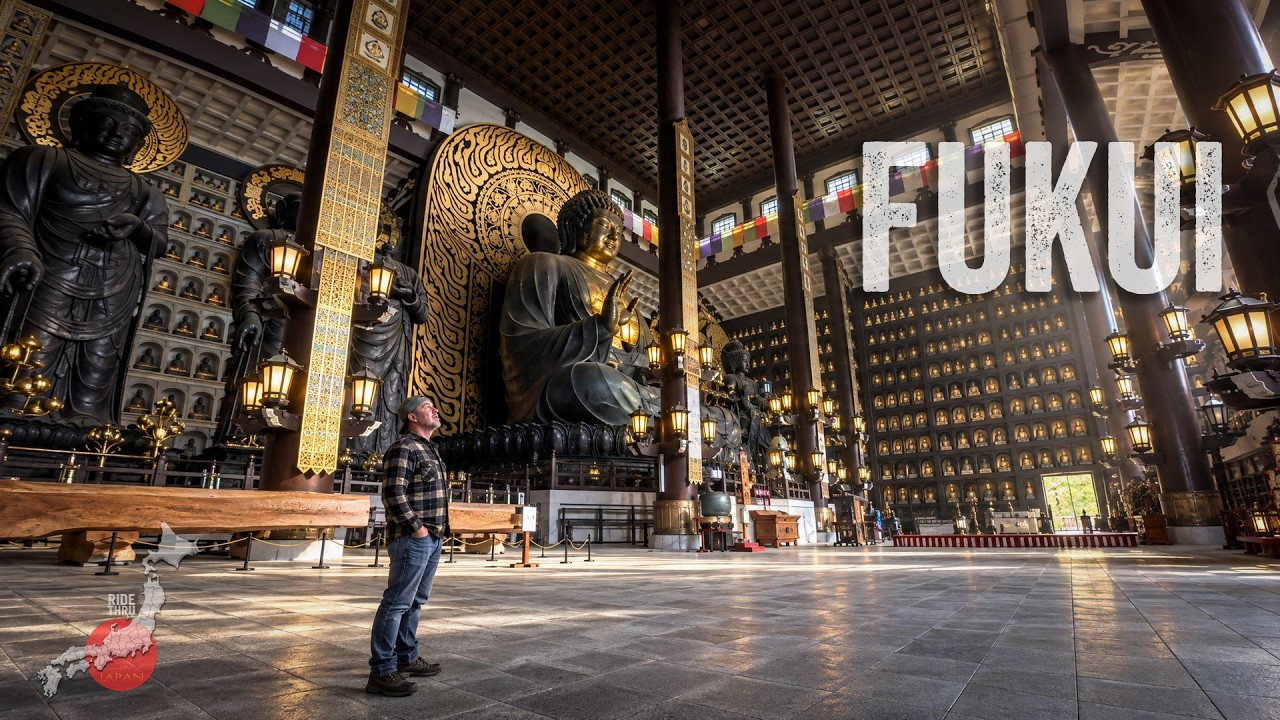
By the time I left, I had made my own chopsticks, ridden roads I wanted to turn around and ride again, abandoned a camping plan in strong coastal winds, and stood inside a temple so enormous I could barely fit the Buddha into the camera.
Then there were the dinosaurs.
This part of my motorcycle journey through Japan took me from Obama and the Rainbow Line to the Echizen Coast, then inland to Katsuyama. Two days in Fukui, with the Harley-Davidson Pan America ST and enough freedom to change direction when something looked interesting.
Fukui gave me plenty of reasons to do that.
Starting the Day With a Roadside Camera Fix
The ride around Lake Biwa in Shiga had brought me north to the western edge of Fukui.
Now I was heading towards Obama, where I wanted to try one of the traditional crafts the area is known for.
First, though, I had a problem.
The USB-C connection I normally used to keep my camera charged had stopped working properly. I suspected water had got into it during the storm a couple of nights earlier. I hadn’t closed it properly.
Without power, I was going to lose most of the riding footage.
It was already hot, so I found some shade, pulled things apart and improvised another way to keep it running.
Not the most glamorous start to the day. But when you’re filming a solo motorcycle trip, these little repairs are part of it.
Camera powered. Everything back on the bike.
Time to go and make some chopsticks.
Making Wakasa Lacquered Chopsticks in Obama
Obama is famous for Wakasa lacquered chopsticks. Around 80% of Japan’s lacquered chopsticks are produced here.
I’d been using disposable wooden ones for most of the journey, so the idea of making a pair and carrying them with me appealed straight away.
The process involved sanding back the layers of lacquer to reveal the pattern underneath.
It was a good excuse to sit still and concentrate on something small for a while. Most of my days involved watching the road, checking the camera, looking at the map or wondering where I was going to sleep.
Here, I just had a pair of chopsticks to work on.
The experience cost me ¥1,500, including the finished pair.
I thought that was a pretty good deal. A chance to try a local craft, and something useful to take away with me.
I left Obama with my own chopsticks and the camera working again.
The day was going well.
Route 162 — Even the Ride to the Rainbow Line Was Good
From Obama, I headed towards the Rainbow Line.
I’d picked it as somewhere I wanted to ride, but I hadn’t expected to enjoy getting there quite so much.
Along Route 162, there were little harbours, boats on the water and rice fields reaching towards the sea. Then the view would open up again and I’d find myself looking across beautiful blue water towards the islands.
I kept wanting to stop.
This was apparently the road taking me to the scenic road.
I was already happy.
That’s one of the things I love about travelling through Japan by motorcycle. You can put a place into the navigation, then spend half the journey getting distracted by everything before it.
Fukui was doing a very good job of distracting me.
Riding the Rainbow Line Above the Mikata Five Lakes
The Rainbow Line winds through the hills above the Mikata Five Lakes, also known as Mikatagoko.
On the bike, it was exactly the kind of road I’d been hoping to find.
Corners, steep climbs and descents, and views that kept making it difficult to concentrate on the next bend.
Blue water below. Hills ahead. Another hairpin.
I stopped at a viewpoint to take it in properly.
There was a lot of “look at this” happening inside the helmet that day. Occasionally, I managed a slightly more useful description.
Mostly, I was just having a great time.
The Pan America attracted some attention at the stops too. During this trip, people often came over to look at it or ask questions. I didn’t see many others out on the road, and it was a good conversation starter.
After a chat, I got back on and kept riding.
The descents were steep enough that my ears popped. Every time the road turned, there seemed to be another view worth stopping for.
By this point, Fukui was already giving me some of the most enjoyable riding I’d had in a while.
And I still had the coast ahead.
The Wind Had Other Ideas About Camping
Coming around onto the exposed side, I realised how sheltered I’d been.
The wind was strong.
Out on the sea, the water was covered in whitecaps. I’d been thinking about camping somewhere along the coast, but the more I rode, the less appealing that sounded.
A tent beside the water is a lovely idea when you’re looking at it on a map.
It’s a different proposition when the wind is already drowning out the sound of the motorcycle.
I passed a nuclear response evacuation sign, then noticed what I thought might be a power station across the water. The camping option that seemed to offer some shelter was near it, and I didn’t fancy staying there.
I also came across a place offering bike café accommodation, but the timing didn’t work out. It was due to open on Sunday.
It was Tuesday.
Eventually, I found a room in an old Japanese house and booked it.
There was only one problem.
It was a lot further away than I’d hoped to ride that day.
Following Route 305 Along the Echizen Coast
Getting to the guesthouse took me along the Echizen Coast on Route 305.
Rocky shoreline. Little fishing communities. The road running right beside the Sea of Japan.
It was a beautiful ride, even with the wind making me work for it.
At one point, I changed the bike’s display so I could keep an eye on the revs. I couldn’t hear much over the wind.
I would have loved to ride that stretch on a calmer day. There were moments when I could see just how good it would be, but I was already tired and still had a fair distance to cover.
So I settled into the ride.
That’s part of a longer motorcycle journey too. Sometimes the afternoon stops being about finding another place to explore and becomes about getting yourself to wherever you’ve decided to sleep.
At least the road there was good.
A Japanese Guesthouse That Felt Like a Home
By the time I arrived, I was done.
The house was beautiful, and the owner made me feel welcome straight away.
I’d bought some proper food, but the immediate priority was a beer and some Ritz cheese crackers.
“Smoked but stoked” was how I described it.
That was about right.
I was exhausted, but I’d had such a good day. The chopsticks, the Rainbow Line, the coast. Fukui had kept giving me more than I expected, and now I’d ended up in a place that felt like a home.
The following morning, the owner came out and we chatted for a while before I left.
Then she warned me about bears.
Apparently, there had been bears around the area, and a trail ran through the nearby hill.
I hadn’t even mentioned bears.
Somehow, she’d gone straight to the one thing guaranteed to get my attention.
A lovely place to stay. Very kind people.
And a good reason to keep moving.
Echizen Daibutsu — An Enormous Buddha and Almost Nobody There
The next day took me inland to Katsuyama.
I wanted to visit the dinosaur museum, but first there was somewhere nearby I wanted to see: Echizen Daibutsu.
I knew there was a large Buddha.
I wasn’t prepared for the scale of the place around it.
The approach was enormous. The hall was enormous. Then I went inside and found myself looking up at a statue I couldn’t properly fit into the shot.
There were more statues beside it, and rows of smaller figures filling the surrounding walls.
Everywhere I looked, there was more to take in.
What struck me just as much was how quiet it was.
I’d been through places on this journey where getting a clear look at something meant waiting for a gap in the crowd. Here, I was standing inside this vast hall with hardly anybody around.
I kept looking up, then looking around, trying to understand how somewhere this big could feel so empty.
It was one of those stops where the camera struggled to explain what it felt like to be there.
You could see the statue.
Getting a sense of its scale was another matter.
I came out of Echizen Daibutsu completely impressed.
And the dinosaurs were still to come.
Visiting the Fukui Prefectural Dinosaur Museum in Katsuyama
Fukui really leans into the dinosaurs.
By the time I arrived at the museum grounds in Katsuyama, that much was obvious. There were dinosaur figures outside, and I parked the motorcycle beside a dinosaur’s tail.
A fairly clear indication that I’d found the right place.
Inside the Fukui Prefectural Dinosaur Museum, I quickly realised this was somewhere you could spend hours.
Fossils, skeletons and displays in every direction. I’d look at one thing, turn around and find something else I wanted to see.
Then there was the T. rex.
You don’t have to arrive with a particular interest in dinosaurs to enjoy standing underneath one of those.
My admission cost ¥1,000, and I came out feeling I’d easily have paid more.
There were more dinosaur figures to explore around the grounds too. It looked like somewhere children could have a great time, but I was enjoying it perfectly well on my own.
Unfortunately, I still had some riding to do.
Ishikawa was next.
Is Fukui Worth Visiting by Motorcycle?
Absolutely.
The Rainbow Line and Route 305 along the Echizen Coast were the riding highlights for me. But what made Fukui memorable was how much else happened between the roads.
I made something in Obama that I could use for the rest of the trip.
A change of plan took me to a Japanese house where I felt genuinely welcome.
Katsuyama gave me an enormous, almost-empty Buddha hall and a dinosaur museum I could happily have spent longer exploring.
If you’re putting together a motorcycle route through Fukui, those places give you plenty to build a journey around.
My route ran from the western coast through Obama, out towards the Mikata Five Lakes and the Rainbow Line, then along the Echizen Coast before heading inland to Katsuyama.
I covered it over two days, but the first became a longer ride than I’d intended. I’d leave more room for the coastal section if I did it again.
And I’d check the wind before getting attached to the idea of camping beside the sea.
Leaving Fukui for Ishikawa
There are prefectures you arrive in with a long list of things you’re excited to see.
Fukui hadn’t been one of those for me.
I had a few ideas, but mostly I was following the road and seeing what happened.
Two days later, I was leaving with my own chopsticks, a camera full of coastal roads, and several places I was already telling people they should visit.
I still wanted to find another good road on the way out.
That probably tells you how much I’d enjoyed it.
Next stop: Ishikawa.
Watch the full Project 47 series in order.
Previous chapter: Around Lake Biwa by Motorcycle — Shiga.
About Project 47
Project 47 follows my solo motorcycle journey through all 47 prefectures of Japan.
Each episode covers another prefecture, with the roads, people, overnight stops and changes of plan becoming part of one continuous story.
I ride, film and discover it as I go.
You can explore the series here or support the journey.