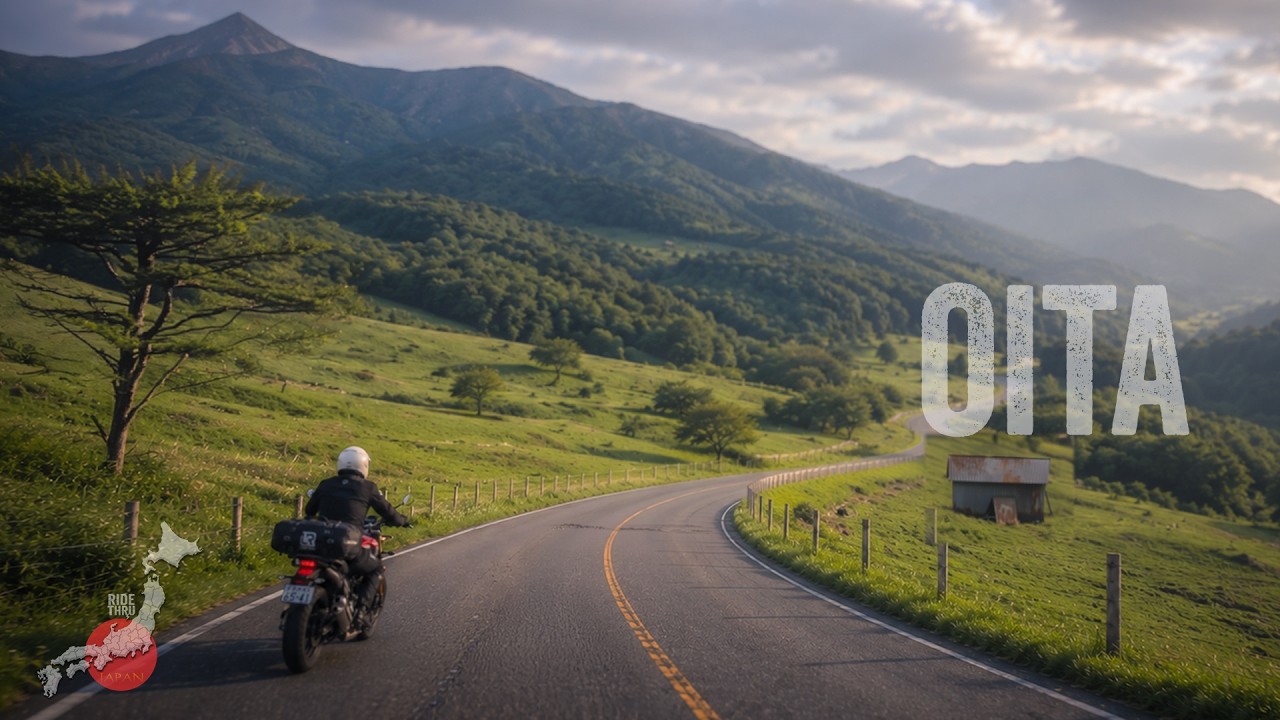
Oita is one of those places Japan doesn’t advertise loudly — and that’s exactly why it works.
It doesn’t try to impress you with major landmarks or world-famous attractions. Instead, it opens slowly as you ride through it: quiet mountain passes, volcanic highlands, empty countryside roads, and villages that feel completely removed from the pace of modern Japan.
This was Episode 4 of Project 47, my solo motorcycle journey across all 47 prefectures of Japan.
Over three days riding through Oita Prefecture on Kyushu’s eastern side, I found some incredible roads, hidden shrines, wild camping spots, and a few reminders that long-distance travel never goes exactly as planned.
Below is the ride, day by day across Oita.
Day 1 — Wild Camping & The Springs of Mount Kuro
I had ridden up into the mountains the night before, looking for somewhere quiet to camp.
The plan was simple: wake up, pack the bike, and start exploring Oita without much of a schedule.
The road down from the mountain made it clear right away that the bike I used previously wouldn’t have enjoyed this terrain very much. But the new bike felt different — comfortable, capable, and ready for a bit of adventure.
Japan isn’t usually seen as an off-road destination. Most of its wilderness is paved, signed, and neatly organized.
But not all of it.
Once I made it back onto open roads under blue skies, the day immediately felt promising.
My first stop was Oike Spring, located on the northern side of Mount Kuro.
It’s one of those peaceful places that instantly slows you down. Clear water flows from the earth at a constant temperature of around 12°C year-round, pushing out more than 14 tons of water per minute.
The forest surrounding the spring is dense and untouched, with roots twisting across moss-covered rocks and towering trees forming a canopy overhead.
Just walking the short path to the spring felt like stepping into another world.
And it was only the beginning of the day.
Toriten Lunch & The Suspension Bridge
Back on the road, one thing became immediately obvious about Oita.
The roads are empty.
You can ride for long stretches without seeing another car, just winding through farmland, forests, and mountain valleys.
Eventually hunger caught up with me, and I stopped to try one of Oita’s local specialties — Toriten, a style of fried chicken unique to the region.
Unlike regular fried chicken, Toriten is lightly battered like tempura and served with dipping sauce and mustard.
Simple, crispy, and perfect road food.
After lunch I headed toward a massive suspension bridge nearby — reportedly the largest pedestrian suspension bridge in Japan.
The view from the bridge was impressive, with a waterfall visible in the valley below, though I’ll admit paying 500 yen just to walk across and back felt a little steep.
Still, it was worth seeing.
Ryumon Falls & The Stone Valleys of Ura Yabakei
The road continued deeper into the mountains, twisting through quiet valleys until I reached Ryumon Falls.
It’s a beautiful two-tier waterfall dropping roughly 26 meters, tucked into a peaceful forest valley.
The setting was perfect for a quiet break.
There were signs warning visitors not to slide down the waterfall anymore — something people apparently used to do — but the view alone made the stop worthwhile.
From there I continued toward Ura Yabakei, a valley famous for its unusual rock formations that rise like stone pillars from the landscape.
The small town at the base of the valley was charming, with a handful of restaurants and quiet streets. From there a short hike leads up into the mountains where the views open up across the valley.
Standing up there looking down at the town and surrounding cliffs, it felt like discovering somewhere that had been quietly sitting there for centuries waiting for someone to wander through.
Night 1 — Beachside Camping
As the sun began to drop, I made my way toward a coastal spot I had seen on Google Maps that looked like it might work as a campsite.
I stopped along the way at a large supermarket called Trial to pick up supplies for a small barbecue.
The final question of the day was simple:
Could I actually camp at the location I had found?
Fortunately, the answer was yes.
A quiet patch near the beach, just enough space to set up the tent, cook dinner, and watch the sun disappear into the horizon.
It had been an incredible first day in Oita.
Day 2 — Getting Lost & Dropping the Bike
The second day began under clear blue skies.
I packed the bike early and headed into the mountains without much of a plan beyond finding interesting roads.
Before long I realized I had completely lost track of where I was.
While checking my map, a local man came over to ask if I needed help. He offered a few suggestions for nearby roads and shrines to visit.
So I took his advice and went exploring.
The road he suggested started beautifully — smooth pavement, sweeping corners, and almost no traffic.
But eventually it ended, leaving me searching again for something interesting.
That’s when I spotted a road leading toward the ruins of an old temple.
And that’s where the day got interesting.
While attempting a tight U-turn on a steep mossy incline, I made a rookie mistake.
The clutch slipped.
The bike lurched forward.
And down it went.
Fortunately the damage was minor — a cracked knuckle guard and a slightly tightened clutch cable — but it was a good reminder that solo travel means dealing with every mistake yourself.
After checking the bike over and making sure everything still worked, I continued up the road to the temple ruins.
Kyusento-ji — The Temple Lost to Fire
Kyusento-ji was once one of the most important temples in the Kunisaki region.
Today, only ruins remain.
A massive forest fire in 1968 destroyed the buildings, leaving behind stone pathways, carved markers, and a quiet sense of history lingering in the forest.
The place felt peaceful and forgotten at the same time.
You could almost feel the centuries of footsteps that once climbed those cobblestone stairs.
Futago-ji & A Roadside Repair
Back at the bike I discovered my right-side mirror had come loose.
And of course, I had forgotten to pack the proper tools.
So I rode back toward the nearest hardware store to pick up a set of spanners before continuing.
That small detour turned out to be worth it.
The road that followed was one of the best of the entire trip — endless curves winding through forests and hills.
Eventually it led me to Futago-ji Temple, located high on the slopes of Mount Futago.
Built in 718, this remote temple has more than 1,300 years of history tied to the monks who once walked the peninsula’s mountains in meditation.
Even though parts of the temple were under renovation, the real charm is walking through the surrounding forest and discovering the small shrines scattered along the mountain trails.
It felt quiet, ancient, and completely removed from the modern world.
Beppu & The Blood Pond Hell
From the mountains I rode toward Beppu, famous for its geothermal hot springs.
One of the most striking is Chinoike Jigoku, or “Blood Pond Hell.”
The hot spring gets its deep red color from iron oxide in the water, giving it an eerie appearance that really does look like something out of a myth.
Despite the name, it’s not for bathing — the water temperature sits around 72°C and the pool is estimated to be about 30 meters deep.
Standing there looking into it, it definitely feels more like observing something from another planet than a normal hot spring.
The Iwashita Collection & Camping in the Forest
Later that day I rode into Yufuin to visit a good friend, Iwashita-san.
His museum, known as the Iwashita Collection, is one of the most unique places I know. It’s packed with vintage motorcycles, rare vehicles, and artifacts that feel like stepping into a different era.
After catching up and sharing stories, he invited me to camp in a part of his property he calls the Forest of Legends.
It was the perfect place to end a long day on the road.
Day 3 — Mount Yufu & Harajiri Falls
The final day began with another perfect morning.
Leaving Yufuin meant riding one of the most famous routes in the region — the road climbing around Mount Yufu.
The sweeping curves, open views, and mountain air make it a favorite among riders for a reason.
After descending from the mountains I headed toward one of Oita’s most famous natural landmarks:
Harajiri Falls.
Often called the “Niagara of Japan,” the waterfall stretches roughly 120 meters across and drops about 20 meters into the river basin below.
A large torii gate sits near the edge of the falls, adding an unexpected spiritual element to the landscape.
It’s one of those places where the scale of the waterfall and the quiet rural setting combine into something unforgettable.
Chinda Falls & The Inazumi Underwater Cave
My next stop was another waterfall that didn’t quite go according to plan.
When I arrived, the main waterfall was completely dry due to hydroelectric work upstream.
But exploring the surrounding area revealed two smaller falls and the remains of an old power plant nearby, turning the stop into something far more interesting than expected.
The final destination of the trip was Inazumi Underwater Cave.
Formed around 300 million years ago and flooded by volcanic activity roughly 300,000 years ago, the cave system is the longest underwater limestone cave in Japan.
Walking through the tunnels takes around 40 minutes and can feel a little intense if you’re even slightly claustrophobic.
But it’s an incredible place.
Above ground there’s also a Japanese garden, a small museum filled with vintage items, and even a giant golden Buddha statue.
Strange, fascinating, and unforgettable.
Three days in Oita.
Wild campsites, forgotten temples, volcanic landscapes, and some of the best riding roads I’ve found so far in Japan.
It may not be the prefecture Japan advertises the loudest.
But that’s exactly why it works.
Next stop on the journey: Nagasaki Prefecture.