Japan looks deceptively easy on a map.
The roads are generally good. The infrastructure is excellent. Petrol is easy to find in most populated areas. Crime is low, convenience stores are everywhere, and even fairly remote parts of the country rarely feel completely cut off from civilisation.
Then you actually try to cross Japan by motorcycle.
A 150-kilometre riding day in Japan is not necessarily anything like 150 kilometres in the United States or Australia.
Get away from the expressways and major national routes and those 150 kilometres might mean hundreds of corners, narrow mountain roads, villages, traffic lights, construction, elevation changes, blind bends and road surfaces that can change completely within a few kilometres.
What looks like an easy morning on Google Maps can become most of your day.
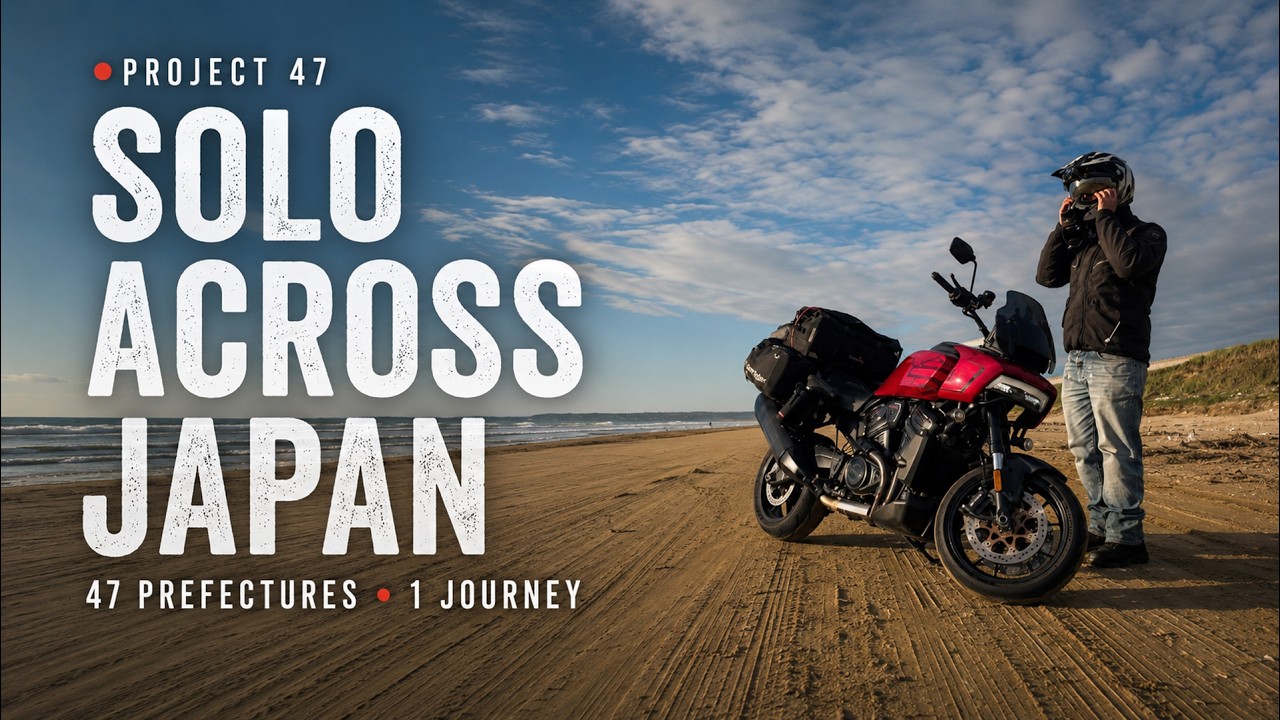
I know because I have now ridden through all 47 prefectures of Japan.
I have also lived here for 27 years.
So this isn’t a guide written after a two-week motorcycle holiday or a loop around Mount Fuji. Japan is home, and riding the entire country for my Project 47 series gave me a very different perspective on both motorcycle travel and a country I thought I already knew extremely well.
If you’re thinking about riding a motorcycle across Japan, this is what I would want somebody to tell me before I started.
Japan Is Small on the Map. It Doesn’t Always Ride Small.
This is probably the first thing to understand.
Japan isn’t enormous geographically, but distance here can be deceptive.
If you stay on the expressways, you can cover huge distances relatively quickly.
That isn’t how I would recommend seeing the country.
The moment you leave the major highways, everything changes.
A road that appears to run directly through the mountains may be narrow enough that two cars can barely pass. You can spend kilometre after kilometre moving between tight corners at relatively low speeds.
Then the road suddenly opens.
Then it narrows again.
The surface changes.
You enter a village.
You climb 800 metres.
Fog appears.
There is construction.
A section is closed.
The navigation sends you onto an older road.
Your 150-kilometre day suddenly doesn’t look quite so short.
There were plenty of days crossing Japan when 150 to 200 kilometres was a genuine full day of riding.
If you’re planning a motorcycle trip here, don’t simply calculate distance.
Look at what kind of roads make up that distance.
That matters far more.
The Mountains Control Much of the Ride
Japan is an extremely mountainous country.
That shapes almost everything about motorcycle travel here.
It shapes the roads.
It shapes the weather.
It shapes where towns are built.
It shapes fuel availability.
And it explains why travelling what looks like a relatively short distance can take so long.
Some of the best motorcycle roads in Japan climb through mountains that separate one populated area from another.
That can mean incredible riding.
It can also mean very rapid changes in conditions.
You can leave a town in sunshine and ride into cloud or rain before reaching the top of the pass.
The temperature can drop noticeably with elevation.
Wind can increase dramatically.
Mountain roads can be wet even when the surrounding area is dry.
In colder seasons, roads at altitude may have completely different conditions from the towns below.
This is particularly important if you are travelling long distances.
Don’t look at one weather forecast for an entire prefecture and assume that is what you will experience all day.
Japan’s geography doesn’t work like that.
150 Kilometres Can Be a Full Riding Day
People planning from overseas often ask how many kilometres they should ride each day.
There isn’t a single good answer.
If you are using expressways, 300 or 400 kilometres isn’t necessarily difficult.
If you are riding through mountains and exploring smaller roads, 150 kilometres may be enough.
And I mean properly enough.
Japan has endless secondary roads where you’re constantly working.
Corner.
Brake.
Accelerate.
Blind bend.
Small village.
Another mountain.
Another series of bends.
Then stop somewhere interesting.
Take your helmet off.
Have something to eat.
Talk to someone.
Get back on the motorcycle.
Do it again.
That is very different physically and mentally from sitting at highway speed across 300 kilometres of open road.
If you want to actually experience Japan rather than simply collect destinations, give yourself shorter days.
You’ll see more.
Japan’s Roads Can Change Character Very Quickly
This is something that surprised me even after living here for decades.
One numbered road is not necessarily one consistent type of road.
You can be riding along a perfectly normal two-lane road and then, without much warning, it becomes substantially narrower.
The centre line disappears.
Vegetation closes in.
The surface gets rougher.
Then twenty minutes later you’re back on perfect pavement again.
This is very normal in mountainous parts of Japan.
There are also plenty of older roads running alongside newer tunnels and bypasses.
Sometimes those old roads are fantastic.
Sometimes there is a very good reason everyone else is using the tunnel.
Navigation apps don’t always understand that distinction.
Google Maps knows whether a road connects Point A with Point B.
It doesn’t necessarily know whether you want to ride a fully loaded motorcycle along it.
Use navigation as a tool.
Don’t treat it as an instruction.
If the road looks wrong, stop and look properly.
And never be afraid to turn around.
Japan Has Several Completely Different Faces
One of the biggest mistakes people make is imagining Japan as one consistent riding environment.
It isn’t.
The country changes constantly.
The Sea of Japan side often feels much more rural.
Settlements can be farther apart, roads quieter and landscapes much more open.
There are beautiful stretches of coastline, mountains reaching down toward the sea and communities that can feel a long way removed from the Japan most overseas visitors experience.
It is often fantastic motorcycle country.
But that extra space also means thinking a little more carefully about fuel, food and where you’re going to sleep.
Then you have places like Kansai and Kanto.
The population density changes everything.
Traffic becomes heavier.
Cities merge into suburbs.
Suburbs merge into the next city.
Some stretches can feel like an endless succession of shops, car dealers, convenience stores, restaurants and strip-mall development.
On a motorcycle it can become tiring very quickly.
But this is where Japan can also fool you.
Ride half an hour in the right direction and suddenly you’re in the mountains.
Traffic disappears.
The road narrows.
The scenery completely changes.
You can be surrounded by one of the largest metropolitan areas on Earth and still find roads and communities that feel surprisingly isolated.
That contrast is part of what makes riding Japan interesting.
Don’t Judge Japan From Its Main Roads
Japan is not always immediately beautiful from the road.
That might sound strange considering how Japan is marketed overseas, but anyone who has spent time travelling around the country knows exactly what I mean.
A lot of towns can look remarkably similar.
Convenience stores.
Family restaurants.
Car dealerships.
Drugstores.
Shopping centres.
Utility poles.
Wide arterial roads.
Rows of newer houses.
If you only move between major destinations on main roads, some parts of Japan can start to feel repetitive.
Then you turn off.
Ten kilometres later you’re riding through rice fields.
Another twenty and you’re in a steep valley.
Then suddenly there’s an incredible mountain pass, an old fishing community, a tiny village or a coastline you didn’t even know existed.
That is one of the central lessons I took away from riding all 47 prefectures.
Japan often hides its best riding one road away from the obvious one.
Famous Japan and Empty Japan Can Be Very Close Together
Japan now receives enormous numbers of international visitors.
Some places feel it.
There are famous destinations where you’re going to deal with tour buses, rental cars, crowded parking areas and people trying to take exactly the same photograph.
Some of those places are famous for a reason.
They are worth seeing.
But you can often ride surprisingly short distances away and find almost nobody.
That is one of the advantages of travelling by motorcycle.
You’re not restricted to stations, tour routes or the places that appear at the top of every search result.
You can see something crowded in the morning and spend the afternoon riding through an area that feels almost untouched.
I don’t think you need to avoid famous destinations.
Just don’t build your entire ride around them.
The places between them are often better.
Michi-no-Eki Are One of the Best Things About Touring Japan
If you’re motorcycle touring in Japan, learn this phrase:
Michi-no-Eki — 道の駅
They’re roadside stations found all over the country.
And they are brilliant.
At the simplest level, they usually give you somewhere safe to stop, toilets and vending machines.
Many have restaurants, local food, produce, information centres, shops, viewpoints or regional products.
Some are tiny.
Some are enormous.
For motorcycle travel they become natural breaks during the day.
You can use one to get out of the rain for a while, eat lunch, check your route, cool down, warm up or just get off the bike.
They are also good places to get a feel for what an area produces or is known for.
But there is an important distinction:
A Michi-no-Eki is not a campsite.
Parking overnight in a vehicle and pitching a tent are not the same thing.
Do not assume that because the car park is open through the night you can unpack your camping equipment and set up beside the motorcycle.
If you want to camp, find somewhere that permits camping.
Camping in Japan Is Excellent — But Not Always Convenient
I camped regularly while riding across Japan.
It can be a fantastic way to travel.
Japan has some beautiful campsites, including public sites, private sites and occasionally free camping areas.
But don’t assume that camping here works like pulling into an empty field somewhere and pitching a tent.
Many official campsites require reservations.
Some require booking several days in advance.
Some have specific check-in times.
Some appear online but aren’t operating when you arrive.
Others may be closed on particular days.
This can make spontaneous travel slightly frustrating.
If you’re travelling without a fixed schedule, you need to search a little harder.
Free campsites still exist.
Simple municipal sites still exist.
There are places where a motorcycle traveller can camp cheaply or for nothing.
But you need to do the research.
And if you’re relying heavily on camping, start looking for your night’s options well before it gets dark.
That becomes even more important in rural areas.
Hotels Are Usually Easy to Find
One of the advantages of touring Japan is that you don’t need to commit completely to camping.
Hotels are everywhere.
Outside the major tourist centres you can often find inexpensive business hotels, local inns and simple accommodation for surprisingly reasonable prices.
This gives you flexibility.
Camp when the weather is good.
Get a hotel when you’ve been riding through rain for eight hours.
Camp when you’ve found somewhere beautiful.
Get a room when you’re exhausted.
Some of the cheapest places won’t appear particularly glamorous in search results, but when you’ve spent all day riding, a hot shower, a washing machine and somewhere dry to put your gear can be worth far more than a beautiful lobby.
Don’t become so committed to the idea of “adventure” that you make the trip miserable for yourself.
Fuel Is Easy Until It Suddenly Isn’t
In populated Japan, you rarely need to worry much about petrol.
In the mountains and more rural areas, that can change.
Petrol stations become less frequent.
Small rural stations may have limited opening hours.
Some close on particular days.
You can also get caught out by route changes.
A road closure that adds 40 or 50 kilometres is much more interesting when your fuel gauge is already low.
My approach after riding across the country is simple:
If I’m heading into a remote area and the tank is getting down, I fill it.
I don’t wait until I technically need petrol.
There is nothing clever about running a motorcycle down to the last few kilometres of range in the mountains.
Fill up early and enjoy the road instead of watching the fuel gauge.
Speed Limits Can Be Surprisingly Slow
This is another adjustment for riders coming from countries with faster rural roads.
Japan’s speed limits can feel slow.
You can be on a beautifully surfaced, relatively open road and still see a speed limit that seems low compared with what you might expect overseas.
Then you will notice local traffic moving faster.
That does not mean the speed limit doesn’t matter.
Speed enforcement exists.
Police operate speed traps.
Motorcycles get tickets.
And if you are travelling through unfamiliar areas, you’re already at a disadvantage because you don’t know where enforcement is common.
Speed limits can also change frequently as roads move between built-up areas and rural sections.
Don’t simply copy the car in front of you and assume you’re fine.
Pay attention to the signs.
Particularly on long riding days, it is surprisingly easy to lose track of what the current limit actually is.
Don’t Assume Everybody Else’s Speed Is the Legal Speed
This deserves saying separately.
Yes, people speed in Japan.
Anyone who has driven here knows that.
That doesn’t give you some invisible exemption because you’re travelling with the traffic.
You can still be stopped.
And enforcement can feel very sudden.
A road may be empty.
Conditions may be perfect.
Then there is a police officer with speed detection equipment around the next bend.
If you’re visiting Japan, a speeding ticket is not something you want to add to the holiday.
Ride with the road, but understand what the posted limit is.
Expressways Are Useful, But They Can Hide the Country
Japan’s expressways are excellent.
If I need to cover distance, I’ll use them.
They are efficient, generally well maintained and make it possible to cross heavily populated areas without spending an entire day trapped in surface traffic.
But I wouldn’t come to Japan for motorcycle travel and spend the entire trip on them.
The roads I remember are almost never expressways.
Use them strategically.
Getting out of a major city.
Crossing an industrial area.
Making up time.
Connecting two regions when the road between them isn’t particularly interesting.
Then get off again.
Japan becomes much more interesting once you leave the fastest route.
Traffic Can Completely Change the Character of a Day
Kanto and Kansai can be particularly challenging.
It isn’t that the roads are inherently dangerous.
It’s the volume.
Traffic lights.
Buses.
Trucks.
Scooters.
Pedestrians.
Multiple lanes.
Navigation.
Overpasses.
Underpasses.
Roads running on top of other roads.
Then the navigation tells you to turn in 100 metres and there are three different roads that all seem to qualify.
It can be mentally exhausting on a motorcycle.
My advice is simple:
If you’re going somewhere in a major urban area, don’t underestimate the time required.
And if you don’t need to ride directly through the centre, don’t.
Sometimes going around is far more enjoyable than going through.
The Other Side of Dense Japan Is Surprisingly Empty
This is what makes Japan fascinating.
You can fight traffic through a built-up area for an hour and start wondering why anybody told you Japan was good for motorcycles.
Then the buildings disappear.
The road starts climbing.
The traffic vanishes.
And suddenly you’re alone.
It can happen remarkably quickly.
The mountains create pockets of rural Japan even near enormous metropolitan areas.
If you’re willing to explore beyond the obvious routes, Kanto and Kansai still have plenty of excellent riding.
You just sometimes have to work harder to reach it.
Weather Can Change Within a Single Riding Day
When you’re touring Japan, check weather constantly.
Not obsessively.
Just intelligently.
A national forecast is nowhere near enough.
Mountains can create their own weather.
Coastal areas can have completely different wind conditions from inland areas.
One side of a mountain range can be dry while the other is wet.
Elevation can turn comfortable temperatures into cold riding surprisingly quickly.
Summer adds heat and humidity.
The rainy season adds prolonged rain.
Typhoon season adds another level of unpredictability.
Winter creates obvious problems farther north and at altitude.
The best skill is not choosing perfect weather.
You won’t.
It is learning when to change your plans.
If conditions are deteriorating badly, change the road.
Change the destination.
Get a hotel.
Leave later.
Stop earlier.
Motorcycle travel gets dangerous when the plan becomes more important than the conditions.
Japan Is Extremely Good for Solo Motorcycle Travel
For me, this is one of the country’s biggest strengths.
There are enough facilities that you’re rarely completely on your own.
Convenience stores are everywhere in populated areas.
Michi-no-Eki provide rest stops.
Hotels are easy to find.
Roads are generally well maintained.
People are usually helpful.
If you do run into a problem, somebody will very often try to help.
But there is another thing that surprised me during Project 47.
Travelling by motorcycle makes Japan much more social.
Japan can be quite anonymous when you’re travelling normally.
People tend to give one another space.
Sit on a train and nobody bothers you.
Walk through a city and most people continue with their own lives.
Arrive somewhere on a motorcycle covered in luggage and that changes.
People become curious.
“Where did you come from?”
“Where are you going?”
“How long have you been travelling?”
“You’re riding all the way there?”
I’ve had strangers start conversations at petrol stations, restaurants, roadside stops, campsites and parking areas simply because they saw the bike loaded for travel.
Other riders are particularly likely to come over.
That makes solo motorcycle travel in Japan far less lonely than you might expect.
The motorcycle gives people a reason to talk to you.
People Will Usually Try to Help
You don’t need fluent Japanese to travel here.
Obviously it helps.
A lot.
But you shouldn’t be terrified of travelling outside the major tourist areas because of language.
People generally understand what you’re trying to do.
Phones make translation far easier than it used to be.
Pointing works.
Maps work.
Showing somebody the name of a place works.
And people will often put quite a lot of effort into helping if they realise you’re stuck.
The farther you get from heavily touristed areas, the less English you may encounter.
But in my experience that doesn’t necessarily make people less helpful.
Quite often the opposite.
Smaller Roads Are Often Where Japan Gets Interesting
I wouldn’t tell somebody to avoid major national routes.
They’re useful.
But if you have time, look at the roads branching away from them.
That doesn’t mean blindly choosing the smallest possible road.
I’ve done enough of that.
It means using the map to look for alternatives.
Old coastal roads.
Mountain passes.
Roads running through agricultural areas.
Secondary routes connecting small communities.
Japan has an incredible network of roads that exist because people actually live in these landscapes.
Many weren’t designed as scenic motorcycle roads.
They just happen to be brilliant ones.
But Don’t Romanticise Every Tiny Mountain Road
There is another side to that.
Sometimes a tiny road is empty because it’s terrible.
Leaves.
Moss.
Loose stones.
Fallen branches.
Poor visibility.
No centre line.
Water running across the surface.
Long stretches where passing an oncoming car is difficult.
And sometimes the navigation has simply found an absurd route.
There is a difference between adventure and making life unnecessarily difficult.
Learn to recognise when the road isn’t worth it.
That comes quickly once you’ve spent enough time travelling here.
Convenience Stores Make Long-Distance Touring Much Easier
It would be difficult to overstate how useful convenience stores are when travelling across Japan.
7-Eleven.
Lawson.
FamilyMart.
And regional chains depending on where you are.
Food.
Water.
Coffee.
ATMs.
Toilets at many locations.
Charging cables.
Basic toiletries.
Rain gear in an emergency.
Hot food.
Cold food.
Ice.
They’re not exciting.
But when you’re moving constantly by motorcycle, they make life dramatically easier.
Just remember that once you get deep into rural areas, even convenience stores can disappear.
Don’t assume the next one is five minutes away.
You Don’t Need to Plan Every Night
Japan is forgiving in this respect.
If you’re outside the absolute peak tourist periods and not insisting on a famous hotel in a famous location, you can often find somewhere to stay relatively late.
That makes flexible motorcycle travel possible.
I prefer having a general direction rather than locking every day down months ahead.
Some days you’ll cover more distance than expected.
Some days you’ll find somewhere and decide you don’t want to leave.
Some days the weather decides everything for you.
The more fixed reservations you have, the less freedom you have to react.
But balance that against busy weekends, national holidays and highly touristed regions where accommodation can fill quickly.
Check the Calendar Before You Ride
Japan has periods when domestic travel increases dramatically.
Golden Week.
Obon.
New Year.
Three-day weekends.
School holidays.
During these times roads become busier, ferries book up, campsites fill and accommodation prices can rise.
A road that is wonderful on a Wednesday morning can be completely different on a long-weekend Sunday afternoon.
If your schedule is flexible, avoiding peak domestic travel dates can dramatically improve the ride.
Ferries Are Part of the Japanese Motorcycle Experience
Japan makes far more sense when you stop thinking only in terms of roads.
There are ferries everywhere.
Short ferries.
Overnight ferries.
Island ferries.
Major routes connecting different regions of the country.
For motorcycles they can be incredibly useful.
Sometimes a ferry saves hundreds of kilometres.
Sometimes it gives you a break from riding.
Sometimes it turns what would be a boring transport day into part of the journey.
If you’re planning to cross large parts of Japan, look at ferry routes while you’re building the trip.
Don’t assume the road is automatically the best connection.
What Motorcycle Is Best for Touring Japan?
There isn’t one.
Japan is incredibly friendly to middleweight motorcycles.
You don’t need 1,200cc.
You don’t need massive suspension travel.
You don’t need an enormous adventure motorcycle covered in aluminium boxes.
A lighter motorcycle can actually be more enjoyable on narrow mountain roads.
Larger motorcycles obviously bring advantages.
Comfort.
Power.
Luggage.
Long-distance ability.
But they also become heavier when you’re manoeuvring on a narrow slope, moving around a campsite or turning around because Google Maps has done something stupid again.
Choose the motorcycle for the journey you’re actually doing.
Not the photograph you want to take.
What I Learned From Riding All 47 Prefectures
After 27 years living in Japan, I thought I understood the country fairly well.
Riding every prefecture changed that.
Not because I suddenly discovered some secret Japan nobody else knows about.
Because I realised how much of Japan exists between the places we normally talk about.
Japan has many faces.
It can be extraordinarily crowded and completely empty.
Modern and incredibly old.
Beautiful and ugly.
Efficient and surprisingly inconvenient.
You can spend an hour riding past suburban development that looks almost identical to the prefecture you left yesterday.
Then cross one mountain and enter a landscape that feels completely different.
Some destinations are overflowing with tourists.
Others are spectacular and virtually ignored.
Some rural communities feel incredibly alive.
Others are slowly disappearing.
That is why I wouldn’t build a motorcycle journey across Japan around a list of attractions.
Use the attractions as reference points.
Ride the country between them.
Why I Rode Every Prefecture in Japan
Project 47 started because I had spent years saying I wanted to travel properly by motorcycle.
Not weekend rides.
Not a quick tour.
A genuine long journey.
I wanted weather, distance, uncertainty, fatigue, wrong turns and all the things that disappear when travel becomes too controlled.
Japan was the obvious place to start.
I’ve lived here for 27 years.
This is home.
But that was exactly why I wanted to ride it.
I wasn’t coming to Japan to discover it for the first time.
I wanted to see what I had stopped noticing.
By the time I had ridden through all 47 prefectures, that became the real value of the journey.
A motorcycle slows the country down.
Not because the bike itself is slow.
Because you experience everything between the destinations.
The temperature.
The weather.
The smell of the sea.
The change in road surface.
The climb into the mountains.
The moment traffic disappears.
The conversation at the petrol station.
The little road you hadn’t planned to take.
That is what Project 47 became.
Not a checklist of prefectures.
A way of seeing the country again.
My Advice If You Want to Ride a Motorcycle Across Japan
Keep the plan loose.
Know the important things.
Your licence.
Your motorcycle.
The weather.
Your fuel range.
Where the road actually goes.
Where you can realistically sleep.
Then give yourself room.
Don’t try to ride 400 kilometres every day because the map says you can.
Don’t assume every famous road will be the highlight.
Don’t assume every tiny road is an adventure worth having.
Don’t assume rural Japan has a convenience store around the next corner.
Don’t assume the local traffic speed is the legal speed.
And don’t panic when the plan falls apart.
It probably will.
Some of the best riding happens because it does.
Frequently Asked Questions About Motorcycle Touring in Japan
Is Japan good for motorcycle touring?
Yes. Very good. Road quality is generally excellent, infrastructure is strong, crime is low and the variety of landscapes is enormous. The biggest challenges are weather, traffic in densely populated regions, mountain roads, relatively low speed limits and underestimating how long secondary roads can take.
How far should I ride each day in Japan?
If you’re exploring secondary roads, 150 to 250 kilometres can easily be enough for a full day. On expressways you can cover much more. Plan according to road type rather than distance alone.
Is Japan difficult to ride?
Not particularly, but it can be mentally demanding. Major cities have heavy traffic, rural mountain roads can be narrow and weather changes quickly. Riders comfortable with different road conditions should adapt fairly quickly.
Does Japan ride on the left?
Yes. Traffic drives and rides on the left side of the road.
Can I camp at a Michi-no-Eki?
Do not treat Michi-no-Eki as campsites. They are roadside stations and rest facilities. If you want to pitch a tent, find a location where camping is permitted.
Is camping easy in Japan?
There are many campsites, but spontaneous camping can sometimes be harder than expected because many organised sites require reservations. Free and inexpensive sites still exist, but finding them takes more research.
Are hotels expensive in Japan?
Not necessarily. Outside heavily touristed locations you can often find inexpensive business hotels, local inns and basic accommodation. This makes mixing camping and hotels practical for long trips.
Is petrol easy to find?
Usually, yes. But rural mountain regions can have long gaps between stations and small stations may keep limited hours. Fuel early when heading somewhere remote.
Are Japanese speed limits low?
They can feel low compared with many other countries. Limits also change regularly between built-up and rural areas. Local drivers may travel faster than the posted limit, but speed enforcement exists and motorcycles can absolutely receive speeding tickets.
Are Japanese mountain roads good for motorcycles?
Many are exceptional. They can also be narrow, steep, damp, covered in debris or very slow. Road character can change rapidly, so don’t judge a route purely by its number or distance.
What is the best part of Japan for motorcycle touring?
There isn’t one. The whole point is how dramatically Japan changes. The Sea of Japan side offers quieter and often more rural riding. Major regions such as Kanto and Kansai are much denser but still hide excellent mountain roads. Hokkaido feels different again. Kyushu and Shikoku have their own character. Choosing one “best” area misses what makes Japan interesting.
Is solo motorcycle travel safe in Japan?
Japan is generally very comfortable for solo travel, but normal motorcycle risks still apply. Fatigue, weather, wildlife, mountain roads, urban traffic and poor decision-making are much more relevant risks than personal security in most situations.
The Best Way to See Japan by Motorcycle
If there is one thing riding all 47 prefectures taught me, it is this:
Don’t rush Japan.
It looks small enough to rush.
The infrastructure makes it possible to rush.
But that is exactly how you miss it.
Get off the expressway.
Take the road along the coast.
Ride over the mountain instead of through the tunnel once in a while.
Stop at the Michi-no-Eki.
Fill the tank before you need to.
Talk to the person who walks over to look at your motorcycle.
Stay somewhere you hadn’t planned to stay.
And don’t judge a day’s ride by how many kilometres you covered.
I have lived in Japan for 27 years.
It took riding across every prefecture by motorcycle to properly understand just how much of it I still hadn’t seen.
That is what Project 47 is about.
And if you’re planning your own motorcycle journey across Japan, that’s the part I hope you discover for yourself.