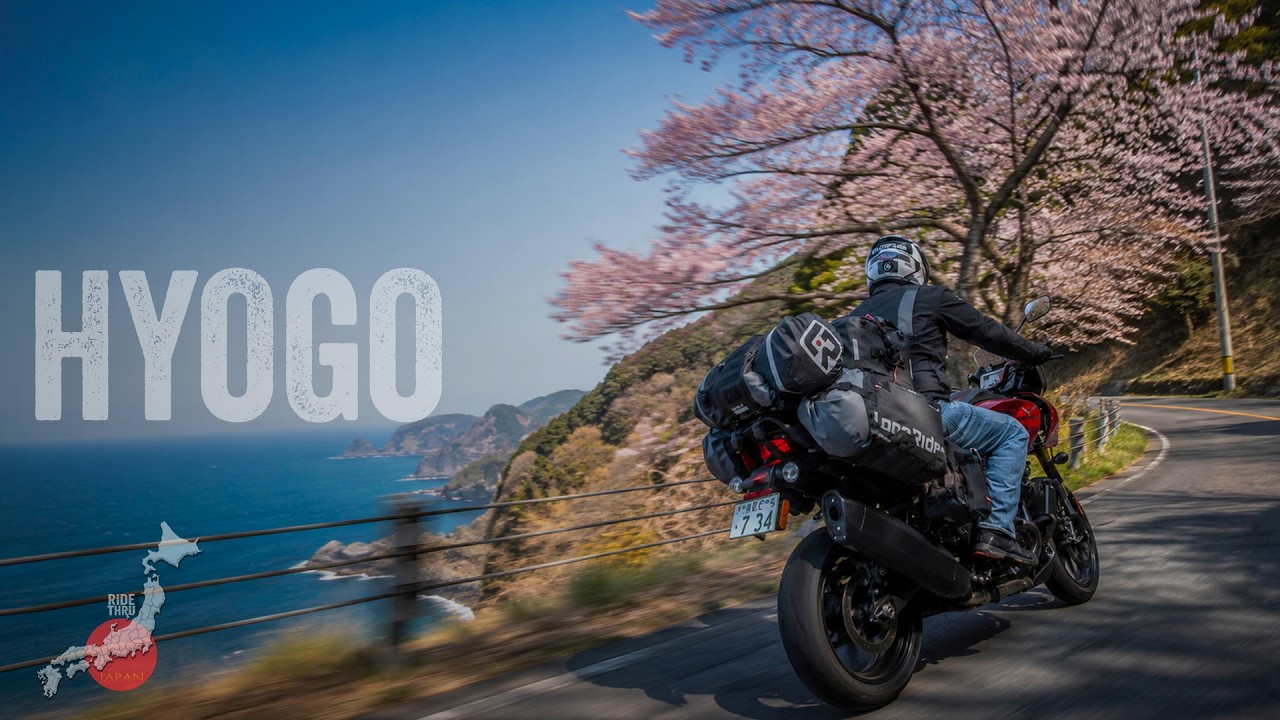
I Had to Make It Across
Hyogo was supposed to be a crossing.
After leaving Tottori, the plan looked simple enough: enter Hyogo from the north, ride the coast above the Sea of Japan, cut south through the mountains, reach the Kobe side of the prefecture, and keep moving toward Osaka.
But the road had other ideas.
This episode of Project 47 follows a solo motorcycle journey through Hyogo Prefecture, Japan — from one of the most unexpected coastal roads of the entire trip to closed access, rough mountain routes, fading daylight, an uneven campsite, Kobe, Kawasaki Good Times World, and one final climb over Mount Rokko before dropping toward the concrete sprawl of Osaka.
This is not a Hyogo travel guide.
It is a motorcycle travel film about distance, decisions, failed plans, and the pressure of trying to make it across a prefecture before the day runs out.
A Solo Motorcycle Journey Across Hyogo, Japan
Hyogo is a prefecture that stretches across more than one version of Japan.
In the north, it touches the Sea of Japan, where the coast feels open, rugged, and far from the city. In the middle, the land rises into mountains, small towns, river valleys, and roads that look promising on a map but do not always ride the way you expect. In the south, everything changes again as the route moves toward Kobe, Osaka, and the huge urban belt that dominates this part of the country.
For a solo motorcycle journey, that made Hyogo feel less like a simple episode and more like a crossing.
North to south.
Sea to mountains.
Mountains to city.
Empty coast to concrete.
The distance was not huge compared to some parts of Project 47, but the pressure was real. I had a lot of ground to cover, daylight was limited, and the only campsite that made sense was all the way down near the south coast.
So the goal became simple.
Make it across.
Leaving Tottori
After Tottori, the north looked wide open.
The road carried me east toward Hyogo, and almost immediately the tone changed. The Sea of Japan came into view, the coastline opened up, and the ride stopped feeling like a simple transfer between prefectures.
Then Route 11 happened.
I expected a nice coastal road.
What I got was one of the best motorcycle roads I had ridden in Japan so far.
The route twisted above the sea, climbing along cliffs, opening toward the water, diving into corners, and giving view after view after view. It was the kind of road that makes it almost impossible to speak normally inside a helmet. Everything becomes “wow,” because there is not much else to say.
The coastline was beautiful. The rocks were dramatic. The beach appeared below. The road kept climbing, turning, and revealing more.
This was the road I did not see coming.
The Road I Didn’t See Coming
Route 11 on the north coast of Hyogo became one of those rare sections where the ride itself completely takes over the episode.
It was not about a landmark. It was not about a famous destination. It was not something I had built the whole day around.
It was just the road.
And that is the best part of solo motorcycle travel in Japan when it works.
The map gives you a line. The road gives you an experience.
This one was exceptional — cliffside corners, ocean views, rocky coastline, elevation, and that perfect combination of beauty and focus that makes motorcycle travel feel different from any other kind of travel.
You cannot just look at the scenery. You have to ride it.
You have to manage the corners, read the road, stay aware of traffic, and still find the space to take in the fact that you are riding above the Sea of Japan on a road that feels like it was built for this exact moment.
For a while, Hyogo felt like it might become one of the great riding prefectures of Project 47.
Then, as usual, the plan started to slip.
Closed Access
The first stop after the coastal ride was a basalt cave area.
It looked promising. The setting was beautiful, with cherry blossoms near the river and a landscape that felt like it should have been worth exploring properly.
But rockfall had changed the plan.
Access was limited. Parts of the area were closed. I could see some of it, but not all of it.
That became the first small reminder that Hyogo was not going to be a clean route from one planned stop to the next.
On a motorcycle journey, closed access is more than a minor inconvenience. It changes the rhythm of the day. Every stop takes time. Every detour costs daylight. Every decision matters more when you still have hours of riding ahead and no guaranteed place to sleep.
So I did what the road often forces you to do.
I took in what I could, got back on the bike, and kept moving.
Crowds and a Change of Plan
From there, I aimed toward a town further south that looked like it might be worth a proper stop.
Izushi has an old-town feel and a well-known clock tower, the Shinkoro. On another day, it might have been a place to park the bike, walk slowly, and let the camera linger.
But when I arrived, it was packed.
Too many tourists. Too much crowd energy. Too much time required for a day that still had a long way to go.
So I rode through instead.
That is one of the less romantic parts of making a solo motorcycle documentary. You cannot stop everywhere. You cannot chase every interesting place. You have to choose what serves the ride, what serves the day, and what keeps you safe.
Hyogo was no longer just a list of possible stops.
It was becoming a crossing.
And I still had to get south.
Mountain Roads and Shifting Plans
Most of the middle of Hyogo is mountains and small towns.
On the map, that looked promising. After the coastal road had delivered so strongly, I was hoping the mountain section would keep the momentum going.
It did not exactly work out that way.
Some of the roads were beautiful. The rivers were gorgeous. The valleys had that fresh, fast-flowing mountain smell that makes you want to stop and just stand there for a while.
But the roads themselves were rough in places, broken by snow damage, uneven surfaces, and speed bumps that seemed to appear right where a motorcycle rider least wants them.
Route 11 on the coast had been one of my favorite roads of the journey.
Some of the mountain roads that followed were closer to the opposite.
That contrast became part of Hyogo’s character.
A prefecture that gave me some of the best riding of the trip in the morning, then made me work through rough, frustrating roads in the afternoon.
Still, the scenery kept pulling me forward.
And there was one specific kind of road feature I had been chasing for a long time.
Denied Again
I have always wanted to ride through one of those natural-looking tunnels carved straight out of the mountainside.
You see them in photos and videos sometimes — roads cut through rock, rough openings, a motorcycle passing through something that feels half road and half cave.
I had tried to reach places like that before.
Twice, I had been denied.
This time, in Hyogo, I thought I had finally found one I could ride through.
The approach was beautiful. The river nearby was stunning. The road had the right feeling. Everything suggested this might finally be the one.
Then I got there.
Closed again.
Three times denied.
I could see it. I could stand near it. I could appreciate the place. But I could not ride through the road I had come for.
That was frustrating, but also perfectly in line with the day.
Hyogo was giving me beauty and blocking the plan at the same time.
Pushing South Before Dark
At that point, the ride became more practical.
I had to get to the campsite.
The map said it was still about an hour away, but there were two problems. First, Google Maps suggested the campsite might be closed. Second, it was a free campsite near the ocean and not too far from the city, on a weekend.
That meant there was a very real chance it would be full.
The sun was dropping. The road was small. Falling rock signs appeared. Glare cut across the road. The day started to feel less like exploration and more like a push to make the south coast before dark.
This is where solo motorcycle travel can become tense in a quiet way.
Nothing dramatic has to happen. You just start doing the math.
How much daylight is left?
How far to the campsite?
What happens if it is closed?
What happens if it is full?
How tired am I?
How much more riding can I do safely?
Those are the questions that shape a real motorcycle journey across Japan.
Not just where to go.
But whether you can make it.
Camp at the End of a Long Day
Eventually, I made it to the campsite.
It was open. Bikes were free. There was space.
That was the good news.
The less good news was the ground.
It was not exactly flat. Setting up the tent meant accepting that sleep might involve slowly sliding or rolling in one direction all night.
But after the day I had just ridden, it was enough.
That campsite became the end point of the crossing — not because it was perfect, but because it meant I had made it across the hardest part of the prefecture. From the Sea of Japan, along one of the best roads of the journey, through closed access, rough mountain routes, missed stops, and fading daylight, all the way down toward the south coast.
When you are riding alone, sometimes “good enough” is a victory.
A place to sleep. A bike parked safely. Gear unpacked. Tent up.
That is the win.
Morning Reset
The original thought was to stay at the campsite another night.
It was a nice little spot, and after a long day, the idea of not packing everything up again had obvious appeal.
But a lot of the places I wanted to visit in Kobe were closed the next day.
And after so much closed access already, I was done with things being closed.
So the decision was made.
Pack up. Load the motorcycle. Head into Kobe. Then continue toward Osaka.
The morning routine was familiar by then — break camp, haul gear, pack bags, load the bike, make sure everything is secure, and prepare to leave the quiet behind.
That is one of the realities of traveling solo by motorcycle in Japan.
Every movement takes effort.
A hotel would be easier.
But the road does not always become memorable because it is easy.
Riding Into Kobe
The ride into Kobe was the next shift in Hyogo.
After the north coast, the mountains, the rivers, and the campsite, the prefecture changed into something urban and industrial. Traffic built up. Buildings grew taller. The concrete started to take over.
I was headed to Kawasaki Good Times World for a quick stop.
I had a hotel booked in Osaka that night, so I could not spend the whole day in Kobe. Himeji Castle would have been packed on a Sunday, and I did not want to lose hours in crowds.
The museum made sense.
It was focused, interesting, and still connected to motorcycles without turning the episode into a bike review.
And honestly, I had always thought of Kawasaki mostly as motorcycles and maybe jet skis.
I was wrong.
More Than a Motorcycle Name
Kawasaki Good Times World turned out to be much broader than I expected.
Aircraft. Ships. Submarines. Tunneling machines. Motorcycles. Engineering history. Industrial history. Racing history. All of it sitting together in one place.
It was a reminder that Kawasaki is not just a motorcycle badge.
It is a massive engineering company whose story reaches far beyond the bikes most riders know.
Of course, the motorcycles were still the part that pulled me in hardest.
Old race bikes. The Mach IV 750 “Widowmaker.” The ZXR750 that brought back childhood memories. The kind of machines that made you imagine what it must have felt like to ride them when they were new, raw, fast, and probably terrifying.
Then there was the Corleo concept — Kawasaki’s robotic, rideable, horse-dog-looking machine that seemed so strange I had assumed it was probably AI when I first saw it online.
But there it was.
Real.
Would it replace a motorcycle? Absolutely not.
Would I try it? Probably.
Would I be terrified the whole time? Also probably.
One Final Climb
After the museum, there was still one road I wanted to ride before leaving Hyogo.
Mount Rokko.
Someone from the channel had recommended it, and after a long day of city edges, museum walking, and the push toward Osaka, I wanted one final climb before dropping into the concrete.
The road up Mount Rokko was exactly what I needed.
I was tired, so I was not there to attack it. But the road had that feeling — curves, elevation, a sense of escape from the city below, and the satisfaction of ending the prefecture with the motorcycle doing what it came to do.
Climb.
Turn.
Breathe.
After everything Hyogo had thrown at me, Mount Rokko felt like a final reward.
Not a huge dramatic ending.
Just the right road at the right time.
Looking Out Over Osaka
At the top, the view opened over the massive concrete jungle of Osaka.
That was the end of Hyogo.
North coast. Sea cliffs. Route 11. Closed access. Crowds. Rough mountain roads. A campsite by the south coast. Kobe. Kawasaki. Mount Rokko. And finally, the city waiting below.
Hyogo had been awesome, strange, frustrating, tiring, and unexpectedly good.
Some parts of it were among the best riding I had done in Japan. Other parts were rough, blocked, or exhausting. But taken together, it became exactly what Project 47 is supposed to be.
Not a perfect itinerary.
A real crossing.
One rider. One motorcycle. One prefecture at a time.
And now, it was time to head down the mountain into Osaka.
Watch the Full Hyogo Motorcycle Travel Film
I Had to Make It Across | Solo Motorcycle Journey is part of Project 47, a long-form motorcycle travel documentary series following one rider across all 47 prefectures of Japan.
This episode is for riders, travelers, and anyone who understands that the best parts of a motorcycle journey often arrive after the plan has already started to fall apart.
Watch the full Project 47 series:
https://www.youtube.com/playlist?list=PLbArCx0u7LtjYBwxR-rRE5GNXNUOzTTdX
Follow the journey on Instagram:
https://www.instagram.com/RideThruJapan/
Support the ride:
https://ridethrujapan.com/support/
About Project 47
Project 47 is a solo motorcycle travel documentary series across Japan.
The goal is simple: ride through all 47 prefectures, not as a checklist, but as a long-form journey through the roads, landscapes, people, and quiet moments that make Japan feel endless again.
One rider. One motorcycle. Forty-seven prefectures.
This is Japan by motorcycle.