One Prefecture, Endless Surprises
Tottori did not reveal itself in one clean way.
It came in pieces.
A strange bridge that looked more dramatic online than it felt in real life. A fishing town full of yokai statues. A fish market that only worked because someone said yes. A campsite on an island that meant carrying all my gear across a bridge by hand. A windy morning. A desert-like landscape beside the Sea of Japan. A museum filled with samurai armor. A closed ramen shop. Then another one that saved the night.
This episode of Project 47 follows a solo motorcycle journey through Tottori Prefecture, Japan — riding alone along the Sea of Japan through coastal wind, small towns, unexpected detours, and one of the strangest landscapes of the entire journey.
This is not a Tottori travel guide.
It is a motorcycle travel film about staying open to the road, even when the prefecture refuses to become what you expected.
A Solo Motorcycle Journey Through Tottori, Japan
Tottori began differently from the way I first imagined it.
After leaving Okayama, I stopped in Matsue in Shimane to spend time with my wife, my dog, and family. That meant I entered Tottori from the west instead of riding straight up from the south.
That turned out to be a good thing.
The route brought me toward one of those bridges you have probably seen online — the one that looks almost vertical in photos, like a rollercoaster dropped into the middle of Japan. Riding it in real life was the perfect opening to Tottori, because it immediately reminded me of something important.
The road is often more honest than the internet.
Yes, the bridge has a strange shape. Yes, it rises sharply enough to feel unusual. But it is not the warped, impossible thing you see in reposted photos. It is a cool bridge with a good view, not a stunt ramp.
And with that reality check, I crossed into Tottori Prefecture.
Number sixteen of Project 47.
The prefectures were starting to fall behind me fast.
The Bridge Reality
That bridge crossing became the first surprise of Tottori.
Not because it was disappointing, exactly. More because it showed the difference between seeing a place online and riding it yourself.
A photo can make something look extreme. A social media post can turn a normal place into a myth. But when you ride there on a motorcycle, you get the truth of it — the wind, the grade, the road surface, the traffic, the view, and the feeling of the bike underneath you.
That is why I keep coming back to Japan by motorcycle.
You cannot fully understand these places from a list or a feed. You have to go there. You have to ride across the bridge, feel it for yourself, and then decide what it actually is.
In this case, it was not the wild vertical road the internet promised.
But it was still a memorable way to arrive in Tottori.
A Strange Town by the Sea
From the bridge, I rode into Sakaiminato, a fishing port town on the western side of Tottori.
The area is known for seafood, especially when crab season is on, but before heading to the market, I stopped in a part of town dedicated to the work of Shigeru Mizuki and GeGeGe no Kitaro.
It was one of the strangest and coolest town walks of the journey so far.
The street is lined with yokai statues — spirits, ghosts, creatures, and strange figures from Japanese folklore. They are not horror in the usual sense. They feel more like old stories that never quite disappeared.
Hundreds of them watch from the roadside, hide beside the path, or appear in little corners as you walk through town.
You do not rush a place like that.
You drift through it.
That is what made Sakaiminato work so well in a solo motorcycle documentary. It was not a big dramatic destination. It was a mood. A strange little pocket of Japan by the sea, full of character and atmosphere.
And, naturally, there was ice cream.
Because in Japan, if a town has a theme, there is usually somewhere to buy themed ice cream.
First Drop of the Bike
Not every surprise in Tottori was scenic.
While getting ready to leave Sakaiminato, the sidestand slipped backward and the bike went down.
At exactly zero kilometers per hour.
That was the first time I had dropped the Pan America ST on this journey, and of course it happened in the least heroic way possible — not on a mountain road, not in bad weather, not during some dramatic off-road section, but in a parking lot.
The good news was that the bike was fine.
The luggage and crash protection did their job. There was barely a mark. Mostly, it was just embarrassing.
But that is part of solo motorcycle travel too.
When you are alone, everything is on you. The riding, the filming, the navigation, the packing, the parking, the mistakes, and the recovery. No crew. No backup vehicle. No one to help you lift the bike unless a stranger happens to be nearby.
Just you and the road.
And sometimes, you get your workout in before lunch.
A Fish Market Stop
After that little parking lot incident, I headed to the fish market.
The previous fish market stop in Okayama had been underwhelming, so I was hoping Tottori would do better. When I arrived, I noticed a sign saying no filming, so I asked for permission.
That could have been the end of it.
Instead, a kind woman called the office, checked for me, and made it happen.
That small yes changed the whole stop.
Inside, the market was full of seafood — crabs, shrimp, and all the things that make this part of Japan such a good place for people who are not traveling by motorcycle and therefore can actually buy half the things they want to eat.
That is one of the funny limitations of motorcycle travel.
You can reach amazing places, but you cannot always carry what you find.
Still, the stop worked. It gave the morning another unexpected turn and reminded me again that so much of this journey depends on small human moments.
Someone says yes.
The day opens up.
Coastal Riding Beneath Mount Daisen
After the fish market, I followed the coast with Mount Daisen in the distance.
The original plan had been to head inland toward Nageire-do, a temple built high into a cave in the mountains. But after calling ahead, I found out that hiking up solo was not allowed.
With wind picking up along the coast and snow still sitting on the mountains, forcing that plan did not make sense.
So I stayed by the sea.
That is one of the constant negotiations of a long solo motorcycle journey through Japan. There is the route you imagine, the route the map suggests, and the route that actually makes sense once weather, time, fatigue, and safety enter the conversation.
Tottori was already becoming a chapter of adjustments.
Not failure.
Adjustment.
The ride continued because the ride always continues.
An Unexpected Stop Inland
My next stop was the Mukibanda Yayoi remains.
It was not a place I expected to become one of the more memorable parts of the day, but then I met Maeda-san.
He was in his 80s and full of energy, walking me through the old houses and explaining the history of the site. More than two thousand years ago, this hillside was a working community, with homes, storage buildings, and daily life spread across the land.
Most of what once stood there is gone, but enough remains to imagine it.
That is what made the stop interesting. It was not just ruins. It was a place where someone took the time to help me see what had been there before.
These are the moments that make Project 47 more than a ride across a map.
A solo motorcycle journey is never just about roads. It is also about the people who step into the story for a few minutes and change how you see the place.
Maeda-san did that.
Island Camp Setup
From there, I headed for Aoshima Camping Ground.
Normally, you have to book several days in advance, even though the campsite is free. I called anyway and got lucky. The woman on the phone was kind enough to fit me in.
There was only one catch.
The campsite was on an island, and I could not ride the motorcycle onto it.
That meant unloading the bike and carrying everything across the bridge by hand. Tent, sleeping gear, camera gear, clothes, batteries, hard drives — all the stuff that makes the road possible but also makes the road a lot heavier.
It was not ideal.
But when I got there, the campsite was beautiful.
The tent went up, the island sat quiet in the water, and sunrise looked like it would come in perfectly the next morning.
It was one of those campsites where the inconvenience becomes part of the memory.
Life on the Road
After the bike is parked and the tent is set up, the work does not stop.
That is one of the things people do not always see in a motorcycle travel film.
At night, I am not just sitting around enjoying the end of the day. I am copying footage to hard drives, charging batteries, checking files, managing cameras, and editing whatever I have the energy to edit before sleep catches up with me.
That is life on the road during Project 47.
Ride all day. Film all day. Set up camp. Back up footage. Edit. Sleep. Pack everything again. Repeat.
It does not suck.
But it is not a holiday.
Tottori’s island camp made that rhythm clear. The road had brought me to a beautiful place, but the work of the journey came with me.
Early Morning in the Wind
The morning started at 5:00 a.m.
I was tired. Some campers had arrived late at night and made enough noise to cut my sleep in half. The wind was already picking up, and the forecast was calling for stronger gusts later in the day.
That meant one thing.
Pack up early and move.
Wind matters on a motorcycle, especially when you are carrying luggage and riding along exposed coastal roads. It changes the whole feeling of the day. You start thinking about bridges, open stretches, storms, and how far you can safely push before the weather becomes the main character.
So I packed the tent, carried everything back across the bridge, loaded the bike, and left the island behind.
The plan for the morning was simple.
Go check out a desert.
Japan’s Most Unexpected Landscape
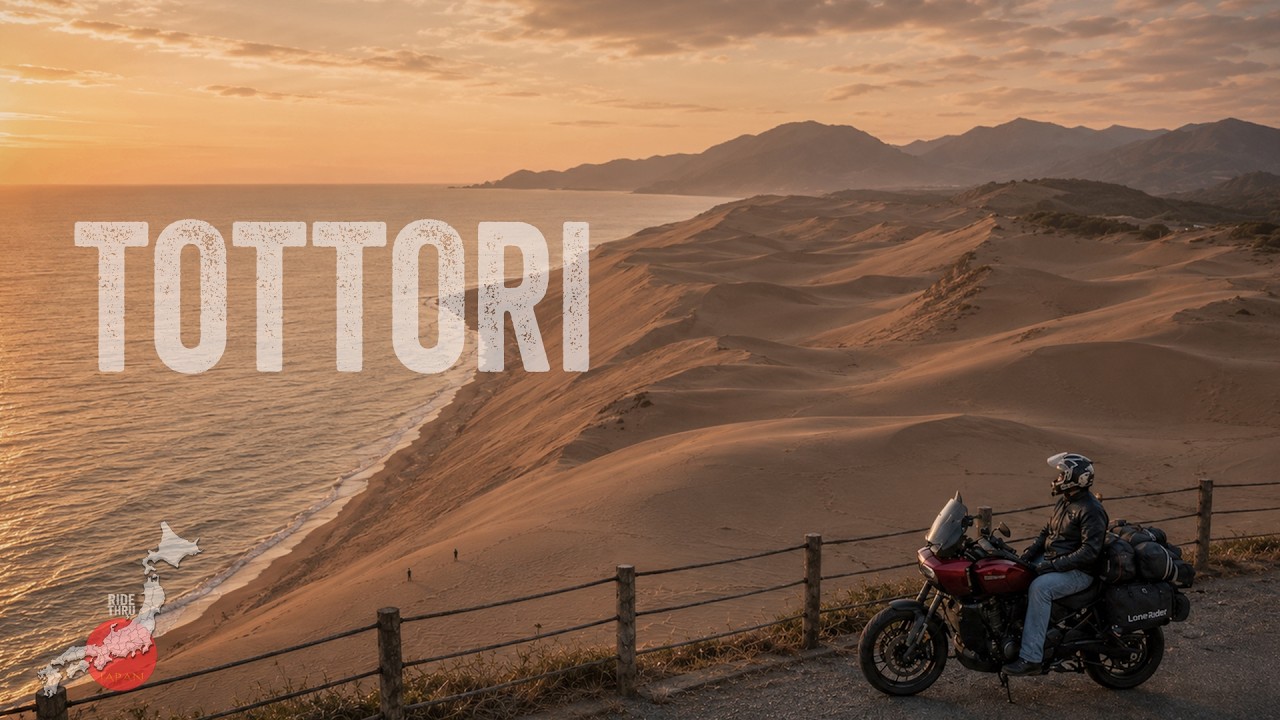
The Tottori Sand Dunes are one of the strangest landscapes I have seen on this journey.
After so many mountains, towns, coast roads, shrines, campsites, and fishing ports, suddenly there was sand stretching beside the Sea of Japan, shaped by wind and weather into something that felt completely different from the rest of the ride.
It was windy when I got there.
Very windy.
The kind of wind that tries to steal your hat and makes every step feel slightly ridiculous. But that almost made the place better. The dunes are shaped by the wind, so experiencing them in calm weather would almost feel like missing the point.
This was not the Japan most people picture.
And that is exactly why it worked.
Tottori had already been strange, but the dunes gave the episode its most unexpected landscape.
A reminder that even after years in Japan, the country can still surprise me.
Riding for the Sake of Riding
After the dunes, I went for a ride.
Not because I had a major destination. Not because the map demanded it. Because I wanted to ride.
Up to that point, Tottori had given me a lot of interesting stops, but not many roads that felt properly fun. With bad weather coming in later and a hotel already booked, I had a small window to make some corners before the day closed in.
So I took it.
The road finally opened up. The corners came. The view appeared. The motorcycle felt alive again.
That is the part of solo motorcycle travel that is hard to explain to anyone who only thinks in destinations.
Sometimes the ride itself is the reason.
Not the museum. Not the market. Not the campsite. Not the dunes.
Just the road, the bike, the corners, the view, and that feeling when the day finally gives you the kind of riding you were hoping for.
Tottori needed that moment.
So did I.
One More Strange Detour
With time before check-in, I stopped at the Watanabe Art Museum.
It turned out to be far more interesting than expected.
The museum was filled with samurai armor, swords, firearms, and historical pieces displayed in a way that felt unusually close and immediate. Some things were behind glass, but others felt right there in front of you, which gave the whole place a different energy from a typical museum.
It also pushed against the overly romantic version of samurai history.
The samurai were not above using firearms. They were a warrior class, and when firearms became effective, they used them. Seeing those weapons up close made that history feel more practical, more real, and more human.
Then, outside, the museum manager came out to look at the motorcycle.
He was a Kawasaki rider.
That turned the stop into another road moment. It does not matter where you go in Japan — if someone loves bikes, the conversation starts immediately.
Different prefecture. Different background. Same language.
Motorcycles.
Closed Doors and a Second Chance
The final mission of the day was simple: ramen.
I found a place near the hotel that looked good, dropped my gear, and walked over hungry.
Closed.
Of course.
That had been the rhythm of Tottori all along. Plans half-working. Doors closing. Unexpected turns. Things refusing to line up cleanly.
But this time there was another ramen shop nearby.
Ramen Homura.
That second chance saved the night. Cold beer, great ramen, good people, and exactly the kind of simple meal you want after a long day of wind, riding, filming, walking, packing, and moving.
Sometimes that is all it takes to turn the end of a day around.
A bowl of ramen. A cold beer. A warm room. A place to sleep.
Call it a win.
The Road Toward Hyogo
By the end of Tottori, I still was not sure I could describe the prefecture in one clean way.
And maybe that was the point.
It was coastal and strange. Windy and quiet. Underwhelming in places, then suddenly beautiful. Full of small surprises that did not always connect until later.
A bridge that corrected the internet. A town full of yokai. A fish market that opened because someone helped. An old village site brought to life by Maeda-san. Island camping. An early morning in the wind. Sand dunes beside the sea. A road that finally delivered. A museum full of armor and motorcycles in the parking lot. A closed ramen shop, then a better one nearby.
Tottori did not become one simple thing.
It became the rhythm of the road itself.
Keep moving. Stay open. Let the ride become whatever it becomes.
That is solo motorcycle travel.
And that is why Project 47 keeps going.
Watch the Full Tottori Motorcycle Travel Film
One Prefecture, Endless Surprises | Solo Motorcycle Journey is part of Project 47, a long-form motorcycle travel documentary series following one rider across all 47 prefectures of Japan.
This episode is for riders, travelers, and anyone drawn to the unexpected side of the road — the strange towns, windy campsites, missed plans, roadside conversations, and landscapes that make riding alone through Japan feel alive.
Watch the full Project 47 series:
https://www.youtube.com/playlist?list=PLbArCx0u7LtjYBwxR-rRE5GNXNUOzTTdX
Follow the journey on Instagram:
https://www.instagram.com/RideThruJapan/
Support the ride:
https://ridethrujapan.com/support/
About Project 47
Project 47 is a solo motorcycle travel documentary series across Japan.
The goal is simple: ride through all 47 prefectures, not as a checklist, but as a long-form journey through the roads, landscapes, people, and quiet moments that make Japan feel endless again.
One rider. One motorcycle. Forty-seven prefectures.
This is Japan by motorcycle.