The Japan I Was Searching For
Okayama began with wind.
After finishing the Shikoku section of Project 47, I crossed the Seto Ohashi Bridge back toward Honshu, fighting brutal crosswinds over the Inland Sea and carrying the fatigue of the previous prefectures with me.
By that point in the journey, I did not need another big destination.
I needed a reset.
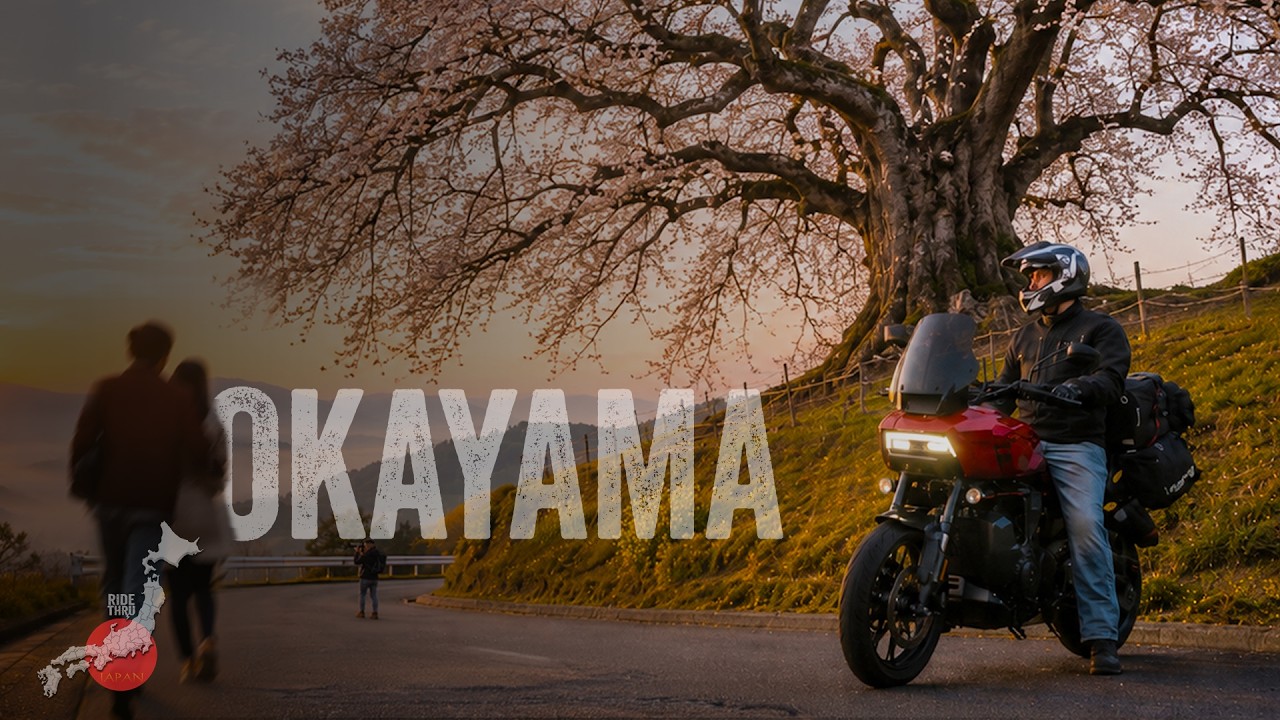
This episode follows a solo motorcycle journey through Okayama Prefecture, Japan — from the exposed bridge crossing out of Shikoku into city streets, quiet historical towns, coastal roads, mountain routes, and finally toward one of the most beautiful cherry blossom trees I have ever seen.
This is not an Okayama travel guide.
It is a motorcycle travel film about slowing down, finding momentum again, and letting the road reveal the version of Japan I had been searching for.
A Solo Motorcycle Journey Through Okayama, Japan
Okayama became the bridge between two different parts of Project 47.
Behind me was Shikoku — storms in Ehime, beautiful roads in Kochi, the remote mountain pressure of Tokushima, and the frustration of Kagawa. Ahead of me were the mountains of the Chugoku region and the road north toward Tottori.
But before any of that, I needed to stop.
Solo motorcycle travel is often shown as constant movement. Endless roads. Perfect views. One destination after another. But the reality is different. When you are riding alone, filming alone, navigating alone, and trying to build a long-form motorcycle documentary at the same time, the trip does not stop just because the bike is parked.
There is gear to sort. Footage to manage. Batteries to charge. Plans to remake. Weather to watch. Fatigue to deal with.
Okayama started as that kind of pause.
And then, slowly, it became one of those prefectures that surprised me.
Not with one dramatic moment, but with rhythm.
Crossing Back to Honshu
The wind hit hard the moment I got out onto the Seto Ohashi Bridge.
This was the crossing back to Honshu after finishing the Shikoku section of the journey, and it was not a relaxing one. The bridge stretched out over the Seto Inland Sea, the motorcycle leaned into the crosswind, and all I wanted was to get to the other side.
That crossing set the tone for the beginning of Okayama.
Not excitement. Not cinematic calm.
Just the physical reality of being out there alone on a motorcycle, exposed to the weather, carrying everything, and trying to keep the journey moving.
Once I made it across, I grabbed supplies, found a place to stay for a couple of nights, and let Okayama become what I needed most at that point.
A reset.
Back on the Road
After a couple of days off the bike, the storm had passed.
The gear went back onto the motorcycle. The bags were loaded. The route started to take shape again.
I knew the first day in Okayama would involve a lot of towns and city riding, which can be one of the harder parts of a motorcycle journey through Japan. It is not always dramatic. It is not always beautiful. Sometimes you are moving through traffic, searching for parking, getting through stretches of road that are necessary rather than inspiring.
But even that is part of the journey.
Project 47 is not just about the perfect roads. It is about crossing every prefecture by motorcycle and taking each one as it comes.
Okayama’s first answer was Kurashiki.
Kurashiki Between Rides
I headed first toward Kurashiki Denim Street, then into the old historical quarter nearby.
Finding motorcycle parking was its own little mission, but once the bike was sorted, the town opened up in a way I did not expect. Kurashiki was bigger than the usual preserved street or small historical district. It had canals, old buildings, narrow lanes, and enough space to get lost for a while.
That quiet walk mattered.
After so many days focused on riding, weather, campsites, fuel, and timing, Kurashiki gave the episode a different pace. It was not the main subject of the journey, but it became part of the reset. A chance to step off the bike, walk slowly, and let the place exist without forcing it into a route.
There are plenty of beautiful towns in Japan, but experiencing them during a solo motorcycle trip feels different.
You do not arrive as a tourist with a clean schedule.
You arrive tired, carrying the road with you.
The Reality of Distance
After Kurashiki, the route pushed me onto Route 2.
And Route 2 is exactly the kind of road that reminds you not every kilometer in Japan by motorcycle is magical.
It is useful. It gets you through Okayama and across the country. But as a riding experience, it is long, busy, flat, and draining. The kind of road that can dull your senses if you stay on it too long.
That is part of the reality of long-distance motorcycle travel in Japan.
The great roads are out there, but you often have to earn them. You have to get through city stretches, industrial zones, bypass roads, traffic lights, and the practical parts of the map before the country opens up again.
Route 2 was one of those stretches.
A road to get through.
Not a road to remember.
An Unexpected Stop
From there, I made my way to the Bizen Osafune Japanese Sword Museum.
It was not the kind of stop I usually build a motorcycle episode around, but it fit Okayama in a surprising way. This area has a long tradition of sword-making, and the museum gave the day a deeper sense of craft, patience, and continuity.
That was something Okayama started to do well.
It did not overwhelm me with dramatic landscapes right away. It revealed itself in smaller pieces — an old town, a working craft, a quiet road, a coastal stay, a mountain village.
The ride still had not fully opened up yet, but the shape of the prefecture was starting to change.
I had tried to find campsites by the ocean, but most of them were expensive glamping setups. In the end, it was cheaper to book a room by the water at a place called the English Club.
That changed the plan again.
And for once, the change worked.
Coastal Stay and a New Plan
The road to the coast felt good.
After the city riding and the flat sections of Route 2, the motorcycle finally had room to breathe again. The RevMax engine came alive, the scenery softened, and Okayama started to feel less like a reset and more like a ride.
The place I stayed was simple, right on the water, and exactly what I needed.
A room. A meal. A chance to sleep. A new plan for the morning.
The idea was to check out a nearby fish market, grab a proper seafood breakfast, then ride north into the mountains for what looked like it might become a serious riding day.
Sometimes the best motorcycle travel plans are the simple ones.
Sleep. Eat. Ride.
Of course, even that did not go exactly to plan.
When the Morning Plan Falls Flat
The next morning was beautiful.
The fish market was not.
I went looking for a proper seafood breakfast and found the place half asleep. Sometimes you hit the perfect local stop. Sometimes you get there and there is not much happening.
That is the thing about filming a real solo motorcycle journey. You cannot make every stop work. You cannot script the road into giving you the perfect scene. Sometimes a place is underwhelming, and the only honest thing to do is move on.
So that is what I did.
I left the coast behind and turned toward the mountains.
That is where Okayama finally became the ride I had been looking for.
Into the Mountains of Okayama
The road changed almost immediately.
The towns thinned out. The corners started coming. The bike felt alive again. After the reset, the bridge wind, the city riding, the dull stretches, and the failed fish market plan, the mountains gave the episode a pulse.
This was the Japan I was searching for.
Not because it was famous.
Because it felt open, alive, and made for the kind of solo motorcycle travel that keeps me doing this journey.
The road twisted up through the hills, the weather started to lift, and suddenly Okayama stopped feeling like a transition between Shikoku and Tottori. It became its own chapter.
The kind of day where the riding itself is enough.
But there was still somewhere I wanted to reach.
Fukiya Furusato Village
Tucked away in the mountains is Fukiya Furusato Village, a place I had wanted to visit for a long time.
The village is known for its deep red buildings, colored with locally produced bengara pigment, but what made it stand out was not just the color or preservation. It was the fact that it still felt lived in.
This was not just a display.
People actually live there. Laundry hung outside. The buildings had texture and age. The rooms were ornate but understated, with small details that made you slow down and look properly.
That is one of the rewards of traveling Japan by motorcycle.
You can reach places that do not always sit at the center of the usual route. You can ride into the mountains, find a village that feels like it has been holding onto time, park the bike, and walk through quietly.
Fukiya gave Okayama a different kind of beauty.
Not dramatic. Not loud.
Just deep, old, and calm.
Choosing the Next Road
By the time I left Fukiya, the day was running out.
I had a familiar problem: too many places I wanted to see and not enough daylight to do them all safely.
That is one of my worst habits on this trip. I want to chase everything. Another road. Another village. Another viewpoint. Another tree. Another stop that might become the defining moment of the episode.
But riding tired into the middle of nowhere at night is not worth it.
So I had to choose.
There was a giant cherry blossom tree nearby, and it was in the direction I was already traveling.
That made the decision.
I pointed the bike toward Daigo Sakura.
Daigo Sakura
Getting to Daigo Sakura was not completely straightforward, but eventually I found my way there.
And then there it was.
A single cherry blossom tree, estimated to be around a thousand years old, standing alone in the landscape.
Some places do not need much explanation.
You arrive, you see them, and the ride suddenly makes sense.
After days of shifting plans, crosswinds, city roads, underwhelming stops, and constant decision-making, Daigo Sakura gave Okayama the quiet ending it needed.
It was not a loud payoff. It was not the kind of destination that turns the whole episode into a travel guide.
It was simply a place worth reaching.
And sometimes, on a solo motorcycle journey, that is enough.
Letting Go of the Plan
By the time I left Daigo Sakura, I knew I was not making it anywhere else.
So I stopped chasing the day.
That might have been the most important part of Okayama.
The road was good. The weather lifted. The bike felt right. The mountains carried me north. And instead of trying to force another stop or another scene, I just rode.
That is where the episode found its real meaning.
Okayama was not the biggest ride of Project 47. It was not the most dramatic. It did not hit me with the danger of Tokushima or the frustration of Kagawa. But it gave me something I needed just as much.
A reset.
A reminder that the road does not always have to be forced.
Sometimes the best thing you can do is let go of the plan and keep moving.
The Road Toward Tottori
At the end of the day, I crossed into Tottori Prefecture.
Okayama was behind me, but it had done its job.
It brought me back from the edge of Shikoku, gave me time to reset, moved me through towns and coast roads, then opened into the mountains and sent me north with the journey feeling alive again.
That is what made it special.
It was the bridge between two parts of the ride.
The end of Shikoku behind me. The Chugoku mountains ahead. One rider, one motorcycle, and the road continuing into the next prefecture.
Okayama gave me the Japan I was searching for.
Not all at once.
But eventually.
Watch the Full Okayama Motorcycle Travel Film
The Japan I Was Searching For | Solo Motorcycle Journey is part of Project 47, a long-form motorcycle travel documentary series following one rider across all 47 prefectures of Japan.
This episode is for riders, travelers, and anyone drawn to the quieter rhythm of the road — the resets, the missed plans, the mountain routes, and the unexpected moments that make a solo motorcycle journey through Japan feel real.
Watch the full Project 47 series:
https://www.youtube.com/playlist?list=PLbArCx0u7LtjYBwxR-rRE5GNXNUOzTTdX
Follow the journey on Instagram:
https://www.instagram.com/RideThruJapan/
Support the ride:
https://ridethrujapan.com/support/
About Project 47
Project 47 is a solo motorcycle travel documentary series across Japan.
The goal is simple: ride through all 47 prefectures, not as a checklist, but as a long-form journey through the roads, landscapes, people, and quiet moments that make Japan feel endless again.
One rider. One motorcycle. Forty-seven prefectures.
This is Japan by motorcycle.