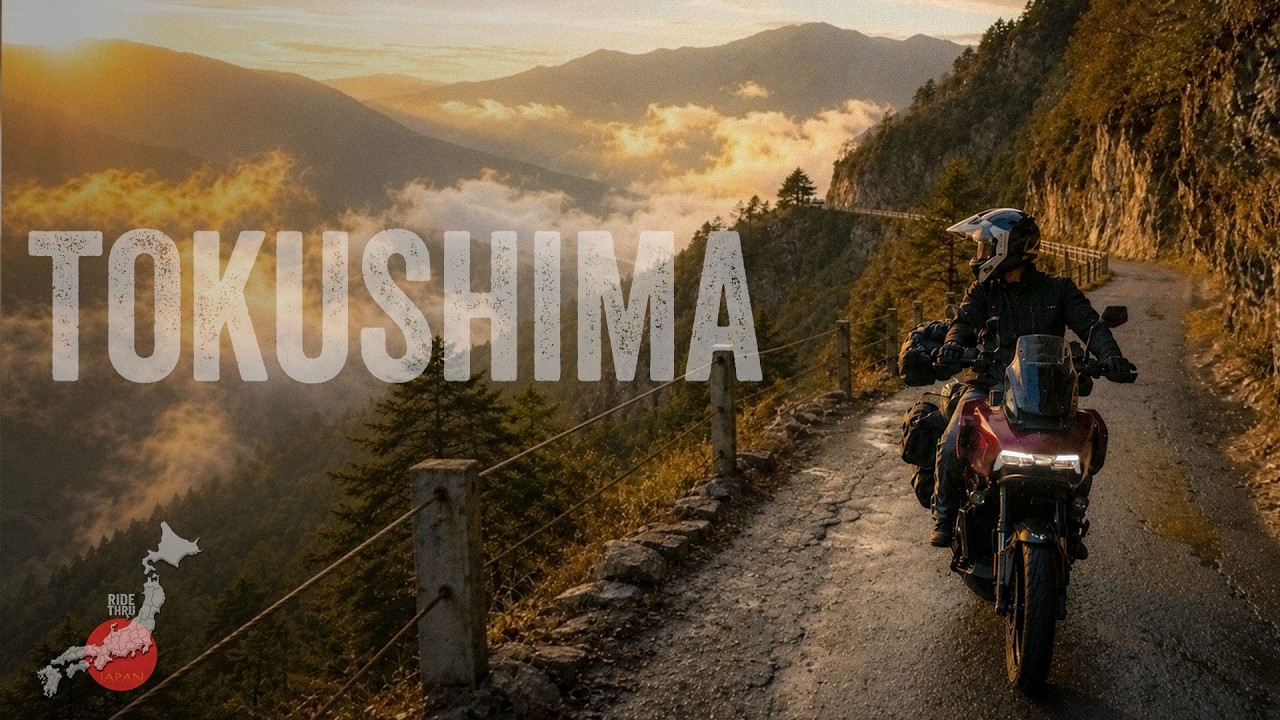
A Long Way From Anywhere
Tokushima was not the kind of ride that sold itself with big landmarks or easy answers.
It was quiet. Remote. Beautiful in places that felt almost forgotten. And for a while, riding alone through the mountains of Shikoku, it felt like I had taken the motorcycle a long way from anywhere.
This episode of Project 47 follows a solo motorcycle journey through Tokushima Prefecture, Japan — into narrow mountain roads, empty valleys, fuel anxiety, closed routes, coastal riding, and the kind of isolation that slowly changes the tone of a trip.
This is not a Tokushima travel guide.
It is a motorcycle travel film about what happens when the road gets smaller, the map stops feeling certain, and there is no one else around to help you decide what comes next.
A Solo Motorcycle Journey Through Tokushima, Japan
Tokushima sits on the eastern side of Shikoku, but this ride did not feel like a simple crossing of a prefecture.
From the first morning, the road pulled away from anything easy. The mountains rose up quickly. The valleys grew quieter. The route narrowed into technical corners, blind bends, rough surfaces, roadside waterfalls, and long stretches where the motorcycle became the only real thread connecting one place to the next.
On a map, Tokushima does not always look like an obvious destination.
From the saddle of a motorcycle, it becomes something else entirely.
The roads are tight, exposed, and demanding. They do not let you relax for long. Every mirror on a blind corner matters. Every patch of gravel matters. Every decision about fuel, distance, and direction starts to feel more serious than it would somewhere easier.
That is what made this ride different.
It was not about ticking off famous places. It was about crossing a part of Japan that felt remote, human, fragile, and strangely powerful.
Into the Mountains of Shikoku
The ride began in the mountains, where cherry blossoms, river valleys, and narrow roads gave Tokushima an almost perfect opening.
But the beauty came with tension.
The route climbed through tight mountain roads where every corner demanded attention. The kind of road that looks beautiful on camera but feels very different when you are riding it alone on a fully loaded motorcycle.
There were waterfalls beside the road. Deep valleys dropping away below. Blind corners with mirrors that became more useful than decoration. Small villages. Rental cars drifting toward the center of the road. Places where one mistake would matter.
That is one of the things I keep learning on this journey across Japan by motorcycle.
A place can be stunning and stressful at the same time.
Tokushima was both.
Iya Valley and the Feeling of Distance
The deeper I rode, the more Tokushima started to feel like a different Japan.
The Iya Valley is beautiful in the obvious sense — steep mountains, clear rivers, dramatic drops, and roads that seem carved into the side of the landscape. But what stayed with me was not just the view.
It was the feeling of being out there.
The statue of the Peeing Boy sits high above the valley, almost absurd against such a dramatic backdrop. The vine bridge nearby brings in the crowds for a moment. But away from those small pockets of attention, the valley quickly returns to quiet.
That contrast is what made the ride work.
One minute there were tourists. The next minute I was alone again, following a valley road deeper into the mountains, not fully sure where I would end up that night.
For a solo motorcycle documentary, that uncertainty is where the story really starts.
Nagoro Scarecrow Village
Further into the valley, I reached Nagoro Scarecrow Village.
It is one of those places that looks strange at first, almost surreal. Scarecrows sit where people used to be — in fields, by roads, near buildings, gathered like residents in a village that time has been slowly emptying out.
But the longer I stayed there, the less strange it felt.
It became sadder. More human.
A lot of the scarecrows are young families and children. That detail stayed with me. In a rural mountain village, the young are usually the first to leave. Then the older people remain. Then, eventually, even they are gone.
Nagoro is not just an unusual roadside stop. It is a quiet reminder of what is happening in parts of rural Japan.
And riding there by motorcycle made that feeling stronger.
You do not arrive sealed off behind glass. You feel the air, the valley, the silence, the road that brought you there. You sit in the shade, hear the river, and realize how beautiful the place is — and how empty it has become.
That was the first moment in Tokushima where the ride started to feel heavier.
Low Fuel, Closed Roads, and No Easy Way Out
After Nagoro, the plan was simple enough.
Head toward the coast. Find fuel. Find somewhere to sleep. Keep moving.
But solo motorcycle travel has a way of turning simple plans into problems.
Google Maps showed road closures ahead. I did not want to backtrack. My fuel was getting low. The route looked remote. And the further I rode, the more obvious it became that Tokushima was not the kind of place where you want to run out of petrol.
That was the tension of the first day.
Not drama for the sake of drama. Just the practical reality of riding alone through mountain Japan.
I had passed fuel earlier thinking there would be another chance. That is an easy mistake to make in Japan. The country is so developed in so many places that you start to assume convenience is always nearby. Another petrol station. Another convenience store. Another way out.
But in the mountains of Tokushima, that assumption starts to break down.
The road climbed. The surface got rougher. The corners kept coming. The fuel gauge became harder to ignore.
Then the route changed again.
A major section of road was closed for several more days. The plan was gone. I had to find another way, another campsite, another decision.
That is when the ride stopped feeling scenic and started feeling real.
The Kindness You Find on the Road
Eventually, I found fuel.
The station looked closed at first, which was exactly the kind of thing I did not need at that point in the day. But then the owner helped me out.
He apologized for the price of the fuel.
That moment hit harder than expected. Here was someone running a small rural fuel station in a place where riders like me depend on people like him, and he was apologizing to me.
Those are the moments that do not always fit neatly into a motorcycle travel video, but they are the ones that make the journey matter.
Project 47 is about riding through all 47 prefectures of Japan, but it is also about these small human encounters — the people you meet for five minutes and remember long after the road has moved on.
With a full tank, the pressure finally lifted.
I found a campsite, set up on rough ground, and let the day end.
It was not perfect. But it was enough.
Day Two: Back Toward the Coast
By the second morning, the mountain road closure had changed the whole shape of the Tokushima ride.
So I stopped trying to force the original plan.
That is one of the rules of motorcycle travel: sometimes the road decides.
I packed up camp and aimed for the coast. No fixed itinerary. No polished route. Just a general direction and the hope that Tokushima would keep giving me something worth following.
Before reaching the ocean, I stopped at a quiet shrine and waterfall surrounded by cherry blossoms. No crowds. No big production. Just one of those places you find in Japan when you get away from the famous routes and let the smaller roads lead.
That kind of stop is hard to explain to people looking for a list of “things to do.”
It is not about the name of the place.
It is about arriving alone, taking off the helmet, hearing the water, seeing the blossoms, and having a few minutes where the whole trip slows down.
Those are the moments that keep me riding.
Route 26 and the Tokushima Coast
After the mountains, I needed the ocean.
I found Route 26 on the map and made for it. From above, it looked like the kind of road that could turn the whole day around — coastal, twisting, exposed, and made for a motorcycle.
It delivered.
The road opened toward the sea, then tightened again into blind corners and sweeping sections that made the Pan America feel alive. After the stress of the previous day, this was the release.
Tokushima had not given me an easy ride. But it had given me the ride.
Mountain roads. Valley roads. Scarecrow villages. Fuel anxiety. Closed routes. Campsites. Waterfalls. Shrines. Ocean air. And now a coastal road that reminded me why I started this journey in the first place.
For riders searching for motorcycle routes in Japan, Tokushima deserves more attention than it gets.
Not because it is easy.
Because it is not.
Camp by the Ocean
That night, I made camp by the ocean.
After the mountain tension, the low fuel, the closed roads, and the long hours of riding, the coast felt like a reset. Not a dramatic one. Just enough space to breathe.
This is the part of solo motorcycle travel that does not always look big from the outside.
Setting up the tent. Getting out of the riding gear. Eating whatever you managed to find. Listening to the wind. Knowing there is another ride tomorrow.
It is simple, but it becomes part of the film.
Because when you are riding alone across Japan, the campsites matter as much as the roads. They are where the day catches up with you.
And in Tokushima, the day had a lot to catch up on.
A Final Stop at Ryozenji Temple
By the third morning, the ride had caught up with me.
I had barely slept. My mind kept drifting back to Reef, my dog of 17 years, who had passed away just a few days before this trip. It was also my wedding anniversary, and being out on the road alone made the distance from home feel heavier than usual.
So I changed the plan again.
Instead of forcing another full day, I rode to Ryozenji Temple, the first stop on the Shikoku pilgrimage.
I was not looking for answers.
I just needed a pause.
That final stop gave the Tokushima episode a different shape than I expected. What began as a ride through mountain roads and remote valleys ended as something quieter — a moment to step off the motorcycle, stop chasing the route, and let the journey breathe for a second.
Then the storm started rolling in.
So I left the road early, found a place for the night, and reset.
Because the journey was not over yet.
Watch the Full Tokushima Motorcycle Travel Film
A Long Way From Anywhere | Solo Motorcycle Journey is part of Project 47, a long-form motorcycle travel documentary series following one rider across all 47 prefectures of Japan.
This episode is for riders, travelers, and anyone drawn to the quieter side of the road — the places that do not always make the guidebooks, but stay with you long after the ride is finished.
Watch the full Project 47 series:
https://www.youtube.com/playlist?list=PLbArCx0u7LtjYBwxR-rRE5GNXNUOzTTdX
Follow the journey on Instagram:
https://www.instagram.com/RideThruJapan/
Support the ride:
https://ridethrujapan.com/support/
About Project 47
Project 47 is a solo motorcycle travel documentary series across Japan.
The goal is simple: ride through all 47 prefectures, not as a checklist, but as a long-form journey through the roads, landscapes, people, and quiet moments that make Japan feel endless again.
One rider. One motorcycle. Forty-seven prefectures.
This is Japan by motorcycle.