
Nagasaki was supposed to be a scenic prefecture ride.
And it was.
But this one came with a cost.
By the end of it, what stayed with me wasn’t just the coastal roads or the hidden campsites or the final bowl of Chanpon. It was the collision of beauty and tragedy — a place where incredible landscapes sit right beside some of the heaviest history in Japan.
This was Episode 5 of Project 47, my solo motorcycle journey across all 47 prefectures of Japan.
I crossed into Nagasaki expecting a great ride through coastal peninsulas, small islands, and historic towns. What I got was all of that, plus brutal summer heat, volcanic disaster sites, the silence of the Atomic Bomb Museum, abandoned underground forts, stealth camps, and a race against an incoming typhoon.
Below is the ride, day by day across Nagasaki Prefecture.
Day 1 — The Ferry to Nagasaki & Entering the Oven
The day started at 5:00 a.m. in Amakusa.
It was one of those beautiful early mornings that tricks you into thinking summer riding is going to be manageable. The light was soft, the sea was calm, and the ferry across to Nagasaki was cheap and easy.
For a moment, everything felt perfect.
Then the heat arrived.
Fast.
By the time I rolled off the ferry and into Nagasaki, it had gone from pleasant to brutal. The kind of heat where you just want wind through your jacket as fast as possible, the kind where every stoplight feels personal.
Still, I was excited.
Nagasaki had been on my radar for a long time, and my first stop was one of the most sobering places in the prefecture: the area devastated by the eruption of Mount Unzen.
Day 1 Morning — Buried by a Volcano
The fields around the disaster zone were beautiful.
That was the strange part.
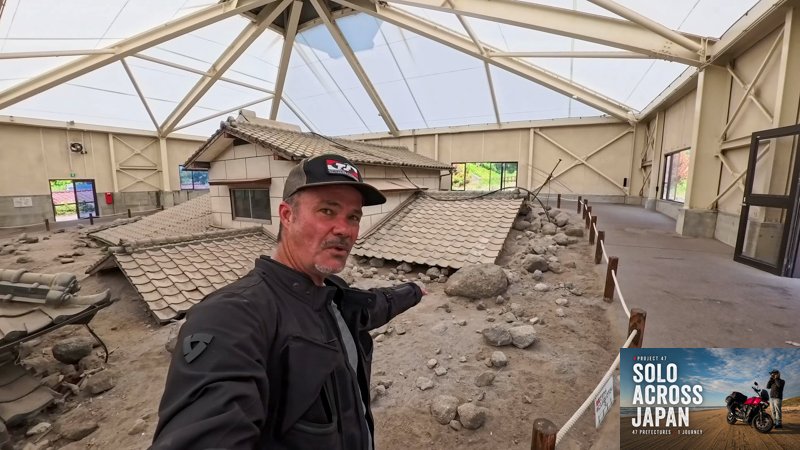
Rice fields, quiet countryside, a mountain looming in the distance — and then suddenly, buried houses, crushed under ash and volcanic debris.
In June 1991, Mount Unzen erupted violently.
Although 43 people lost their lives, most of them scientists and journalists working in the area, the residents of the village had already been evacuated. What remains now is a chilling record of what happened.
Standing there looking at the roofs of homes half-buried under volcanic rock and ash, it was hard to process the force involved. Massive boulders had been hurled through the air and dropped onto entire neighborhoods.
Nature doesn’t negotiate.
It just arrives.
By that point I was already soaked through from the heat. My shirt was drenched, and I could feel the day beginning to turn into something I’d have to manage carefully.
Shimabara Castle & The 49°C Heat Crisis
After leaving the volcanic memorial, I headed toward Shimabara Castle.
I was already cooked.
Properly cooked.
At one point my dash showed 49°C, and whether that was exact ambient temperature or heat reflecting up from the road, it didn’t really matter. It was dangerous hot. The kind of heat where you start making mistakes if you don’t pay attention.
I missed my turn for the castle because my brain was already slowing down.
Once I got there, though, Shimabara Castle was worth the stop.
Originally built in 1624, the castle carries a heavy history of its own. The daimyo Matsukura Shigemasa, who governed the region, became known for brutally enforcing the ban on Christianity after it was outlawed in Japan. The original castle was later dismantled in the Meiji era, and what stands now is a reconstructed concrete version housing a museum.
Interesting, but by that point I badly needed air conditioning, food, and a reset.
So I found a Joyful, sat down in the cool, and gave myself a chance to recover.
Into the Mountains — Escaping the Heat
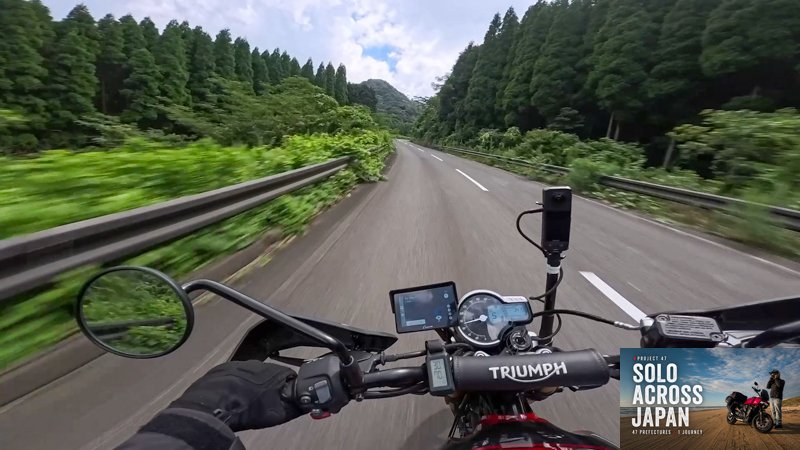
After lunch I left Shimabara and started climbing up into the mountains.
Almost immediately the ride changed.
The temperature dropped.
Tree cover closed in.
The road turned into a tunnel of green.
It felt like stepping out of an oven.
This part of the day was pure relief — forest roads, cooler air, volcanic landscapes, and mountain villages with sulfur in the air. I didn’t want to come back down to sea level at all.
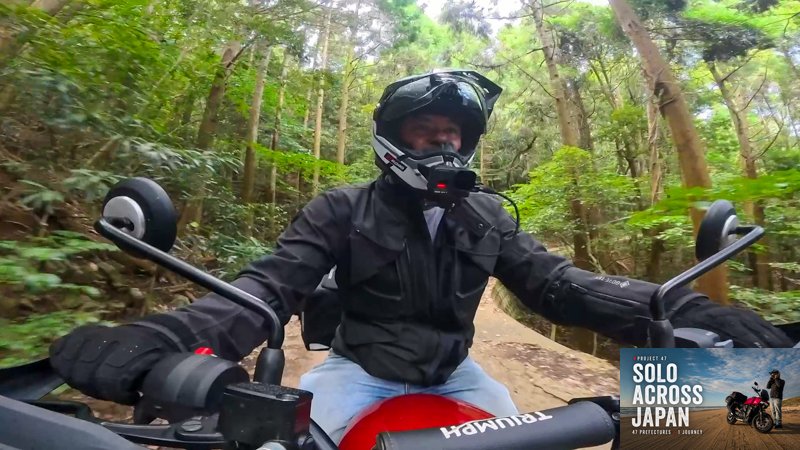
The roads through the mountains were incredible. Quiet, twisting, and beautiful in a way that makes you stop thinking and just ride.
Eventually I descended toward Nagasaki City for one of the most important stops of the trip.
Day 1 Afternoon — The Atomic Bomb Museum
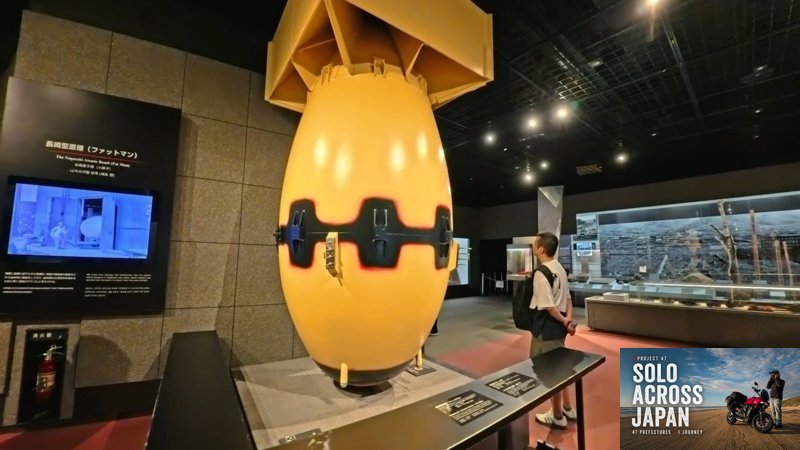
On August 9, 1945, at 11:02 a.m., an atomic bomb detonated 500 meters above Nagasaki.
More than 70,000 lives were ended in an instant.
The museum is not a place you rush through.
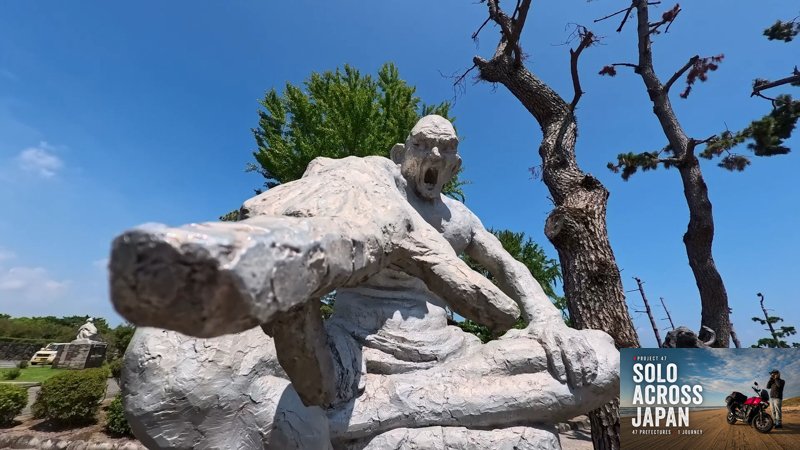
It contains images and artifacts far too graphic to treat casually, and even walking through it leaves a weight on you. It is one of those places that strips away distance from history and reminds you that this was not abstract, not symbolic, not something that happened in black and white.
It happened here.
To real people.
The message at the end is simple and necessary:
May peace prevail on earth.
Leaving there and putting riding gear back on felt strange. Like moving from one world into another too quickly.
But the road continued, and I still had to find a place to sleep.
Night 1 — Omura Bay & A Campsite by the Sea
As I rode away from the city along Omura Bay, Nagasaki softened again.
The roads became more rural, the coastline opened up, and the day slowly settled.
I had come very close to heat exhaustion earlier, but now, with the sun dropping and the traffic thinning out, I actually felt human again.
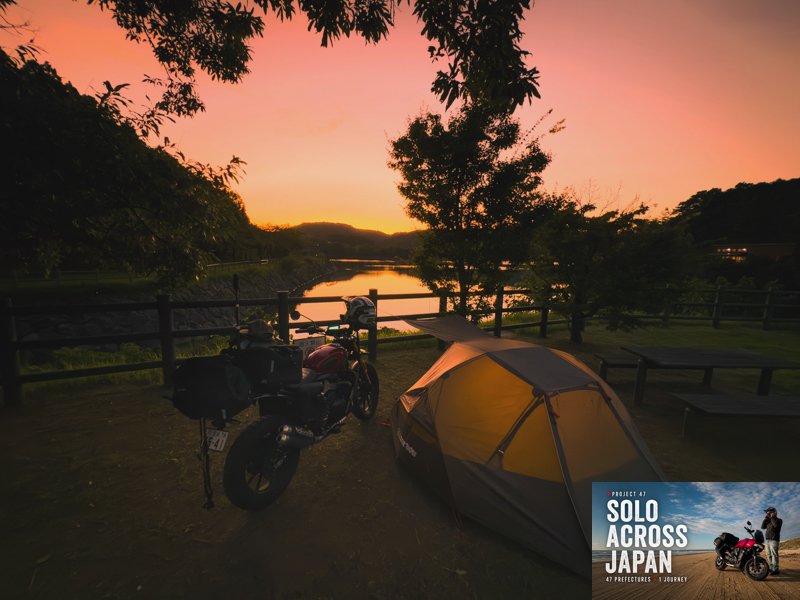
Eventually I reached the campsite.
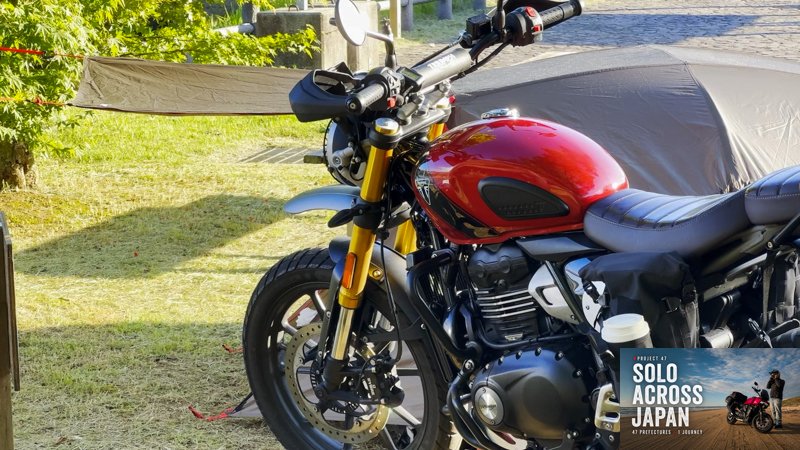
Tent up.
Bike parked.
Sunset over the water.
After everything the day had thrown at me — volcanic destruction, extreme heat, and the emotional weight of Nagasaki City — the simple act of reaching camp felt like a win.
Day 2 — Oshima, Fish Bus Stops & Brutal Heat
I woke up rough.
The heat from the day before had definitely taken something out of me.
Still, it was another beautiful morning, and Nagasaki’s geography meant I was entering one of the best kinds of riding landscapes in Japan: a maze of islands, peninsulas, bridges, and overlooked coastal roads.
I had almost no mental map of Nagasaki Prefecture, which honestly made the day more fun.
It felt like pure exploration.
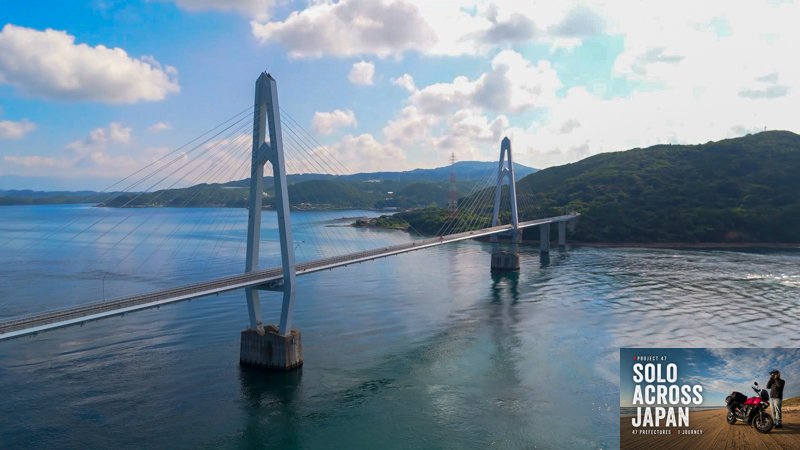
By late morning I had reached Oshima, crossing long bridges over bright blue water. The wind had completely died, which made the heat feel even heavier, but the views were ridiculous.
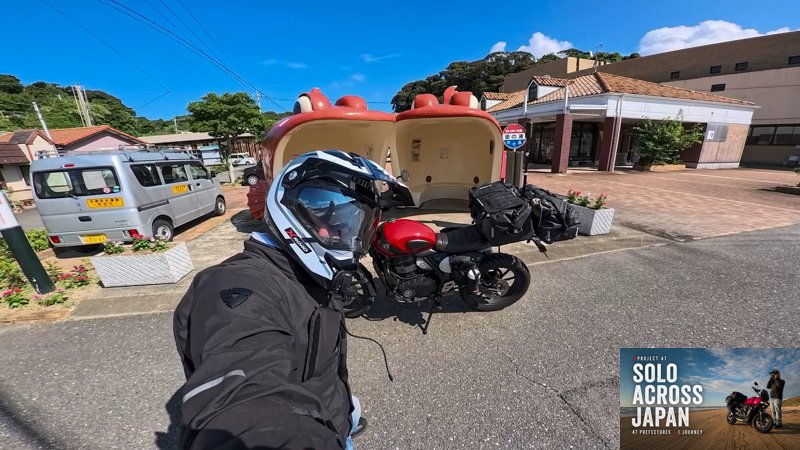
At one point I stopped to see one of the island’s odd little sights — a fish-shaped bus stop.
And somehow, that fit Nagasaki perfectly.
Strange, scenic, memorable.
Into the Darkness — The Underground Forts
From Oshima I headed toward the ruins of an old fort that had caught my attention on the map.
At first I thought it might be from World War II.
It turned out to be much older.
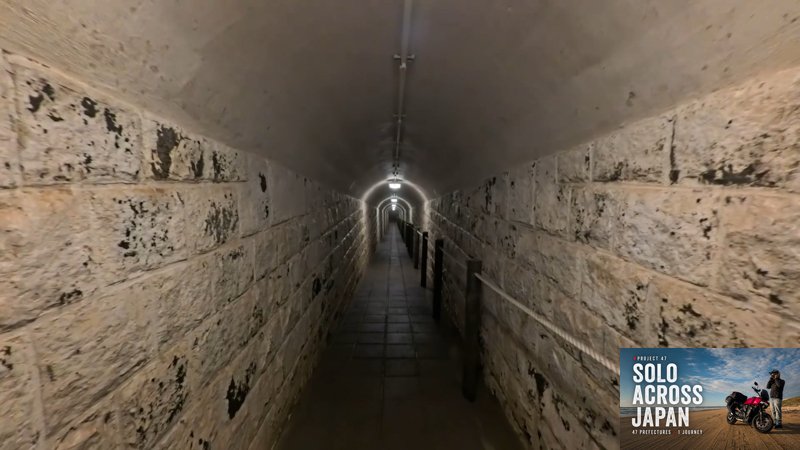
The underground fort had been commissioned in 1897, used during the Russo-Japanese War and World War I, but never actually fired a shot in combat. It was decommissioned in 1929 and abandoned.
Walking into it was like stepping underground into another era.
Long dark passages.
Echoing chambers.
Bats hanging from the ceiling.
It was eerie and fascinating at the same time.
You could imagine soldiers waiting there in darkness for something that never came.
Of all the stops in Nagasaki, this was one of the most unexpected.
Sasebo, Failed Missions & The Most Westerly Point
By the time I reached Sasebo, the heat was savage again.
I ended up ducking into a private booth place where I could recharge batteries, copy footage, cool down, shower, and basically stop myself from melting.
That pause probably saved the rest of the day.
Afterward I tried to head out to find some old gun installations buried deep in the hills.
That did not go well.
The route turned into a muddy goat track, my boots got slick with mud, and eventually the road simply disappeared into bushwhacking territory.
At some point you have to draw the line.
I love the adventure, but not enough to stumble off into the forest in that heat, alone, chasing ruins I wasn’t even sure I could reach.
So I bailed.
Mission failure.
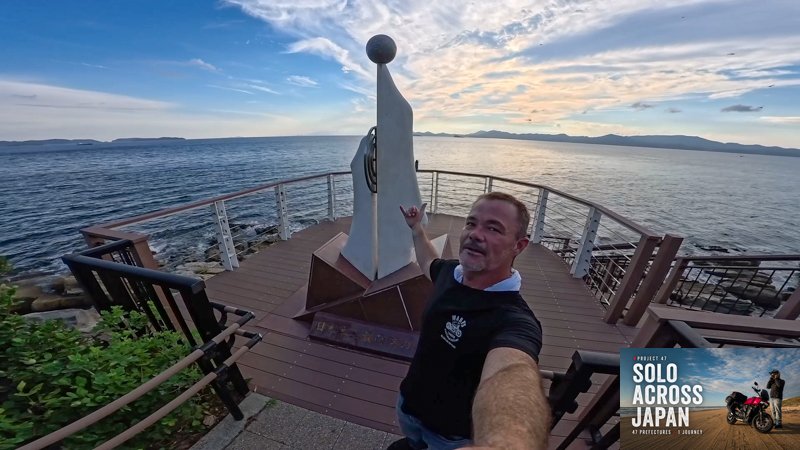
Instead, I changed plans and rode west toward what Google Maps described as the most westerly point of mainland Japan.
The ride there took me through rice fields, little towns, and coastal roads until I finally reached the monument and walked up to it.
It was beautiful.
Not dramatic in some oversized tourist way — just a good, quiet reward after a day that had refused to go smoothly.
By then the sun was dropping and I still needed to figure out where to sleep.
Night 2 — Stealth Camping by the Beach
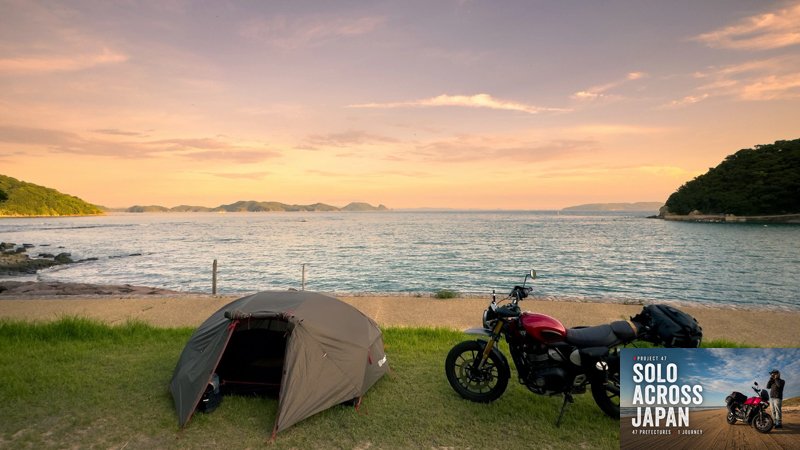
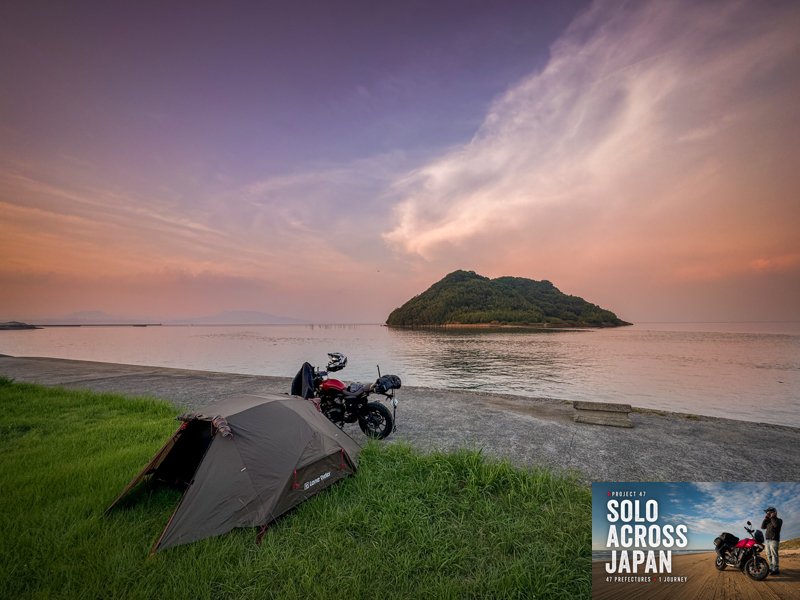
Just around the corner from the western point, I spotted a beach that looked like it might work for a stealth camp.
So I checked it out.
Not only did it work, it was spectacular.
One of those spots that makes you wonder how often pure luck gives you something better than anything you could have planned.
The sea was right there.
The light was fading.
And for the second night in a row, I had found a place that made the hardship of the day feel worth it.
Day 3 — Churches, Hirado Bridge & Rider’s Nirvana
I woke at 5:00 a.m. to uncertain weather.
The direction I was heading didn’t look great, and I had a feeling I might have my navigation slightly wrong, which is pretty easy in this part of Japan. Nagasaki is all little peninsulas, islands, inlets, and roads that seem to double back on themselves.
Still, I was excited.
I had wanted to ride Hirado for a long time.
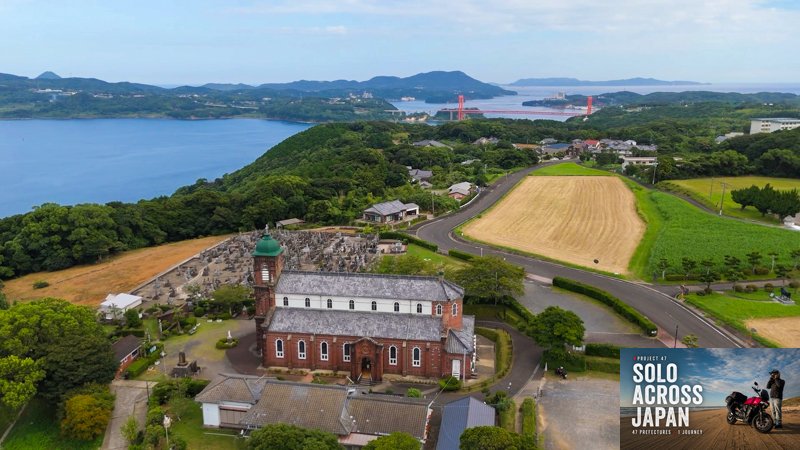
On the way, I stopped at Tabira Catholic Church, a reminder of how deep Christianity’s roots run in Nagasaki. Christianity first arrived here with Francis Xavier in 1549, survived centuries of prohibition, and still remains visible in parts of Kyushu in a way that surprises many visitors.
The church, completed in 1918, is still fully active today.
From there I crossed the bright red Hirado Bridge, and that felt like the real beginning of the day.
I had seen a photo of Hirado a long time ago — a road, some coastline, a feeling more than a destination — and since then I had wanted to get out here on a motorcycle.
The moment I arrived, I knew it had been worth the wait.
Hirado was unreal.
Quiet roads.
Ocean views.
No traffic.
Perfect riding.
It felt like one of those rare places where everything lines up exactly the way you hoped it would.
At one point I could only really describe it one way:
Rider’s nirvana.
Kasaga Tanada & The Typhoon Clock
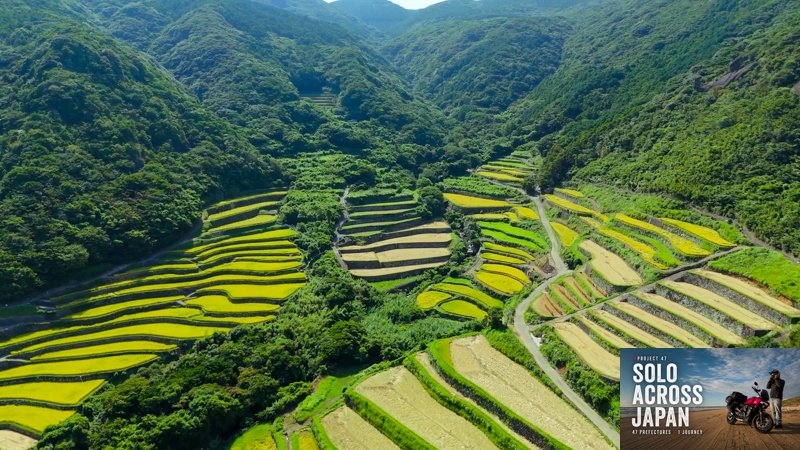
One of the highlights of Hirado was Kasaga Tanada, a series of rice terraces stretching from the sea up into the hills.
The terraces are recognized as an important cultural landscape in Japan, and seeing them in person made that easy to understand. Sea, fields, mountains, and road all layered together into one view.
It was stunning.
But by then the wind had started to pick up.
So I checked the weather.
A fast-moving typhoon was on its way, set to clip the southern part of the peninsula.
That changed everything.
I still wanted to ride down to the most westerly motorable road in Japan — I had already done the official mainland western point the day before, so finishing the other one felt like the logical next step.
But now I was racing the weather.
The Trash Reality & The Run for Chanpon
The road down turned into another little adventure.
Narrow.
Unexpected.
Loaded bike.
Cliffs nearby.
Storm approaching.
Not the ideal combination.
And then, just when the landscape should have been perfect, I started noticing something ugly.
Trash.
Everywhere.
Plastic and garbage scattered along the coastline.
For all the beauty of Nagasaki, that stretch of coast hit hard in a different way. It was a reminder that even the most beautiful places aren’t immune to neglect, and that the ocean always returns what people throw at it.
By then I could feel the cool air from the storm front starting to move in fast.
That meant I had maybe an hour — maybe less — before this turned into gale-force wind and heavy rain.
So it became a straight race to my last objective:
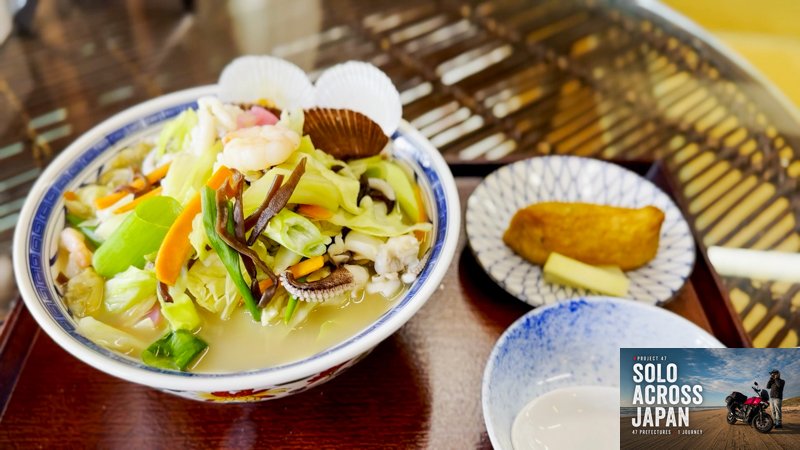
Find Nagasaki Chanpon before the storm hit.
Chanpon is one of Nagasaki’s signature dishes — a noodle soup loaded with vegetables, seafood, and pork, something like a cousin to ramen but definitely its own thing.
I found a place that looked promising.
But it was closing at 2:00 p.m.
And I had exactly one shot.
So I rode for it.
Hungry, tired, aware of the weather chasing me from behind.
And somehow, I made it.
The restaurant let me in.
The food was unbelievable.
And after everything Nagasaki had thrown at me — heat, failed missions, history, exhaustion, stealth camps, typhoon pressure — that bowl of Chanpon felt like the perfect final reward.
Nagasaki — Where Beauty & Tragedy Collide
Nagasaki gave me some of the most beautiful riding of the trip so far.
It also gave me volcanic destruction, the weight of atomic history, brutal heat, abandoned military ruins, and a hard reminder of how quickly the elements can turn a dream ride into a survival exercise.
That tension is what made this prefecture unforgettable.
Beauty and tragedy.
Peace and violence.
Perfect roads and punishing conditions.
All of it existing together.
And that, in the end, is what made Nagasaki feel so real.
Next stop on the journey: Saga Prefecture.