Some of the best days riding in Japan have started without much of a plan.
Not completely without one.
I knew which direction I was going.
I knew I had to keep moving north.
And I knew that somewhere ahead of me was Lake Biwa.
Beyond that, I was pretty happy to let the day work itself out.
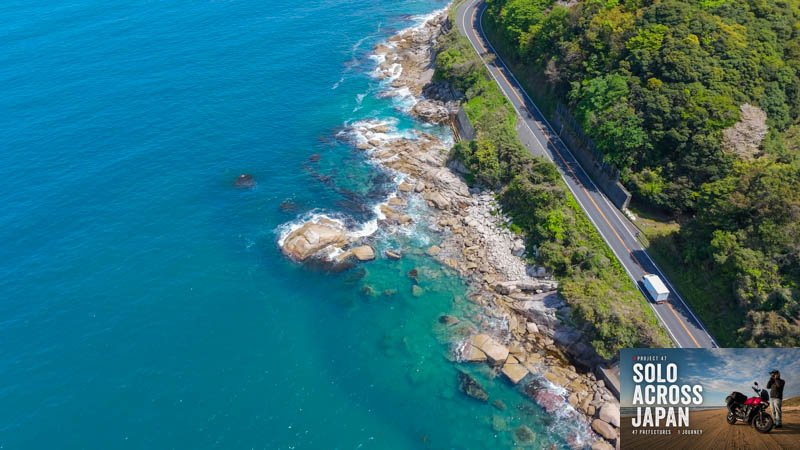
I had spent most of the morning riding down from Kyoto’s northern coast. By the time I crossed into Shiga Prefecture, I had already been on the motorcycle for hours.
Lake Biwa dominates the map here.
It is the largest lake in Japan, and when you look at Shiga it is almost impossible not to build the journey around it.
So that was about as sophisticated as my plan became.
Ride toward the lake.
Explore.
Find somewhere near the water to sleep.
See what happens.
After weeks of travelling through Japan by motorcycle, I had learned that sometimes that is enough.
Riding Into Shiga
There is a strange moment when one prefecture turns into another on a long motorcycle journey.
Nothing dramatic happens.
There is no wall.
No great change in the road.
Usually just a sign.
One moment I had been riding through Kyoto.
Then I was in Shiga.
Project 47 had reached another prefecture.
I had already covered a lot of ground that day, but there was still plenty of light left and I wanted to get closer to Lake Biwa before stopping.
On the map, the idea looked fantastic.
A huge lake.
Roads running around it.
Motorcycle.
How complicated could it be?
Quite quickly, I discovered that the ride was not going to be exactly what I had imagined.
Lake Biwa Wasn’t the Road I Had Imagined
In my head, riding around Lake Biwa was going to mean a beautiful road tracing the shoreline.
Lake on one side.
Open road ahead.
Maybe somewhere to pull over every now and then.
Reality was a little different.
A lot of the route took me through ordinary towns.
Traffic lights.
Houses.
Farmland.
Then suddenly the lake would appear again.
Then disappear.
Then another stretch of road would open up.
It was not bad riding.
It simply was not the great uninterrupted lakeside road I had constructed in my imagination.
That is something worth knowing if you are thinking about riding around Lake Biwa yourself.
Do not expect every kilometre to hug the water.
The landscape changes constantly.
And, as I would discover the following day, that actually became one of the things I enjoyed about it.
At that particular moment, though, I was mostly thinking about somewhere to sleep.
Six Hours on the Motorcycle and Nowhere to Camp
I spotted some grass.
That was enough to get my attention.
After riding for the better part of six hours, apparently my standards for potential accommodation had become:
Grass.
Nearby water.
Preferably legal.
I pulled in and had a look.
Then I saw the sign.
No camping.
Right.
Back to the map.
I had found what looked like a free campsite on Google Maps, but it was on the other side of Lake Biwa.
More than two hours away.
It was also the weekend.
I had no idea how busy it would be.
I did not really know what I would find when I arrived.
And by this stage I had ridden more than 300 kilometres since leaving the north coast of Kyoto that morning.
I was tired.
I was hungry.
And the thought of adding another couple of hours simply to discover whether I had somewhere to put the tent was becoming less attractive by the minute.
There are moments on a long motorcycle trip when determination is useful.
There are others when determination is just stubbornness wearing nicer clothes.
I was approaching the second category.
Burger. Tacos. Coffee. Beer.
Then I saw a sign.
Burger.
Tacos.
Coffee.
Beer.
That is a remarkably persuasive combination after 300 kilometres on a motorcycle.
There was grass nearby.
There was a toilet.
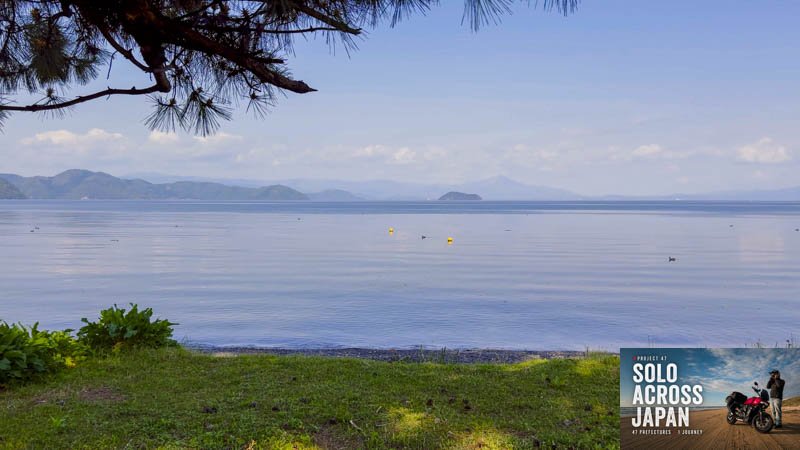
There was Lake Biwa.
I actually remember saying to the camera:
“I want to stay here.”
I rode in.
Not because I had suddenly discovered some secret motorcycle destination.
I wanted a hamburger.
That was it.
I did not even film myself walking into the place for the first time. I wanted to ask if filming was okay before sticking a camera in somebody’s face.
Once I had permission, I started looking around properly.
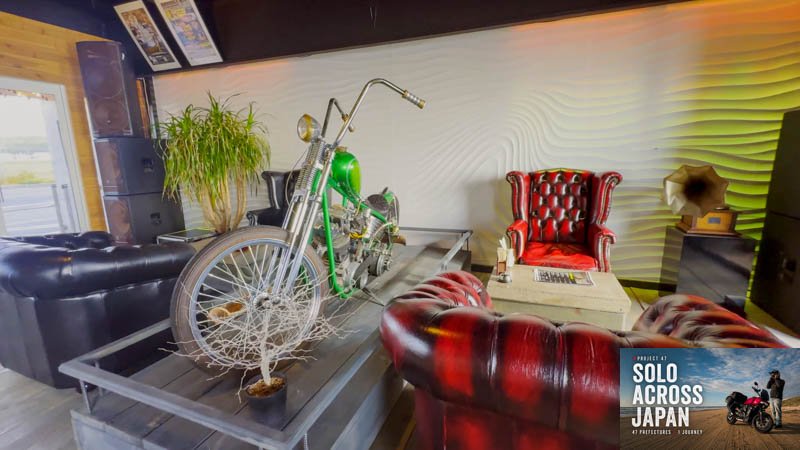
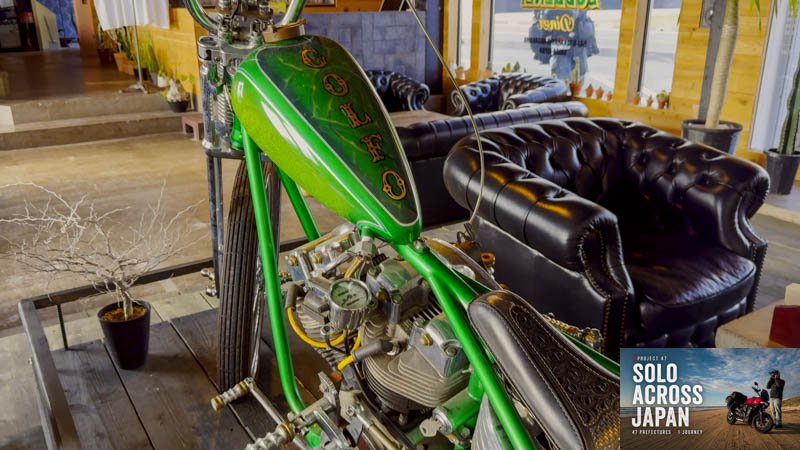
This place was cool.
An old custom chopper inside.
Leather chairs.
Huge speakers.
Records.
A deck looking straight across Lake Biwa.
Exactly the sort of place I would have happily stopped at even if I had somewhere else to be.
And right then, I really did not.
Sometimes the Best Campsite Isn’t a Campsite
The guy working there was Ippei.
We started talking.
Then somehow the conversation reached the fact that I was trying to find somewhere to camp.
He told me I could put the tent up outside.
Problem solved.
Just like that.
I had spent part of the afternoon looking at maps, worrying about riding another two hours and trying to manufacture a plan.
Instead, I had stopped for a burger and found somewhere to sleep.
This is one of the things I have come to love about travelling through Japan by motorcycle.
A car gives you freedom too.
A train can carry you enormous distances effortlessly.
But travelling on a motorcycle leaves you exposed to the journey in a different way.
You stop because you are hungry.
Someone asks where you are going.
You talk about the bike.
A five-minute stop becomes an hour.
The route changes.
And occasionally a hamburger becomes a campsite.
Ippei’s DragStar
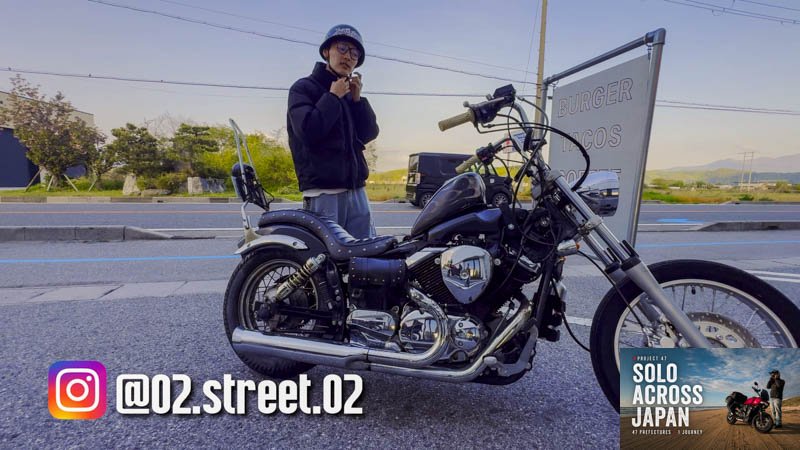
Ippei was also into motorcycles.
His bike was a Yamaha DragStar, but not remotely a standard one.
He had customised the whole thing himself, including the paint.
It suited the place perfectly.
The shop had already felt as though motorcycles belonged there, and then his DragStar rolled out and confirmed it.
He was also a musician and told me his first album was on the way.
Another completely random person I would never have met if I had ridden past because the schedule told me I needed to be somewhere else.
This is why I have become increasingly suspicious of overplanning motorcycle travel.
Planning matters.
You need fuel.
You need somewhere to sleep eventually.
You need some idea where the road is taking you.
But if every hour of the day already has a destination attached to it, there is very little room left for anything unexpected to happen.
Camping Beside Lake Biwa
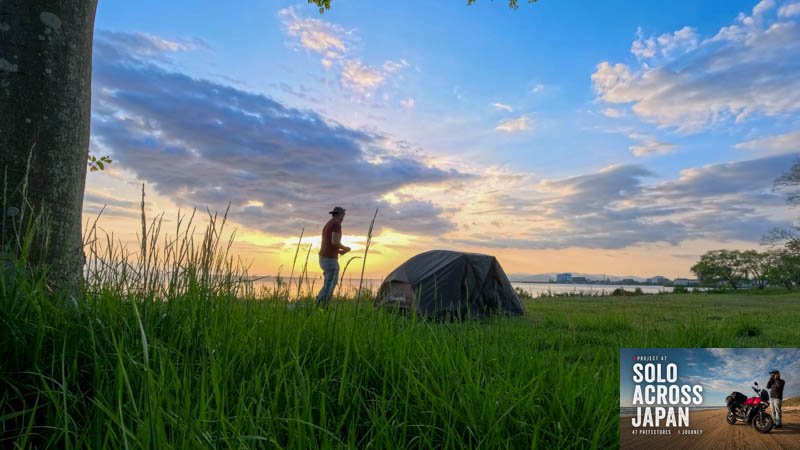
I set the tent up near the water.
Done.
After spending most of the day on the motorcycle, I could finally stop moving.
The burger shop changes into a bar on weekends, and Sayaka, who had been working in the kitchen, asked if I wanted to come back for a drink later.
That sounded like an extremely easy decision.
So that evening I walked back over.
No riding.
No searching for accommodation.
No GPS.
Just a drink beside Lake Biwa with people I had met because I happened to stop when I was hungry.
It was exactly the kind of night that Project 47 had slowly become about.
Not the famous destination.
Not the road somebody told me I absolutely had to ride.
Just being somewhere long enough for something to happen.

A Cup Noodle and a C.C. Lemon
Later that night I was back at the tent when I heard somebody outside.
“Adam, you awake?”
Ippei and his girlfriend had stopped by.
They had brought me a little care package.
A Cup Noodle.
A C.C. Lemon.
That was it.
And I loved it.
There was nothing grand about the gesture.
Nobody was performing kindness for the camera.
They had simply been out, thought about the idiot sleeping in the tent beside the lake, and brought something back for me.
Those moments stay with you.
You can plan temples.
You can plan roads.
You can save viewpoints in Google Maps.
You cannot plan somebody turning up beside your tent at night with instant noodles because they thought you might want something to eat.
The Next Morning — Riding Around Lake Biwa
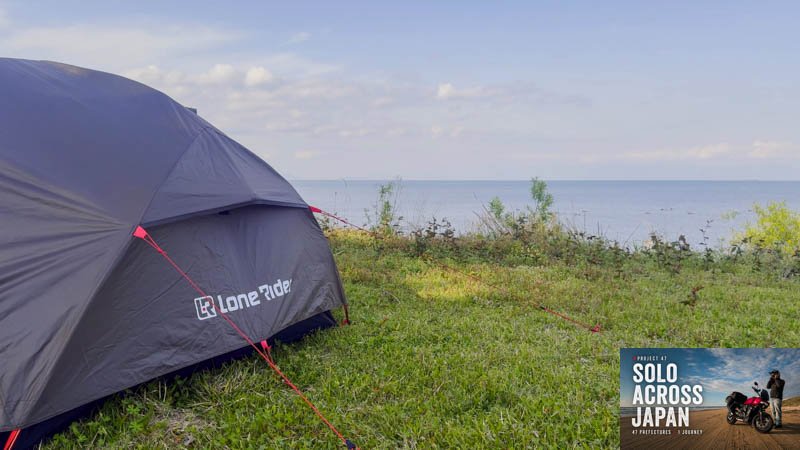
I woke up beside the lake.
That did not suck.
It had poured rain overnight, but by morning there were patches of blue appearing between the clouds.
The wind was strong.
My hair was ridiculous.
The tent had done its job.
Time to ride.
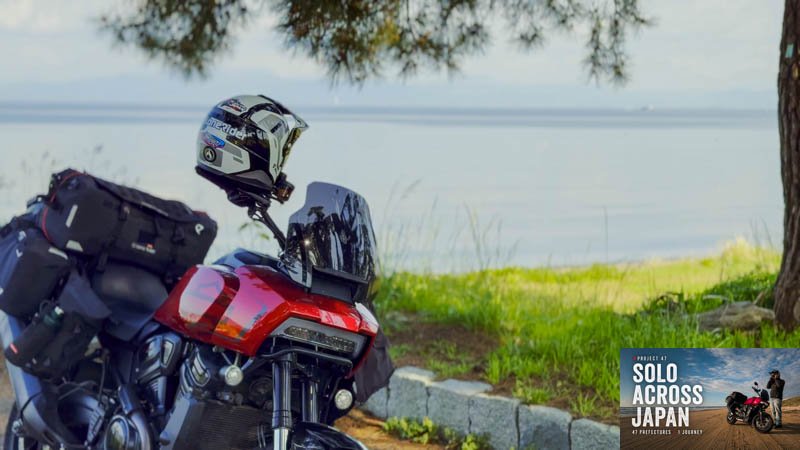
I packed everything back onto the Pan America and started working my way along Lake Biwa.
This time I had a few places I wanted to see, but once again the road between them was going to be most of the day.
This Was More Like It
The road kept changing.
Town.
Farmland.
Forest.
Lake.
Small back road.
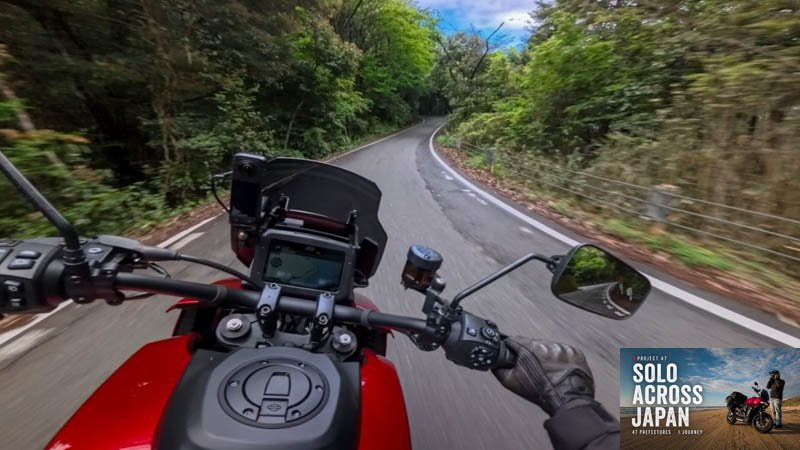
Then suddenly I found myself on exactly the sort of stretch I had imagined the previous day.
Trees overhead.
Water beside me.
Corners ahead.
“This is what I had in mind.”
It was.
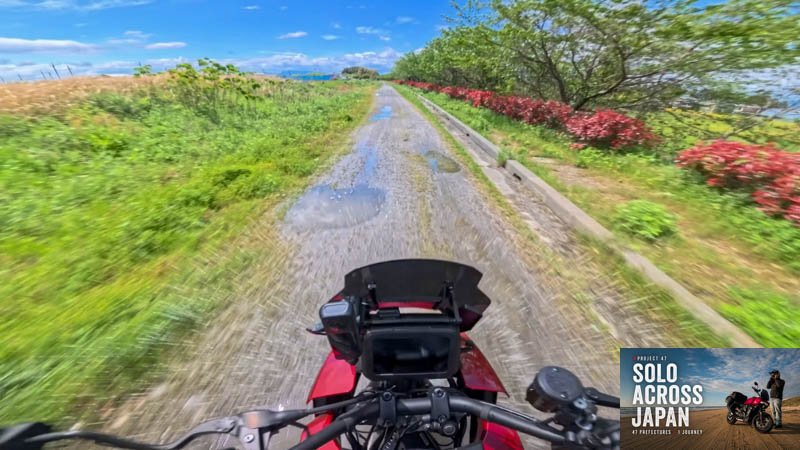
Then the navigation sent me down a little gravel road past some farmhouses.
Nothing particularly difficult.
It had been raining, so there were puddles everywhere, and within a few minutes the Pan America had managed to throw enough dirty water around to make sure my clothes were no longer clean.
A little bit of gravel.
A little bit of mud.
Then back onto the road.
That variety became the ride.
Lake Biwa was not one spectacular motorcycle road.
It was a constantly changing collection of ordinary roads, genuinely beautiful stretches, towns, farms, forest and unexpected little diversions.
For me, that was more interesting anyway.
Mangetsu-ji and the Floating Hall
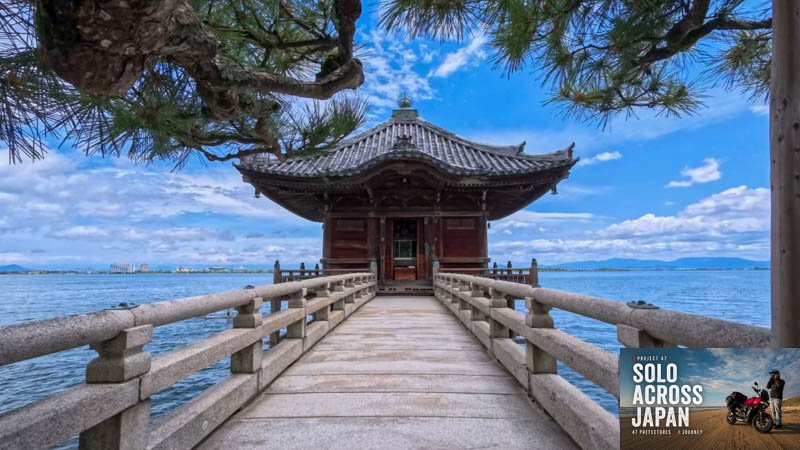
My first proper stop was Mangetsu-ji.
The temple sits on the shore of Lake Biwa and is best known for Ukimido, its small hall built out over the water.
This is one of those places that does not need to overwhelm you.
The setting does the work.
Water.
Old trees.
The hall sitting out over the lake.
Quiet.
The origins of Ukimido go back more than a thousand years. Tradition holds that the monk Genshin established a hall here during the Heian period as a place to pray for safety on the lake and for the salvation of others, with a thousand images of Amida Buddha housed inside. The present floating hall was rebuilt after its predecessor was badly damaged by a typhoon in 1934.
I had spent the morning moving constantly.
This was somewhere to stop for a while.
No great speech required.
It was simply beautiful.
Riding North Through Shiga
From Mangetsu-ji I continued north.
This stretch was mostly towns and suburbs.
Again, this is worth saying because motorcycle travel on the internet has a habit of removing all the ordinary bits.
Every road is not a mountain pass.
Every corner does not reveal Mount Fuji.
Sometimes you ride through suburbs.
Sometimes there are traffic lights.
Sometimes somebody in a kei car is doing 37 kilometres an hour in front of you for what feels like the rest of your natural life.
That is also riding in Japan.
Eventually the road brought me to one of Shiga’s most recognisable sights.
Shirahige Shrine.
Shirahige Shrine — The Photograph and the Reality
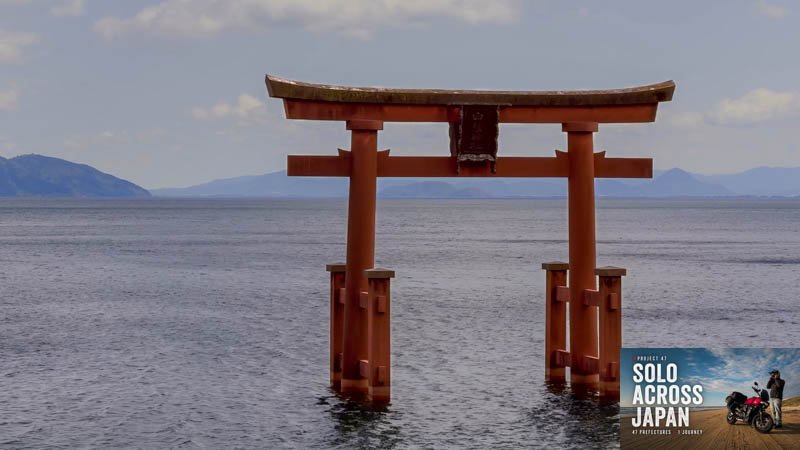
You have probably seen the photograph.
A red torii gate standing in Lake Biwa.
Water behind it.
Mountains in the distance.
Very calm.
Very Japanese.
Very Instagram.
There is one element most photographs tend to leave out.
The busy national road between the shrine and the lake.
That changes the experience slightly.
The torii itself is still beautiful, but this is one of those places where the carefully framed photograph and actually standing there are two different things.
The road is also why visitors should use the designated viewing area rather than trying to cross to the lake side; the official Shiga tourism information specifically warns people not to cross the national highway in front of the shrine.
But the torii ended up not being the most memorable part of my stop anyway.
A Rider From Kyoto
Back at the motorcycles, I started talking to another rider.
He was from Kyoto.
Forty-nine years old.
He rode a Kawasaki Ninja, but longer rides were beginning to bother his back, so he was considering something with a more neutral riding position.
Naturally this meant sitting on my Pan America.
Motorcycle riders can apparently turn almost any conversation into sitting on each other’s bikes eventually.
We talked for a while.
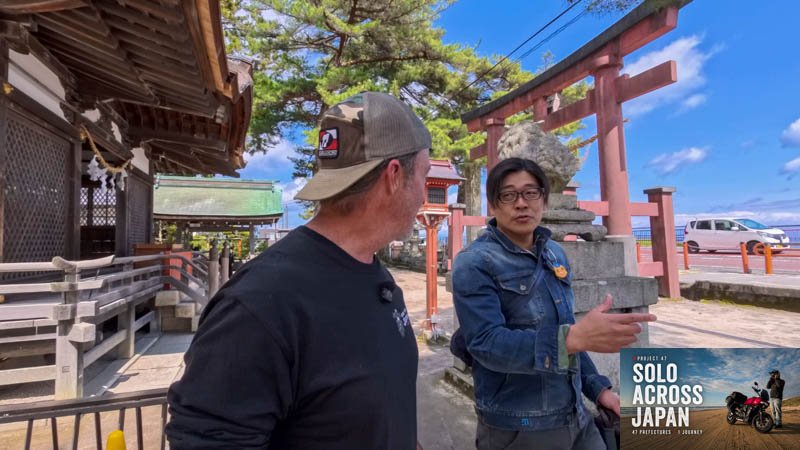
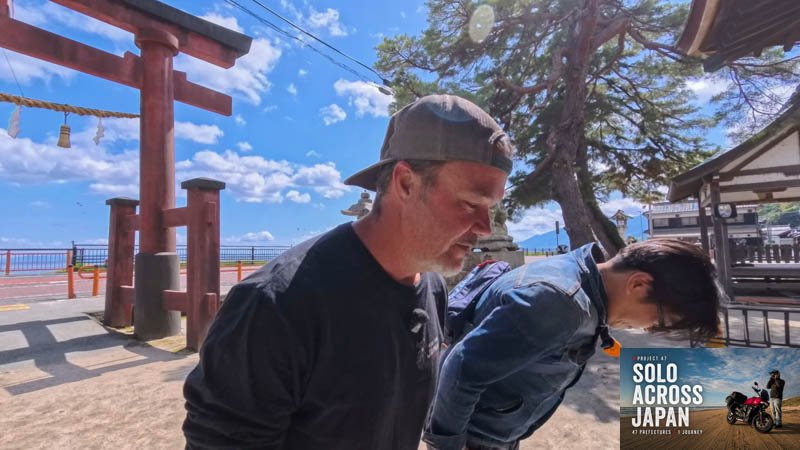
Then he asked if I knew how to pray properly at a Shinto shrine.
Not really.
So he showed me.
He explained the shrine.
We bowed.
We clapped.
And then he prayed for my safety on the journey.
A stranger I had met beside a motorcycle a few minutes earlier was now praying that I made it safely through the rest of Japan.
That was pretty special.
Talking About Kyoto
Afterwards we kept talking.
He told me he was from Kyoto.
I had just come from Kyoto.
So inevitably we ended up talking about how much the city had changed.
I had first visited around twenty years earlier, and the difference had shocked me.
The crowds.
The number of visitors.
The pressure on some of the most famous areas.
He had his own perspective as somebody from Kyoto.
I had mine as somebody who has lived in Japan for decades but was, at that moment, still a tourist in his city.
That distinction mattered to me.
It is very easy to complain about tourists while somehow imagining you are not one of them.
I was.
I had gone there to see Kyoto just like everybody else.
What had changed my own experience was getting back on the motorcycle and leaving the centre.
Kifune.
The mountains.
The north coast.
That had given me another version of Kyoto entirely.
Now here I was in Shiga, having another conversation I had not planned with somebody I would never have met without the motorcycle sitting between us.
We swapped details.
He told me he would follow the channel.
I told him to message me if he ever came down to Miyazaki.
Maybe one day we will go for that ride.
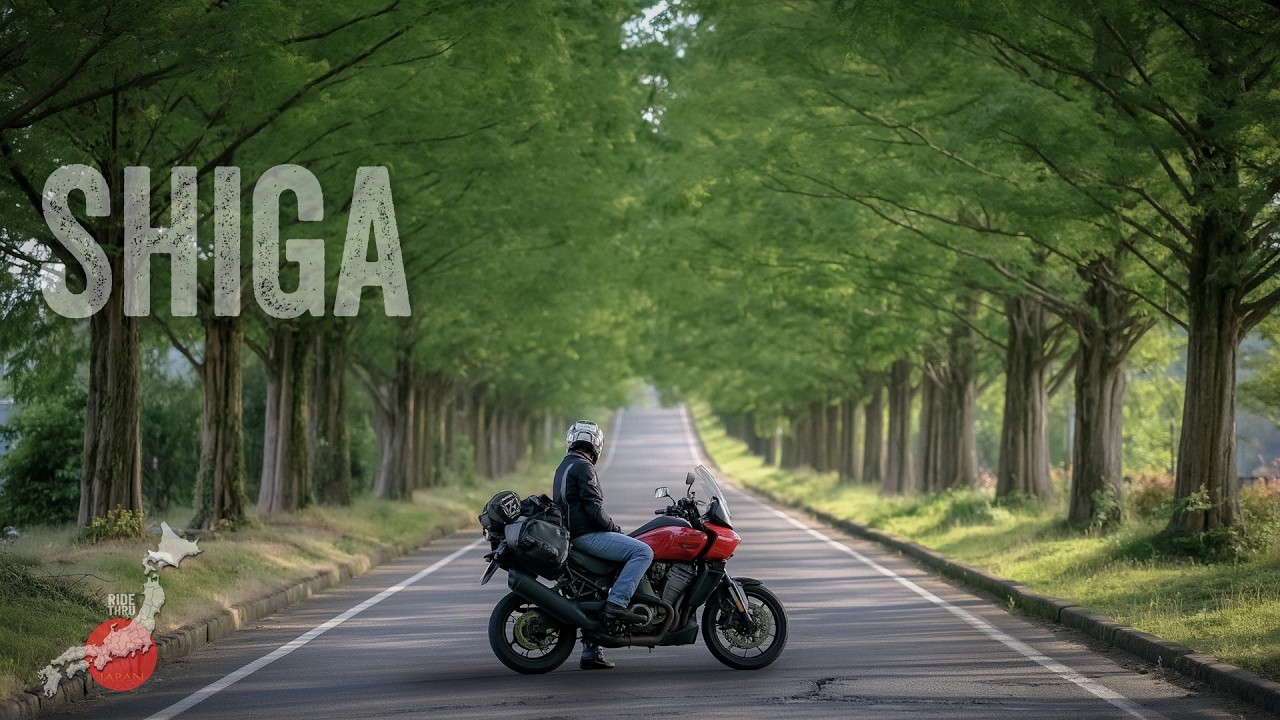
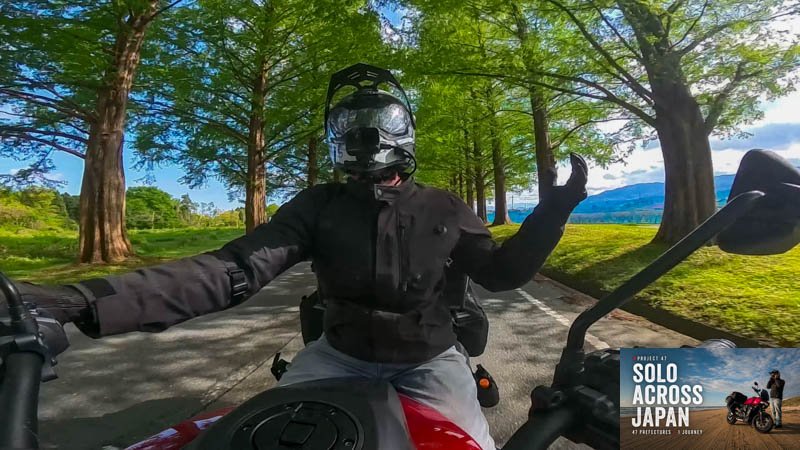
The Avenue of Metasequoias
I had one final place I wanted to see before leaving Shiga.
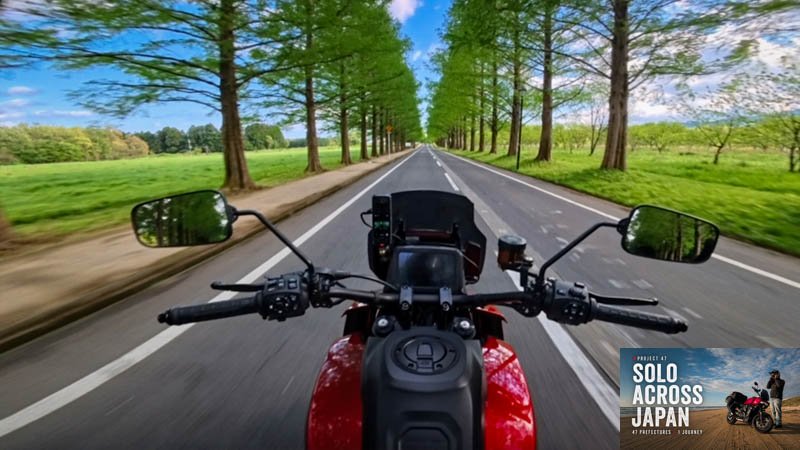
The Avenue of Metasequoias in Makino.
I had seen photographs.
Long straight road.
Trees forming a wall on either side.
Looked nice.
Then I rode into it.
Okay.
Now I understood.
There are roughly 500 metasequoia trees lining about 2.4 kilometres of road here, and the appearance changes dramatically through the seasons.
I was there while everything was green.
In autumn the same road turns gold and brown.
In winter it can be almost skeletal.
But green was doing a pretty good job.
The road just kept going.
Tree after tree.
A tunnel of them.
Sometimes a place lives up to the photographs.
This did.
“Beautiful. What can I say?”
Not my most sophisticated piece of narration.
Accurate, though.
Is Lake Biwa Worth Riding by Motorcycle?
Yes.
But I would go into it with the right expectation.
If you are searching for a Lake Biwa motorcycle route, do not imagine one continuous scenic road running beside the water.
At least that was not my experience.
The ride changes constantly.
There are urban sections.
Suburbs.
Traffic.
Farmland.
Forest.
Small back roads.
And then sections where Lake Biwa suddenly opens beside you and everything makes sense again.
For a motorcycle trip, that variety is part of the appeal.
Mangetsu-ji gave me somewhere quiet to stop.
Shirahige Shrine gave me a conversation I did not expect.
Metasequoia Avenue gave me one of the most visually memorable roads of the day.
And a burger shop I had never heard of gave me somewhere to sleep.
If I had tried to optimise the day into the “best motorcycle roads in Shiga,” I probably would have missed half of what made it good.
Riding in Japan Without Planning Every Minute
I do not think motorcycle travel has to mean riding without a plan.
Project 47 itself is obviously a plan.
Forty-seven prefectures is a fairly specific objective.
But there is a difference between knowing where you are going and deciding in advance exactly what will happen when you get there.
More and more, I prefer the first.
Choose a direction.
Have a few things you want to see.
Leave enough space between them for the day to change.
Japan is particularly good for this kind of motorcycle travel.
One road leads into a town you have never heard of.
A convenience-store stop becomes a conversation.
A wrong turn becomes a better road.
You get hungry and stop for a burger.
Then somehow you are camping beside Lake Biwa.
That was Shiga.
No great plan.
Just keep riding.
Leaving Shiga for Fukui
The Avenue of Metasequoias was the last stop.
From there I still had somewhere else to be.
I had booked a traditional Japanese room on the Sea of Japan, right on the western edge of Fukui Prefecture.
So I pointed the bike north again.
Shiga disappeared behind me.
Another prefecture finished.
Another one beginning.
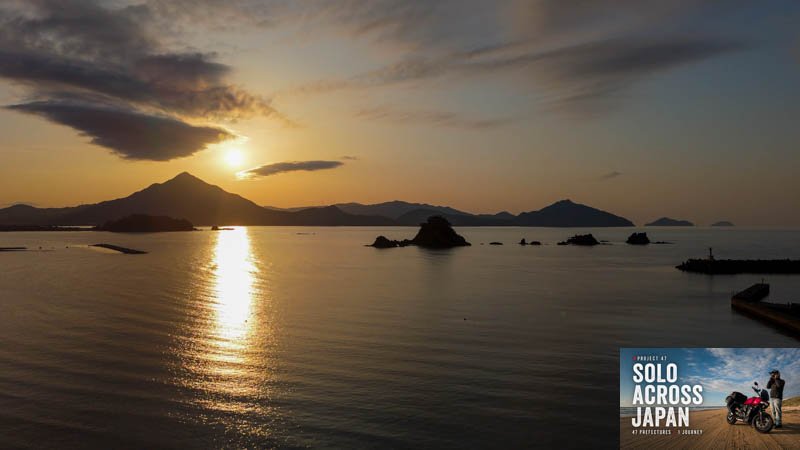
By the time I reached the coast, the sun was already dropping.
The water turned gold.
Small islands became silhouettes against the horizon.
I stopped riding.
Fukui could wait until morning.
Watch the Full Shiga Motorcycle Journey
No Plans, Just Ride is Episode 23 of Project 47, my solo motorcycle journey through all 47 prefectures of Japan.
This chapter follows the ride from Kyoto’s northern coast into Shiga, around Lake Biwa and eventually north toward Fukui — including motorcycle camping beside the lake, Mangetsu-ji, Shirahige Shrine, the Avenue of Metasequoias and the people I met because the day did not follow a fixed itinerary.
Watch Episode 23:
https://youtu.be/TK3Cbs1JgoM
This is not a Lake Biwa motorcycle guide.
It is what happened when I rode there.
About Project 47
Project 47 is a solo motorcycle travel documentary across Japan.
The goal is simple: ride through all 47 prefectures, not as a checklist, but as one continuous journey through the roads, landscapes, people, cities, mountains, coastlines, camps and unexpected moments that appear along the way.
Each prefecture is one chapter.
Together, they make the journey.
One rider. One motorcycle. Forty-seven prefectures.
This is Japan by motorcycle.
Continue the Ride
Project 47 Episodes
Follow the complete motorcycle journey through all 47 prefectures of Japan.
Riding a Motorcycle in Japan
Practical information for anyone planning to ride in Japan, from licences and road rules to tolls, parking and what riding here is actually like.
Riding a Motorcycle Across Japan
What I learned from crossing the entire country by motorcycle — distances, roads, weather, planning and the reality of long-distance touring in Japan.
Solo Motorcycle Travel in Japan
The other side of travelling alone: solitude, meeting people and what happens after enough hours inside your own helmet.
Episode Details
Series: Project 47
Episode: 23 — Shiga
Journey: Kyoto → Shiga → Fukui
Motorcycle: Harley-Davidson Pan America ST
Locations: Lake Biwa, Mangetsu-ji / Ukimido, Shirahige Shrine, Makino, Avenue of Metasequoias
Format: Solo motorcycle travel documentary
Video: https://youtu.be/TK3Cbs1JgoM
Published: September 2026